Ant Forest, a green initiative operated inside China's Alipay super-app, has accomplished something the Western civic imagination has struggled to achieve for decades: it has made environmentally friendly behavior into something ordinary people actually want to keep doing — for ten years straight.

Alipay Ant Forest was launched in 2016, and it has been operating for a decade
As of August 2026, more than 700 million users across China have joined the program and planted over 700 million real trees. Ant Group has invested more than RMB 5.1 billion (USD 759 million) over the past decade.
But the deeper story is not about numbers. It is about why this project exists — and why it succeeded where similar attempts in the West have stalled.
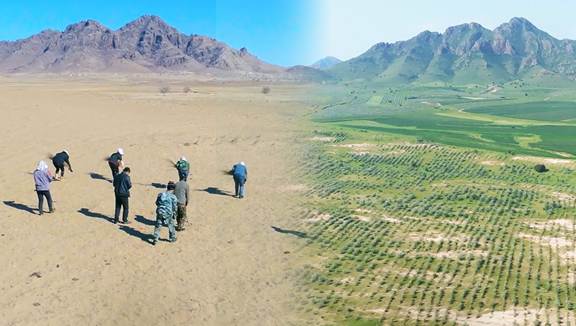
Before (2019) and after (2026) comparison of Ant Forest Project No. 464 in Inner Mongolia
Ant Forest, launched in August 2016 inside the Alipay app, is elegantly simple. Every time a user takes a low-carbon action — riding public transit, cycling, walking, paying bills online — the app awards "green energy points." These points grow into a virtual tree. When it matures, Ant Group funds the planting of a real tree through partnerships with environmental organizations in the deserts of Inner Mongolia, Gansu, Hebei, and beyond.
In Europe and North America, governments have spent decades trying to build green consumer incentive programs — carbon offsets, recycling rewards, eco-labeling — and most have struggled to sustain engagement beyond the initial novelty. Western civic design assumes individuals need tangible, immediate personal benefit. Ant Forest sidesteps this entirely. It offers no financial return, no tax incentive. It offers the quiet satisfaction of knowing that your daily commute, your online bill payment, your refusal of a plastic receipt — these small acts accumulate into something real, visible on a satellite map, connected to 700 million others doing the same.
This is "light participation." The barrier to entry is a phone and a few minutes a day. The emotional payoff over time becomes substantial. Ant Forest has turned environmentalism from a cause people feel guilty about into a habit they cannot imagine giving up.
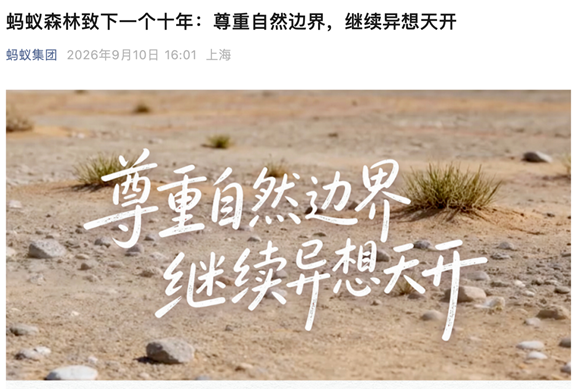
On September 10, 2026, Ant Forest's official WeChat account published an open letter marking its tenth anniversary, titled "Respect Natural Boundaries, Continue Dreaming the Impossible." It was less corporate press release, more family letter. The responses from Chinese netizens offer a window into what a decade of participation feels like from the ground.
Wang Tianbao from Shandong described a family transformed: "In 2024, my parents lost their jobs. I taught them Ant Forest. My parents don't know romantic gestures — their love is the most plain."
Dudu Youyu from Henan, approaching 70, shared how her daughter taught her the app nine years ago and she plans to keep going until she is 90. "I have planted dozens of trees. Watching them add green to the desert, I feel it is truly meaningful."
A reserved teacher in Shanghai found Ant Forest by accident in 2023. "I just quietly accumulated energy. My special education job is demanding and draining. Ant Forest became my sanctuary."
Read together, these voices — a grandmother planning another decade, an introvert finding quiet purpose — describe something no Western "citizen engagement" campaign has managed to articulate: the deep, unspoken ways a trivial digital action becomes woven into family life, identity, and emotional survival.
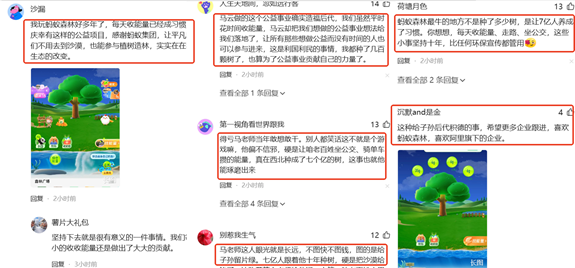
Three commenters — a parent, a grandmother, and an introvert teacher — showing how Ant Forest became part of their emotional lives
What makes Ant Forest different from Western consumer tech firms is not the technology — it is the patience. No Western app has asked 700 million people to do something small every day for ten years and trusted them to keep showing up.
Let us address the elephant in the room. Ant Forest, at RMB 5.1 billion over ten years, is not trivial. The project was born from a brainstorm by a frontline Ant Group employee in 2016 — an idea colleagues called "impossible." It survived because someone at the top believed in it.
Jack Ma, the founder of Alipay and Ant Group, stepped back from daily operations years ago. He is not the operational driver of Ant Forest. But his strategic imprint is unmistakable. Ma built Alibaba not to chase quarterly returns but as a platform ecosystem designed to solve real-world problems at scale – making it easier to do business for all. Ant Forest extends that same logic.
In short: Jack Ma built Alibaba to solve a trust problem, not to chase quarterly returns. Ant Forest is that same logic applied to ecology — if you can connect 1.3 billion people to daily commerce, you can connect them to make the planet greener.
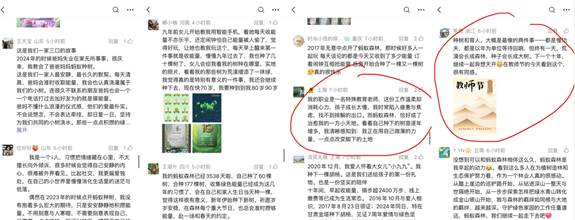
Netizen comments praising Jack Ma’s long-term vision for the project
The question Western observers should ask is not "Can Ant Forest sustain this investment?" but "What kind of company thinks in decades, not quarters, and treats the engagement of 700 million ordinary citizens in ecological restoration as a serious strategic asset?" The answer is a company built by someone who understood that real loyalty — the kind that lasts ten years — cannot be bought with discounts or gamification tricks.
Ant Forest is not perfect. Critics have documented cheating among users to get more energy points. Cheating is a real problem, but it also reveals something important: the system is valuable enough that people are willing to game it. That is not a design flaw — it is a sign that the habit has taken hold. Some academics argue the project reinforces consumption patterns, albeit these patterns are environmentally friendly. These are fair critiques.
But the deeper lesson — the one the West is sleeping on — is this: when you remove the need for citizens to feel guilt, attend rallies, or make sacrifices, and instead embed environmental action into the smallest possible daily gestures, you unlock participation that is not performative, not transactional, and not fragile. It becomes a quiet habit — as normal as checking your phone in the morning.
That is what Ant Forest has achieved. In a world obsessed with instant gratification, Ant Forest has, through a payments app and a decade of patient investment, quietly demonstrated that ordinary people will protect the planet — if you give them a way to do it that is easy, visible, emotionally rewarding, and free of condescension.
The trees are growing. Seven hundred million of them. And they are growing because one company decided, ten years ago, that a phone-based tree-planting app was not a joke — it was the future.