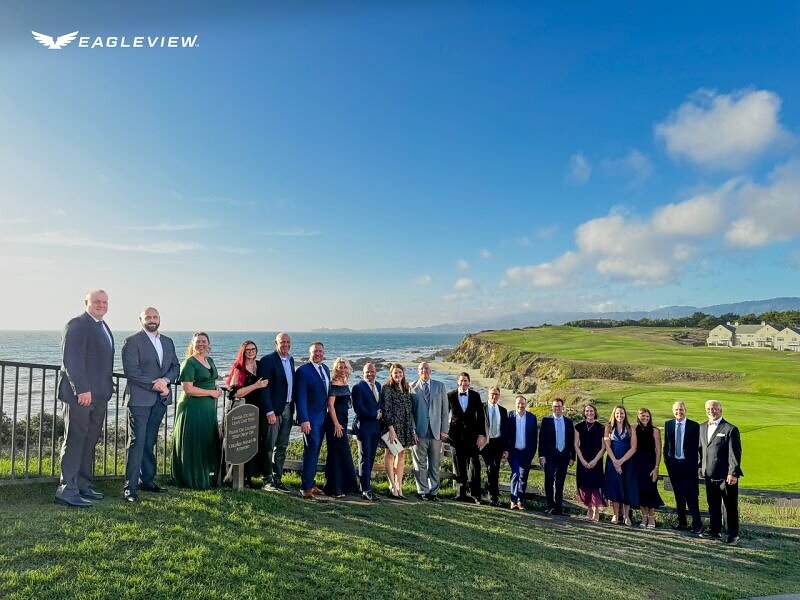
Eagleview brought insurance executives, innovators and decision-makers together in Half Moon Bay for its first Property Claims Leadership Forum and used the gathering to launch new research on how artificial intelligence is changing risk assessment, claims workflows and decision-making across the insurance value chain, the company said.
Piers Dormeyer, Eagleview's chief executive, said the meeting showed that leaders are deeply engaged in improving their businesses and increasingly see AI as the way to do it. He said the industry is moving from reactive to proactive management of risk, and that now is the time for carriers to invest and prepare for the challenges ahead. Attendees focused on near- and far-term changes including automation and loss adjustment expenses, how risk is processed, more tailored policy offerings, and speed to settlement and customer experience, he said.
According to NOAA, the United States averaged 23 weather and climate disasters a year over the past five years, each costing more than a billion dollars in claims, against a long-term average of about nine. An April 2026 AM Best survey found that roughly two-thirds of insurers planned to increase AI investment over the next 12 to 24 months and that nearly 60 percent expected the technology to reshape their business models within three years. Yet only about one in ten property-and-casualty carriers has moved AI beyond pilots into production, according to Capgemini's 2026 World Property and Casualty Insurance Report, which the release said also found that the carriers furthest along reported stronger revenue growth and share-price performance than their peers.
Wildfire is the fastest-growing catastrophe risk of all, with insured losses climbing an estimated 12 percent a year, and global insured catastrophe losses reached $107 billion in 2025, according to Swiss Re, with wildfires, storms and floods driving a record 92 percent of that total. Eagleview's new white paper, written by Patrick Gill, its senior vice president and general manager of insurance and commercial solutions, and Jenna Kinsman, its vice president and head of insurance solutions, argues that the information gap between a carrier and the properties on its book is closing fast enough that operating models built around that gap are starting to show their age. It focuses on portfolio intelligence and policy-in-force review, pre-loss identification and intervention, and faster, more accurate claims handling after catastrophic events.
Eagleview said its claims-assessment teams worked manually through carrier property lists in the days after the Los Angeles wildfires earlier this year, while Eagleview Horizon, its AI-powered geospatial property intelligence platform now in early access, completed comparable portfolio-wide damage assessments in a fraction of the time. Gill said Horizon completed in minutes a process that would previously have taken weeks, which he said meant faster delivery, a better experience for policyholders and more capacity to manage risk. Leaders at the forum said the aim was not to remove people from claims work but to keep expert adjusters and underwriters in the loop while AI handles scale and speed, and that compressing coverage timelines after events such as the Los Angeles wildfires had become a competitive necessity. Eagleview said Horizon is available to select customers through its Horizon Charter Program, and that the forum will return for a second year with dates to be announced.