What the survey covered
Appian, the Nasdaq-listed AI automation company, said it had published research into AI-assisted development among UK AI decision-makers and IT leaders. The survey was run by Censuswide among 200 senior decision-makers who mainly work in AI, engineering or IT, at organisations with 5,000 or more employees or annual revenue above US$1bn, and who work on at least three software systems a year. Responses were collected between 21 and 30 October 2026, the company said. The release introduces the term aloneware for applications built or changed with AI development tools outside an approved enterprise platform environment.
The budget figure
Seventy-nine per cent of respondents said they commit at least 10% of current technology innovation funds to testing, deploying, maintaining, updating, integrating or repairing software built outside a platform. Forty-three per cent said at least 20% of that budget goes to such work now, and 55% said they expect to reach that level within two years.
Time and support
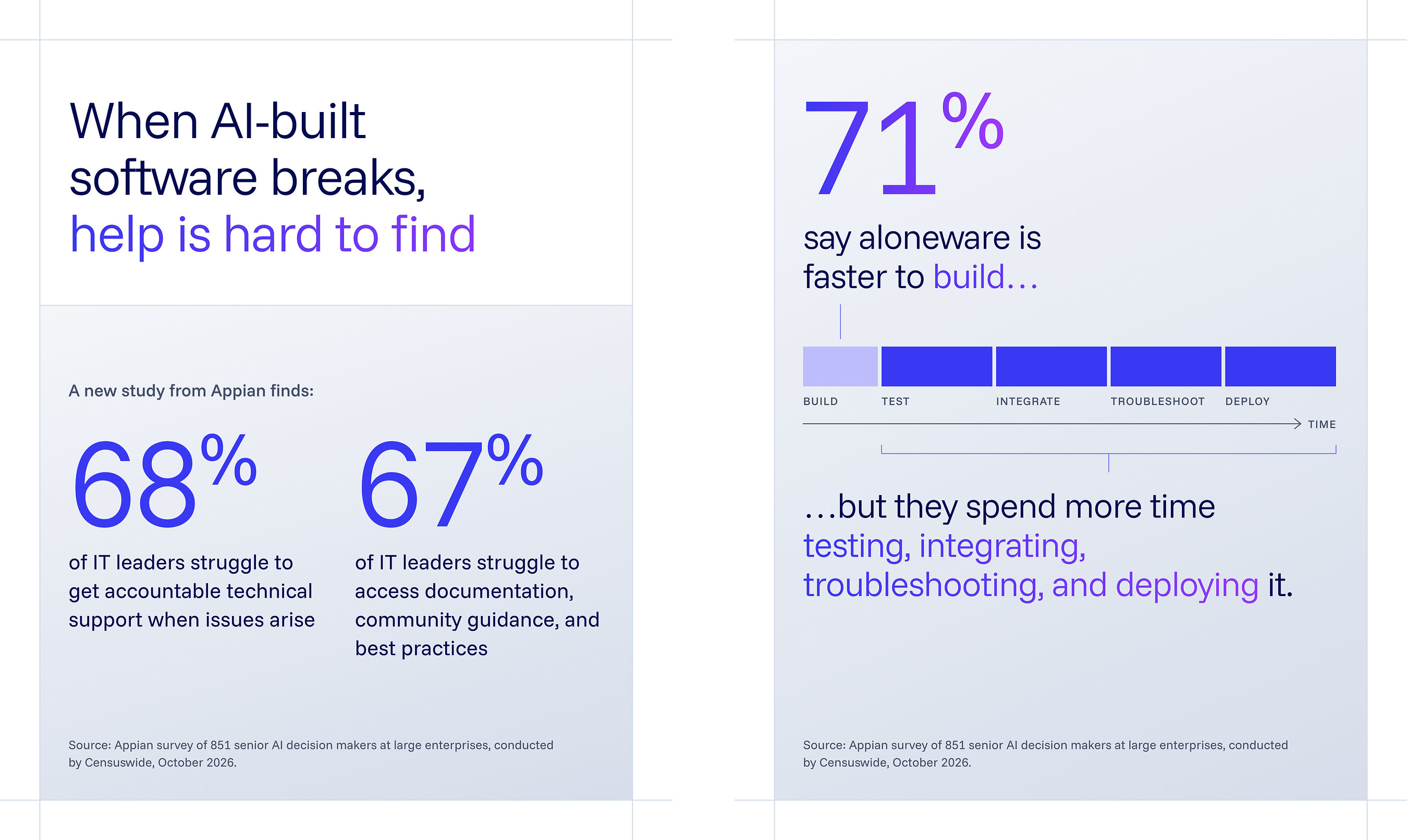
Sixty-four per cent reported spending more time on testing, system integration, troubleshooting, scaling or deployment, even though standalone AI tools speed up the first stage of development. Sixty per cent reported unplanned post-launch costs or resources tied to security, governance and compliance fixes. The same share said it is hard to obtain accountable technical support when applications built outside a platform go wrong, and 61% said they struggle to keep code, architecture, dependencies and integrations current.
What the company says
Matt Calkins, Appian's chief executive, said enterprises can now accumulate technical debt faster than before, and that the applications that matter most need someone to turn to when problems arise; building on a commercial platform, he said, pairs AI speed with supported technology. Fifty-nine per cent of respondents said a shared architectural foundation would improve their control of total cost of ownership, and 60% said it would help them maintain software over time.