The most interesting number in Ant Group’s year is not the 27%. Derived from Alibaba Group’s quarterly disclosure — Alibaba holds 33% of Ant and records its results one quarter in arrears — Ant earned an estimated RMB 10.5 billion (US$1.6 billion) in the June quarter, up 27% year on year, and RMB 15.2 billion in the first half, up 17%. Fair-value gains did part of the work, as Bloomberg’s headline made clear.
But the quarter matters for a different reason. It is the first hard evidence that the reconstruction Ant began after its IPO was suspended in 2020 — from payment company to AI application platform — has started to pay. The same disclosures that show the returns also show what the rebuilding costs.
A method, interrupted
Ant has run the same play for most of its life: solve the problem first, monetise later. Alipay began in 2004 as an escrow service, because early Chinese e-commerce had no trust infrastructure between strangers. Yu’ebao, launched in 2013, turned a payments balance into a money-market fund almost as a side effect of convenience — the moment the banks began to pay attention. Digital lending and insurance marketplaces followed the same sequence.
The 2020 IPO suspension, and the restructuring that came with it, interrupted the flywheel’s financial form but not its method. Ant rebuilt around the technology layer itself: its own models, its own database, its own agents and robots — businesses that sell technology to consumers and to other companies rather than intermediating finance. Ant’s chief executive, Cyril Han, argued in a China Daily opinion piece this month that Chinese companies have moved from copying products to exporting capability — a “copy-China-to” model — citing the ten Asian wallet businesses Ant has backed since 2014, each now the largest in its home market, as proof the method travels.
Whether the phrase ages well depends on what Ant ships next.
Rebuilding on the technology layer
The stack now runs four layers deep (Figure 4). At the bottom sit distribution and rails: Alipay, with more than one billion users and over 80 million merchants, and Ant International — the Alipay+, Antom, Bettr and WorldFirst family — which raised US$1.2 billion in July to push cross-border payments and what it calls agentic commerce into new markets.
Above that, infrastructure. OceanBase, the distributed database Ant built for itself, now sells commercially: in October it signed an MoU with Vietnam’s MB Bank, and this month the Japanese game developer f4samurai became its first customer in Japan, reporting 1.7 times its previous throughput, over 70% less storage and 40% lower monthly running costs. Robbyant, the robotics unit, open-sourced LingBot-Touch in November — a tactile foundation model pre-trained on nearly 5,000 hours of real-world data — after signing a memorandum with the Arab Federation for Digital Economy in September to deploy embodied AI in the Gulf.
The model layer is the Ling family: production-scale Ling-3.1-flash, the locally deployable Ling-3.0-tiny, the vision-language flash-VL, and a vertical tuning — Ling-3.0-flash-Fin, built with financial institutions for accuracy and auditability and released as an open model in September.
On top sit the agents consumers actually touch. Ah Bao, Alipay’s super service agent launched in June, executes errands inside the app: the Starbucks “Coffee Alarm Clock”, which takes a standing voice order and pays for it on schedule, is the clearest case yet of a brand paying to live inside an agent’s workflow. Afu, the health app, reached 150 million users in September — 50% growth in eight months — and handles nearly 20 million consultations a day, having expanded from appointments and referrals into weight, exercise, nutrition, sleep and mental wellbeing. LingGuang 2.0, launched in October, is the proactive variant: it follows up on tasks over time rather than waiting to be asked.
On 23 November Ant open-sourced the weights of two LingSante models (as Asia Tech Times reported). The family’s name, interestingly, is French — santé means health, accent dropped. LingSante-3.1-flash is a 560-billion-parameter reasoning model with a one-million-token context; LingSante-3.1-air-VL reads text, images and video natively with 5.5 billion active parameters, light enough for workstation-class hardware. Three specialist models complete the family: Pulse, which scores risk across more than 150 conditions; MedGuard, for medical safety, compliance and bioethics; and Live, a real-time video-consultation agent already inside Afu. Afu’s twenty million daily consultations are production evidence most open medical models cannot offer.
The layer serves enterprises too: Ant Digital Technologies sells Agentar, a full-stack agent development platform used by more than 200 financial institutions, and its July release — Agentar 2.0, a “commercial agent super-factory” — ships 200 ready-made role-based digital-expert templates.
The clearest signal came in November, when Ant renewed its UEFA partnership through EURO 2028: one contract naming Alipay, Ant Fortune and Afu alongside Alipay+, Antom and WorldFirst — the whole portfolio, marketed as one platform.
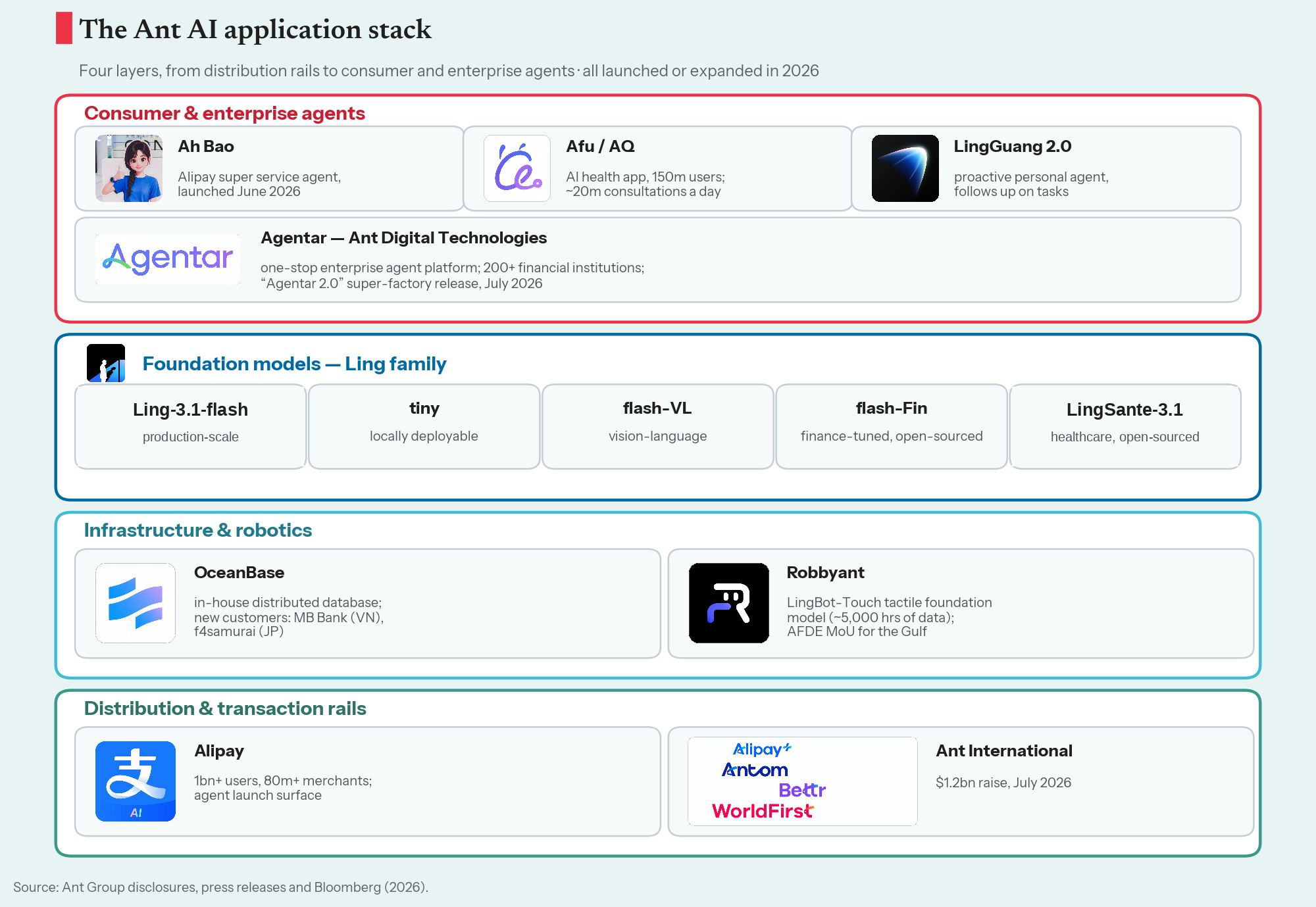
Figure 4 — The Ant AI application stack, from distribution rails to consumer agents.
The bill, and the first returns
Ant is private, discloses no revenue, and its profit line must be assembled from its shareholder’s filings. The arithmetic is simple: each quarter, Alibaba reports its share of Ant’s profit, recorded one quarter in arrears; divide by the 33% stake and the eighteen quarters since 2022 reassemble into an estimated series (Figure 1; method note below).
Two things stand out.
The first is the shape of the spending. Ant’s sustainability reports put R&D investment at RMB 20.46 billion in 2022, RMB 21.19 billion in 2023 and RMB 23.45 billion in 2024 — above 10% of revenue every year, by the company’s own statement — before reaching RMB 35.03 billion in 2025 (Figure 2). Part of that 49% jump is definitional: from 2025, the disclosed figure covers Ant International, OceanBase and Ant Digital Technologies alongside the parent. But the direction is not in doubt, and the 2025 report calls the spend a record in absolute terms and as a share of revenue.
The second is what the spending did to profit. Estimated profit fell from RMB 31.2 billion in 2022 to RMB 23.8 billion in 2023 — the year a RMB 7.1 billion regulatory fine landed — rebounded to RMB 38.3 billion in 2024 on a swing in net investment gains, then fell to RMB 15.3 billion in 2025, with the September and December quarters down 91% and 79% year on year as AI and health costs compounded and fair-value marks turned (Figure 3). The June 2026 quarter, at RMB 10.5 billion, is the first in which the profit curve and the investment thesis point the same way.
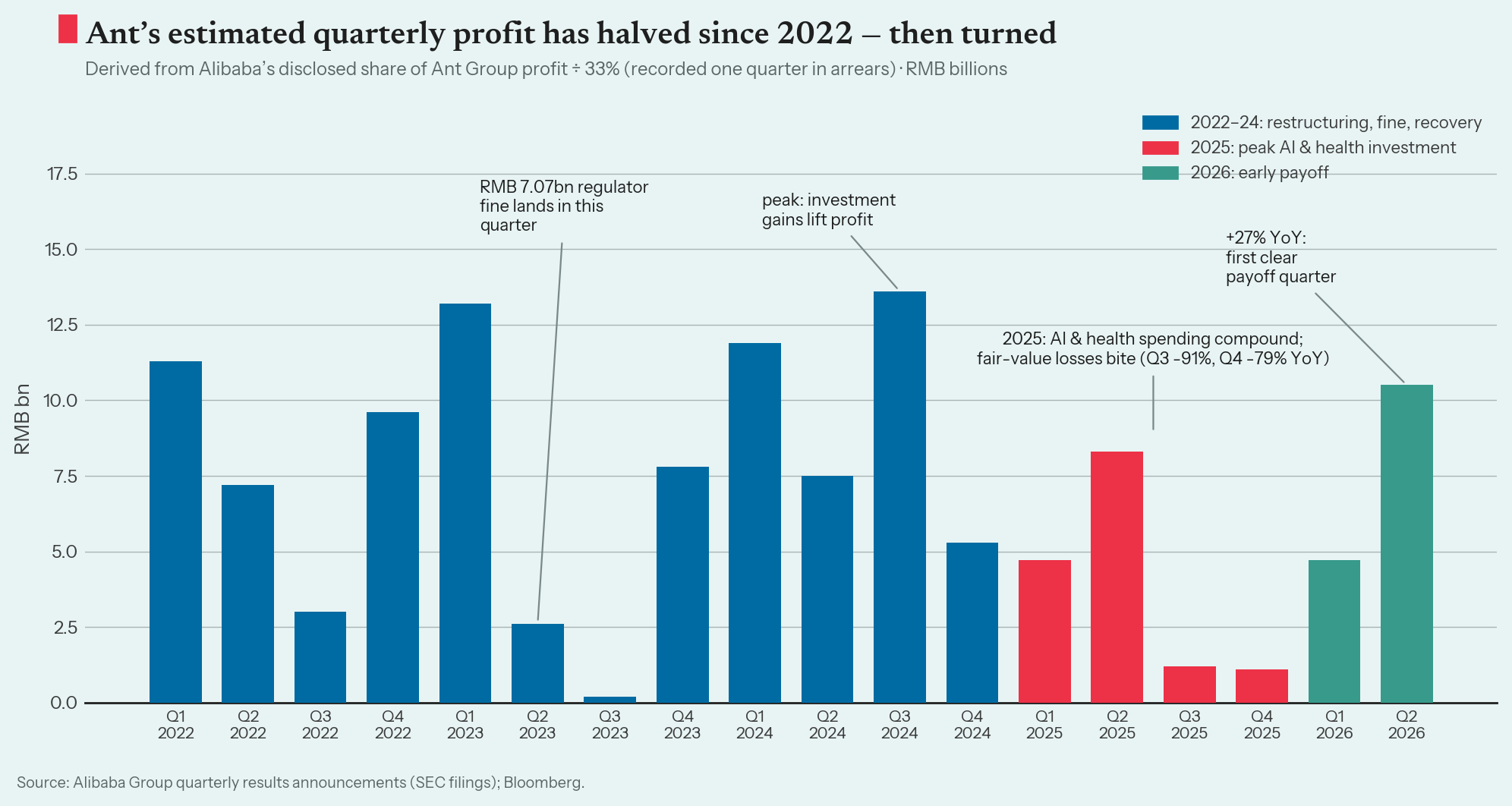
Figure 1 — Ant Group’s estimated quarterly profit, RMB billions, derived from Alibaba’s disclosed share of Ant profit ÷ 33%. Red: the heavy-investment year 2025; green: the 2026 recovery.
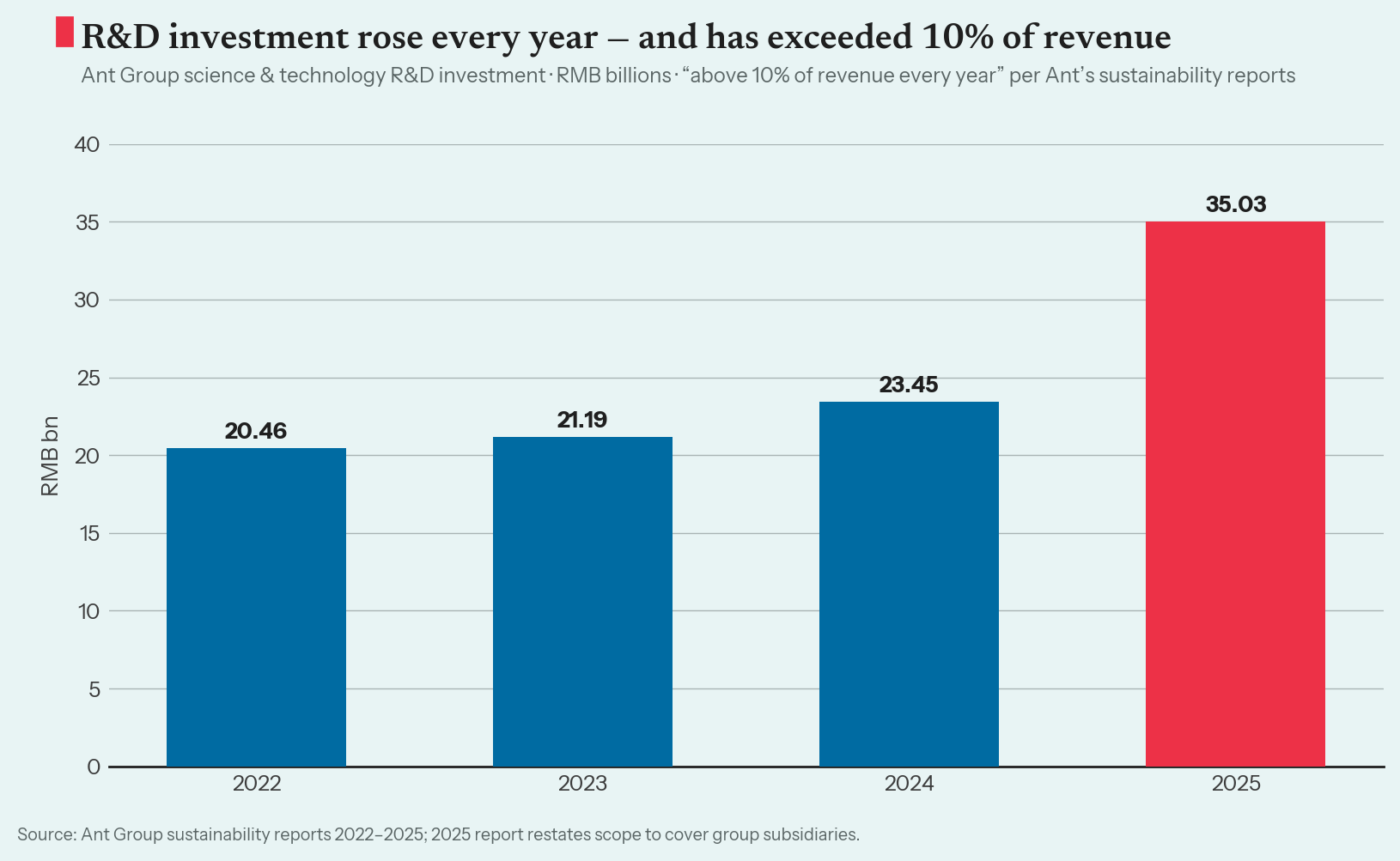
Figure 2 — Ant’s disclosed R&D investment. The 2025 jump partly reflects a wider reporting scope that adds group subsidiaries.
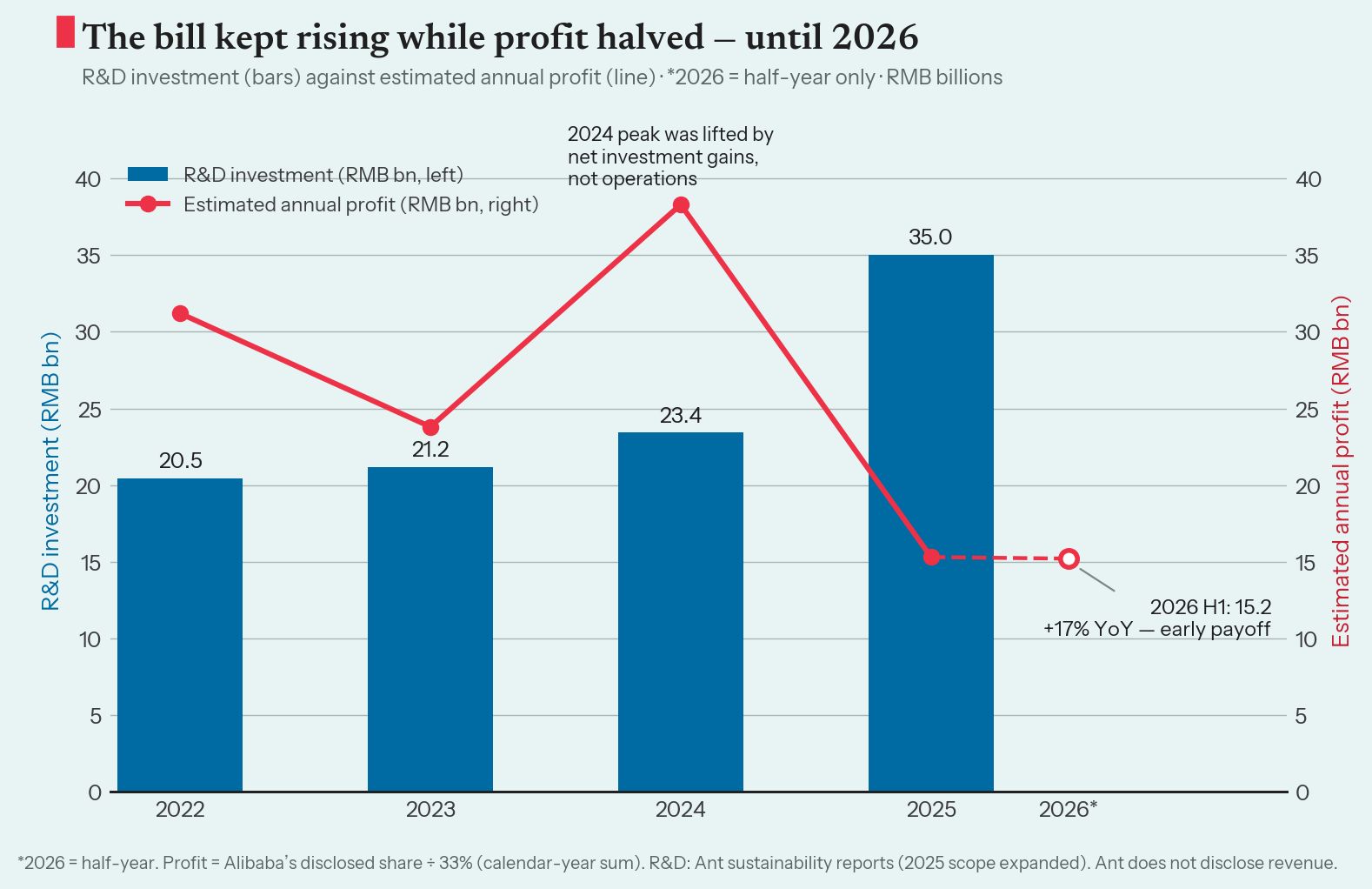
Figure 3 — R&D investment against estimated annual profit. The 2024 peak was lifted by net investment gains, not operations.
Bloomberg Intelligence’s Francis Chan expects the drag to continue: Ant’s AI and health-care drives “will require heavy investment, offsetting payments growth”, and investment gains or losses “might also swing earnings”. Nor is Ant waiting for its long-stalled IPO to fund this. Ant International has raised US$1.2 billion; OceanBase, Ant Digital Technologies and Robbyant are seeking outside capital, each with an independent board set up in 2024. A 2023 share repurchase valued Ant at about US$79 billion, against the US$280 billion its aborted IPO implied.
Two markets, one platform
Underneath the products are two markets that analysts already size in trillions. McKinsey’s QuantumBlack arm projects agentic commerce at US$3–5 trillion globally by 2030; Morgan Stanley puts US agent-driven online spending at US$190–385 billion by the same year, and finds about 23% of Americans have bought something through an AI assistant in the past month. In health, Bloomberg has sized China’s online healthcare market at US$69 billion, while Grand View Research projects global AI-in-healthcare revenue growing from US$36.7 billion in 2025 to US$505.6 billion by 2033, a 38.9% compound annual rate (Figure 5).
Ant’s claim to be unusually equipped for both rests on four things, each demonstrable rather than asserted. Distribution: an agent launched inside Alipay starts with a storefront the size of a country — in the eight months to September alone, Afu added 50 million users, taking it to 150 million. Rails: the payment step is what separates an agent from a chatbot, and the Starbucks service shows the loop working — request, remember, execute, confirm, pay. Merchant ecosystem: mini-programs and existing merchant relationships give agents real services to call, not demo sandboxes. Stack: models, database and domain tuning owned in-house, so the margin on AI applications is not entirely rented from a third-party model vendor.
The counter-argument is numerical too. Gartner warns that more than 40% of agentic AI projects will be scrapped by the end of 2027. “Well equipped” and “will win” are different claims.
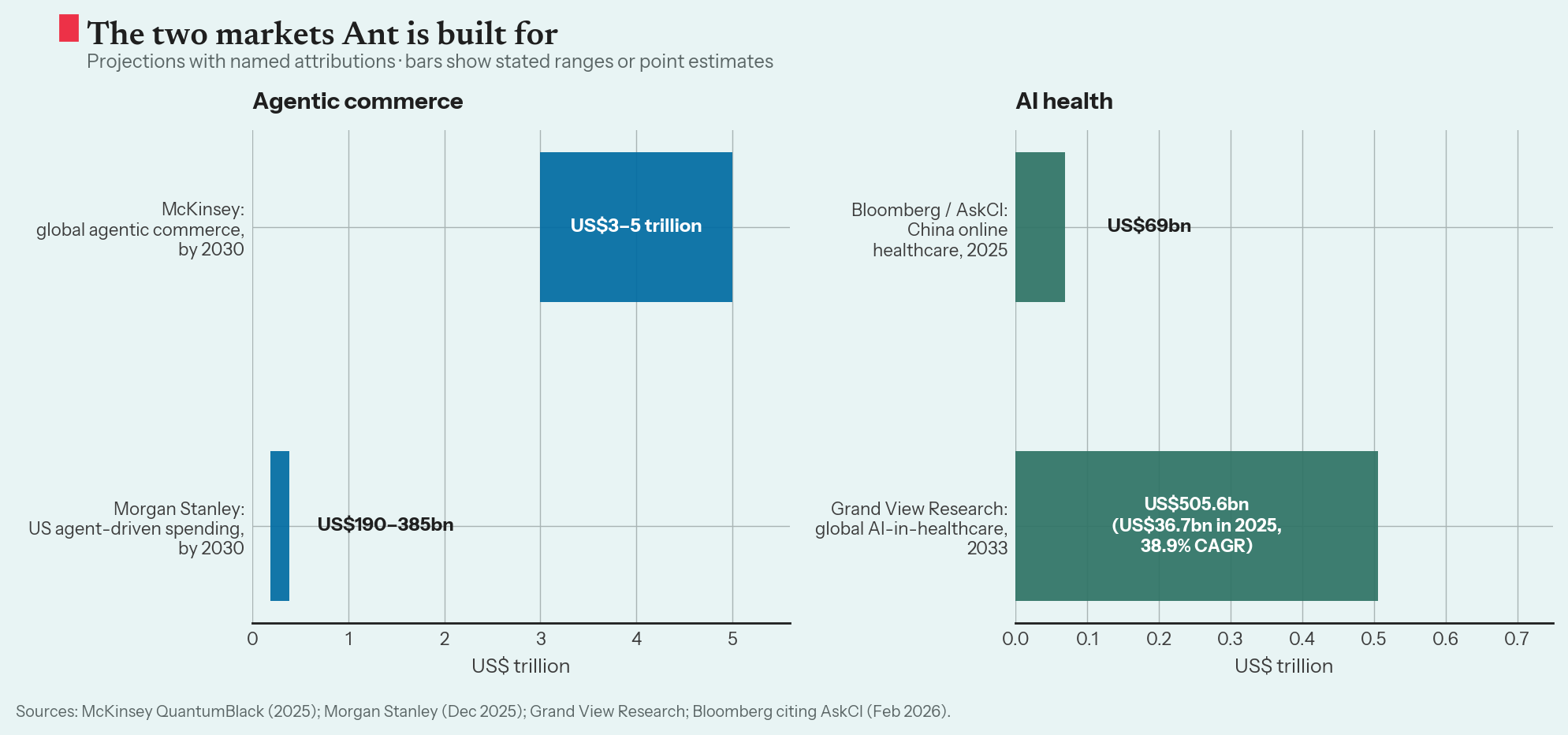
Figure 5 — The two markets Ant is built for, with named projections.
The scoreboard
The competition is spending as if it agrees with the McKinsey number. Tencent’s cash capital spending jumped 225% year on year in the September quarter, and management has said AI investment will at least double this year; the Financial Times reports that a WeChat AI agent is close to launch — the one distribution rival in China with more daily users than Alipay. ByteDance’s Doubao chatbot reached 345 million monthly users in March and moved to paid subscriptions in May. Baidu, which demoted its health-care unit in 2024, relaunched a consumer “AI health manager” in October 2025, built with input from 360,000 doctors.
None of them, so far, combines consumer agents, payment rails and a health franchise at Afu’s scale under one roof. That combination — not any single model — is the premise of Ant’s second act. It is also the hardest thing for a rival to copy. The LingSante release sharpens that distinction: a rival can now download Ant’s medical models, but not Afu’s users or Alipay’s rails.
The open-weights playbook
Ant is not the first to try this strategy. DeepSeek open-sourced R1 in 2025 (DeepSeek-R1 on GitHub) and kept selling the API; the free models became the marketing, and developers who could not self-host became customers.
LingSante points the same mechanism at medicine (Figure 6). Open weights lower the cost of trying: hospitals and research teams deploy it on their own premises, over their own data, without a procurement cycle. In a regulated market, that is the argument — running the model inside their own walls builds trust, goodwill and familiarity over time, the factors that decide success in healthcare. Every partner that builds on it widens the ecosystem.
DeepSeek’s users were developers, who adopt fast and leave fast; Ant’s are hospitals, which adopt slowly and stay. Slower to pay off, harder to reverse if it works.
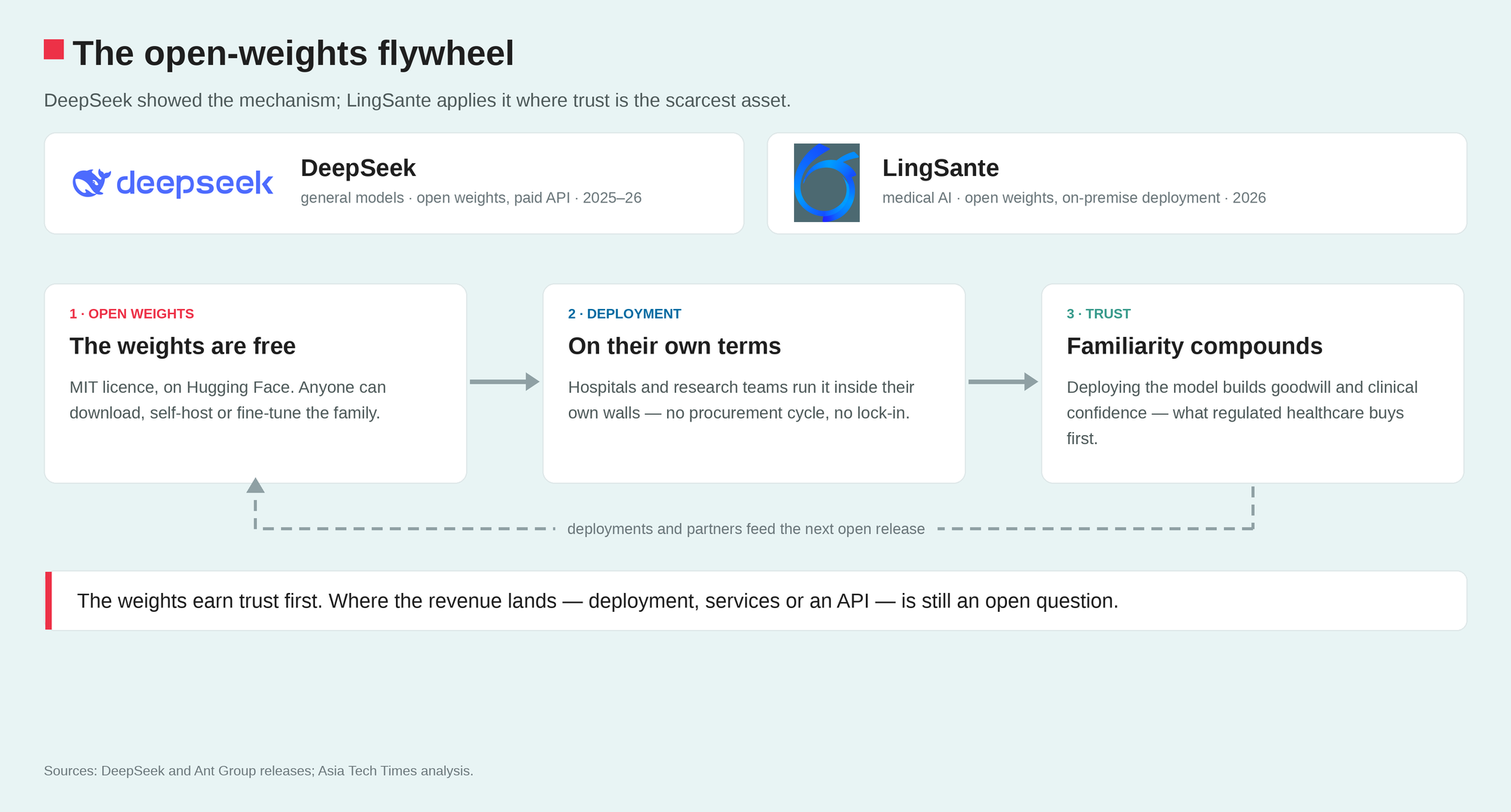
Figure 6 — The open-weights flywheel: DeepSeek’s play in medicine.
The second act
The June quarter is not proof the AI bet has paid off; one quarter, helped by fair-value marks, settles nothing. But two lines finally moved the same way: spending up by design, profit up on evidence of usage — twenty million consultations a day, brands paying for agent workflows, companies buying the AI payment and AI health technology solutions.
The test of the second act is whether those lines keep rising together into 2027. If they do, the company that missed its IPO will have found a slower, more durable listing: its products, in daily use, paying for the next round of research.
Method and sources
Alibaba holds 33% of Ant Group (fully diluted) and accounts for it under the equity method, one quarter in arrears; each quarterly results announcement discloses Alibaba’s share of Ant’s profit for the previous quarter, and dividing by 33% yields Ant’s estimated profit. Quarterly figures are taken from Alibaba’s results announcements filed with the SEC, covering Ant quarters from January–March 2022 to April–June 2026; annual figures are calendar-year sums and reconcile with the fiscal-year disclosures in Alibaba’s Form 20-F. R&D figures are from Ant Group’s sustainability reports, 2022–2025 editions. Ant does not disclose revenue; the “above 10% of revenue” statement is the company’s own. USD conversions follow the sources. The LingSante release is described from Ant Group’s press release of 23 November 2026 and the model cards on Hugging Face.