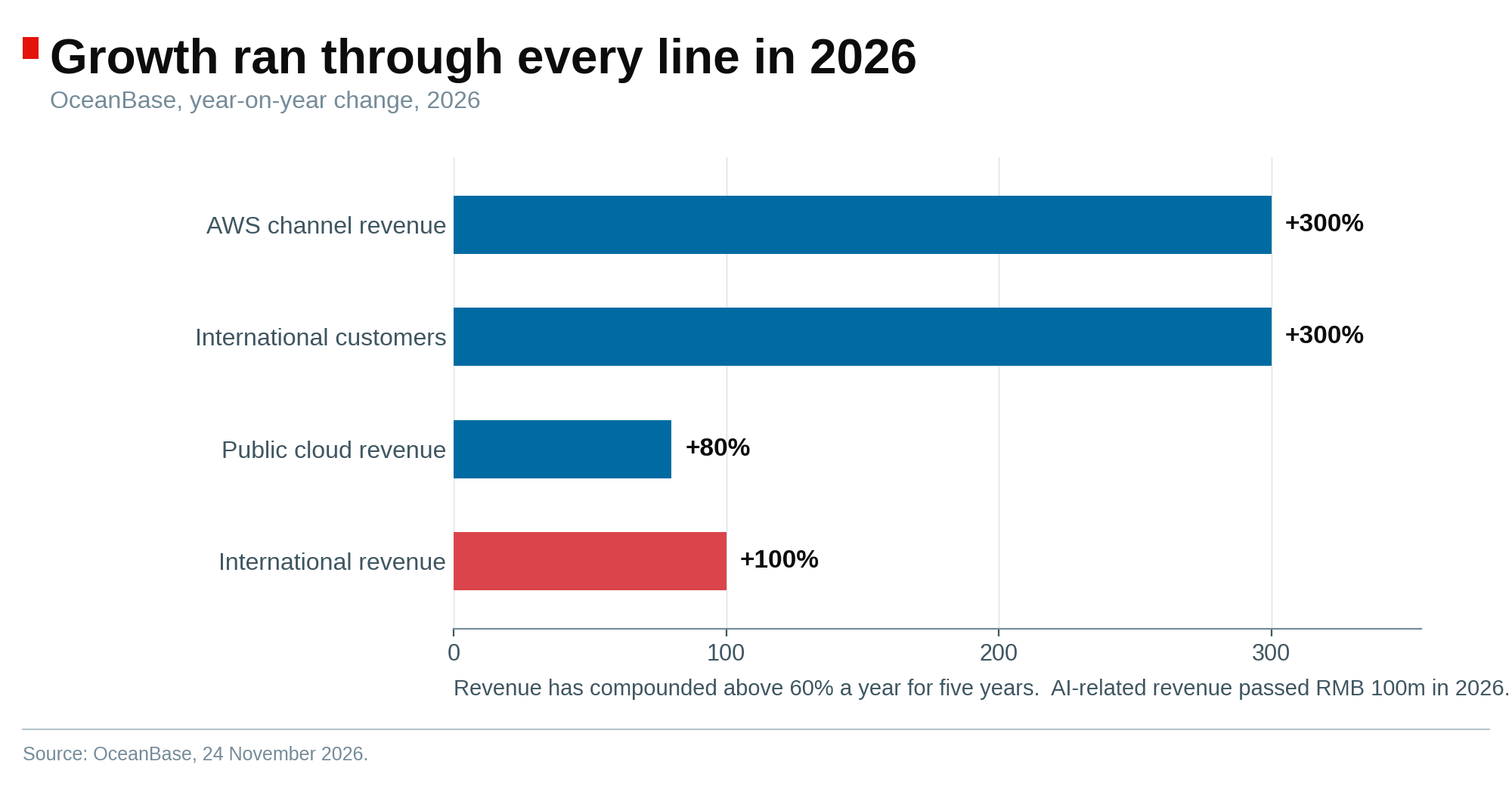
OceanBase reported its 2026 results on 24 November: growth on every line it discloses, and a platform launch to match. At its AI Data Conference in Beijing, the company said international revenue grew 100% year on year and now accounts for more than 15% of the total, its international customer base three times larger; revenue has compounded above 60% a year for five years. It also unveiled OceanLake, an “integrated lakebase AI data platform”, and open-sourced its AI database as OceanSeek.
The numbers are the announcement. The story is what OceanBase did with them — and, read together with a guest op-ed by chief executive Evan Yang, published in ITTech Pulse, the two describe an ambition larger than either: that in enterprise AI the value is migrating from models to data infrastructure, and that a company built on transaction processing can meet Databricks and Snowflake at the layer where the money is going.
The numbers
International revenue doubled, and the business — anchored in Southeast Asia, expanding into Japan, the Middle East and North Africa — now accounts for about 15% of revenue at a company born out of Alipay’s core payments systems; its international customer base tripled over the year.
Public cloud grew faster than the whole. Revenue rose 80% year on year, multi-cloud arrangements accounted for 35% of public-cloud revenue, and revenue through the AWS channel was up 300%. The service now runs on seven major public clouds across 16 countries and more than 240 availability zones — for an independent database company competing with the cloud vendors’ engines, breadth is the argument.
The market position is more specific. An Omdia report released in September, based on 2025 revenue, named OceanBase the top distributed transactional database vendor in Asia and Oceania, with a 15.5% share. Its customers include more than 20 e-wallets, over 50 payment institutions and more than 30 fintech companies — and, the line that matters for the next act, banks outside its home market: HSBC, SMBC and Hang Seng have begun choosing OceanBase to modernise core systems.
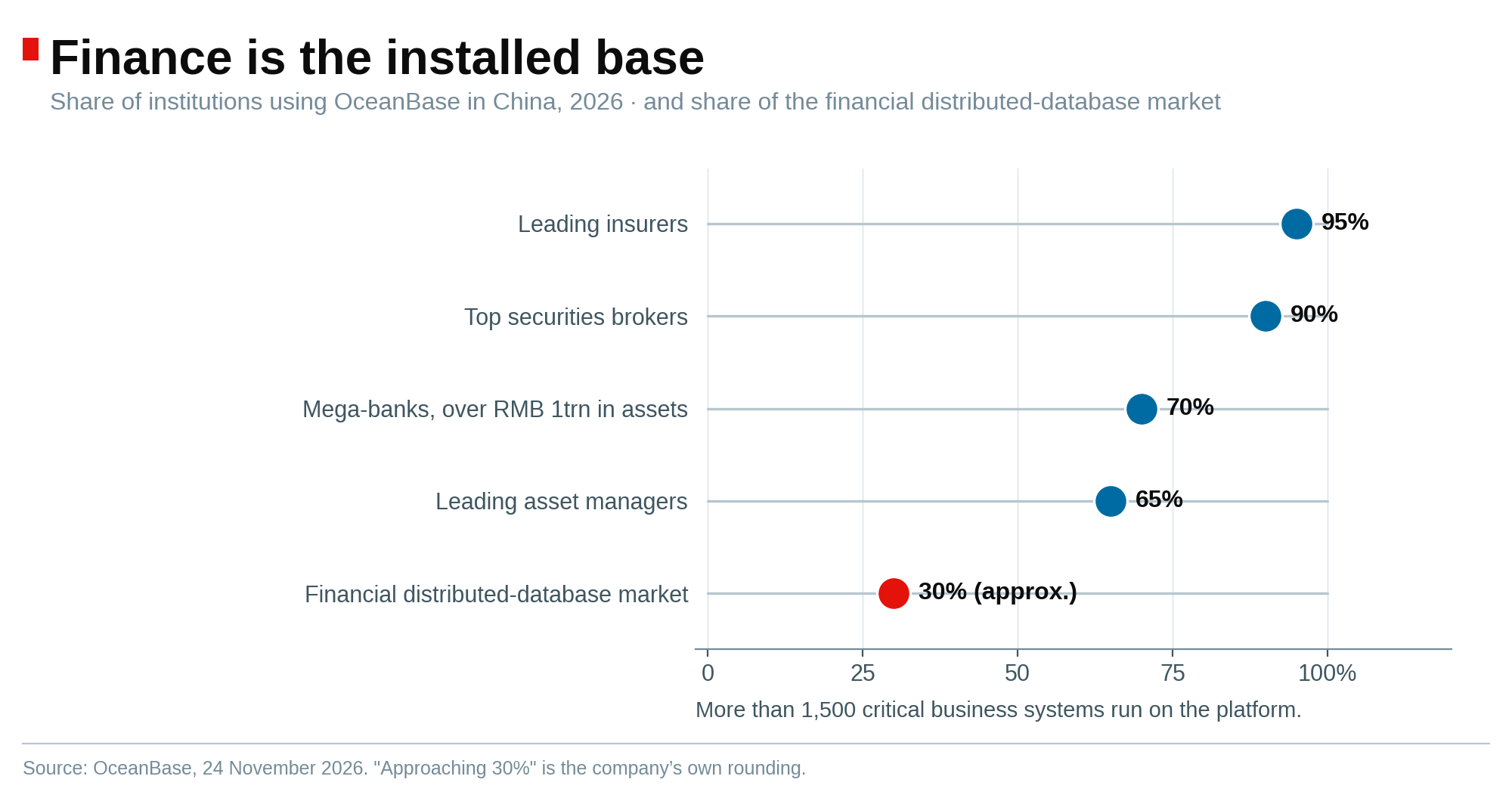
Behind it sits the financial sector — 70% of China’s mega-banks with over RMB 1 trillion in assets, 100-plus mid-sized banks, more than 1,500 critical business systems, and a share approaching 30% of the financial industry’s distributed database market, first in on-premises deployment for three consecutive years.
Yang put it plainly: “These milestones demonstrate that our strategic priorities on AI, globalization, and public cloud over the past few years are being validated by the market and are translating into tangible growth,” he said in the statement. “Even as technology cycles evolve, the critical importance of data remains constant.”
The argument underneath the numbers
The launch came with a thesis, set out at length in that op-ed. Titled “The Last Bottleneck in Enterprise AI Was Never the Model. It Is the Data.”, it builds from a 1986 warning that still holds. Fred Brooks, in “No Silver Bullet”, separated the accidental complexity of software — the friction of tools and languages — from its essential complexity, the difficulty of real-world behaviour. Better tools relieve the first kind and quietly amplify the second.
Yang wrote that this is what has just happened. Natural language has become the programming language of the AI era; the interface between intent and execution has collapsed. But the difficulty has not vanished — it has migrated into data. He offers three signs: the model has become a commodity, with frontier capability passing the average human benchmark as prices fell; public data is exhausted as an advantage, because everyone has it; and the flywheel that should turn business growth into richer data has not started.
The value, Yang wrote, sits in three icebergs: private data beneath public data, multimodal beneath structured, and disorder beneath order. “Model selection is no longer the moat,” he writes. And, further down: “The interfaces will keep getting simpler. The data will keep getting harder. That asymmetry is not a bug in this wave of AI; it is the wave.”
The op-ed draws on two academics for laying out the key point: Avi Goldfarb of the University of Toronto, on why AI needs data-centred investment before it produces productivity gains, and Qiang Yang of Hong Kong Polytechnic University, on why models cannot advance without private data being unlocked.
One platform, one copy of data
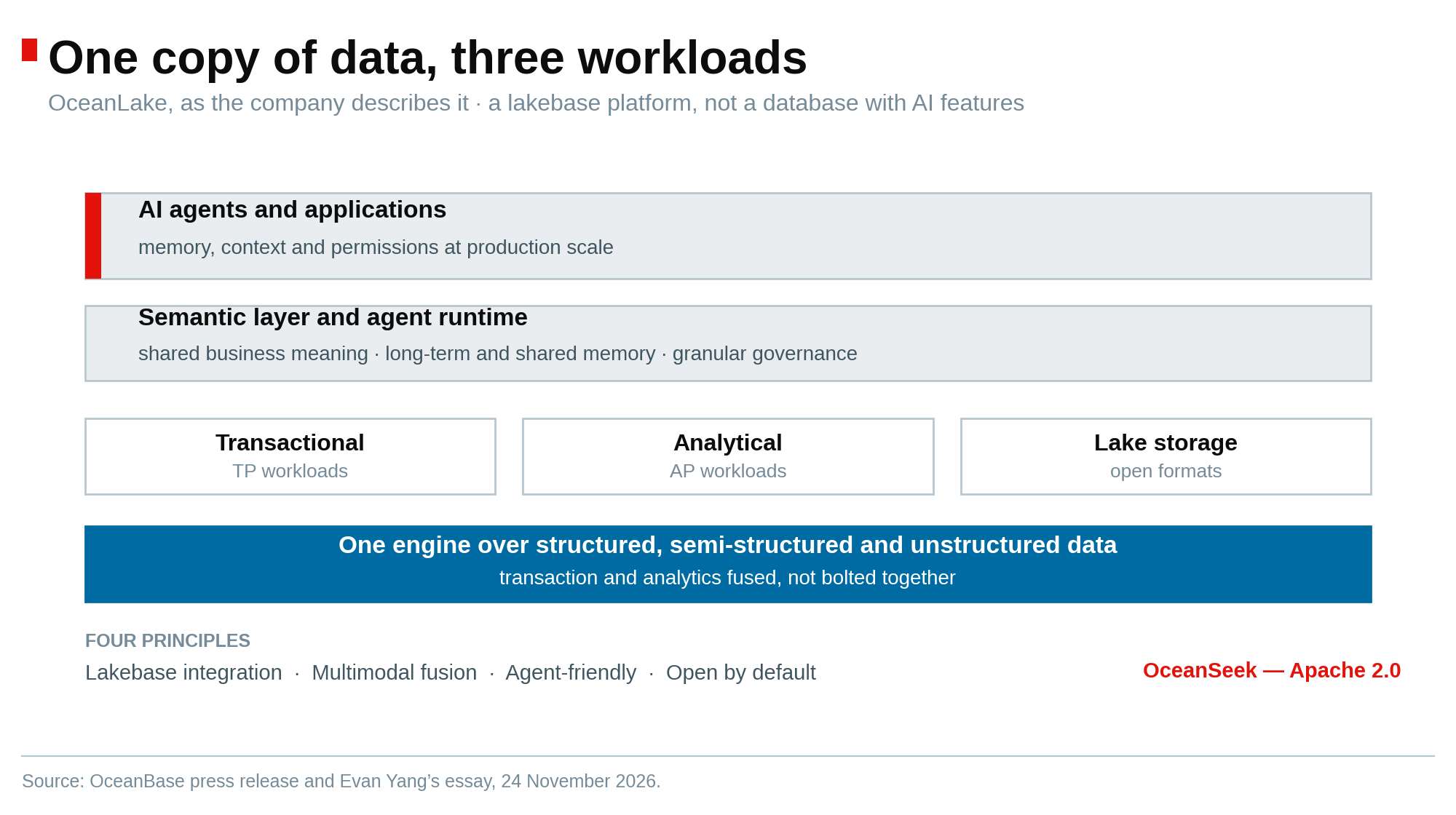
OceanLake is the answer in product form: a platform that combines the transactional processing of a database, the analytical power of a data warehouse and the open storage of a data lake, over one copy of data — structured, semi-structured and unstructured, managed together. On top of that engine sit the pieces that make it a platform for agents rather than a faster database: a semantic layer that gives the data shared business meaning, and an agent runtime that lets AI applications hold memory and context at production scale.
The proof points are specific. At Ping An Life, ontology modelling has let AI systems read decades of insurance expertise, cutting typical data query delivery from days to about 15 minutes; at Haier, ontology-driven agents have moved from natural-language data retrieval to executing business workflows; at Xiamen Airlines, finance teams query financial data in natural language through a system called DataPilot. Inside the wider Ant group, OceanLake runs Robbyant’s and LinkerBot’s training pipelines, powers more than 30 million “Flash Apps” on Lingguang, and cut evaluation preparation for the Afu health app from days to minutes.
OceanSeek, released the same day under Apache 2.0, is the open-source half of the strategy: an AI database with hybrid retrieval and data sandboxes, built on the same lakebase architecture. It follows a principle the company has upheld since it open-sourced its core engine in 2021 — seekdb in 2025, OceanSeek now — toward a complete, open-source stack for the AI era.
“Fifteen years ago, we believed the quality of mobile payments would be decided by its data. Five years ago, that same belief carried us into modernizing the core systems on which an economy depends. Today we hold it more firmly than ever,” Yang wrote in the op-ed.
Databricks took the other road
Bloomberg has called OceanBase China’s Databricks, and the comparison is instructive — the two companies are travelling the same road in different directions.
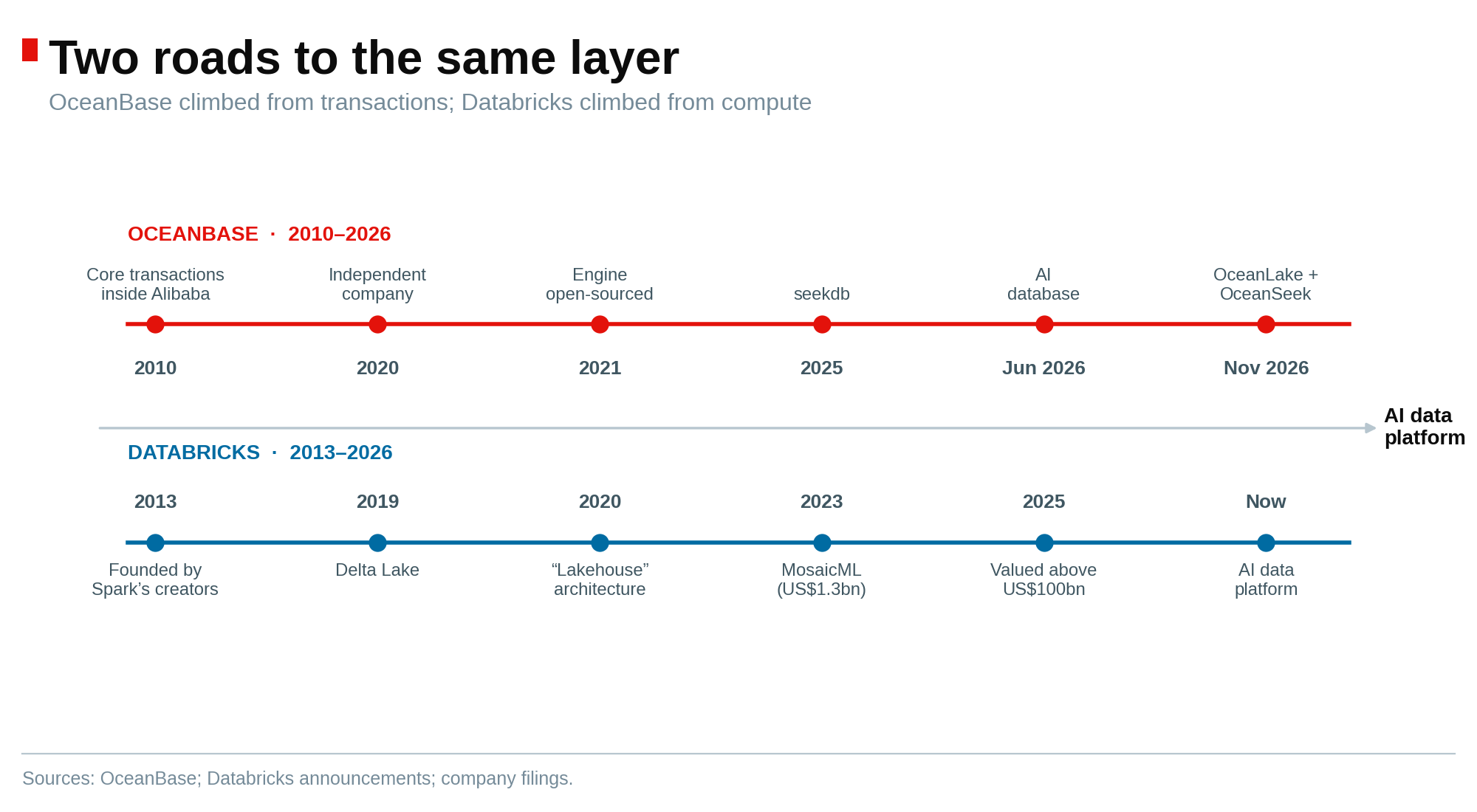
Databricks began in 2013 with the creators of Apache Spark, a compute engine. It moved down into storage with Delta Lake in 2019, coined the lakehouse to describe the combination, bought the model-training company MosaicML for about US$1.3 billion in 2023, and now sells itself as an AI data platform; its private valuation passed US$100 billion in 2025. Snowflake, the other pole, began as a cloud data warehouse, went public in 2020, and has spent the years since building an “AI Data Cloud” around its storage — adding model functions, governance and application layers rather than letting data leave.
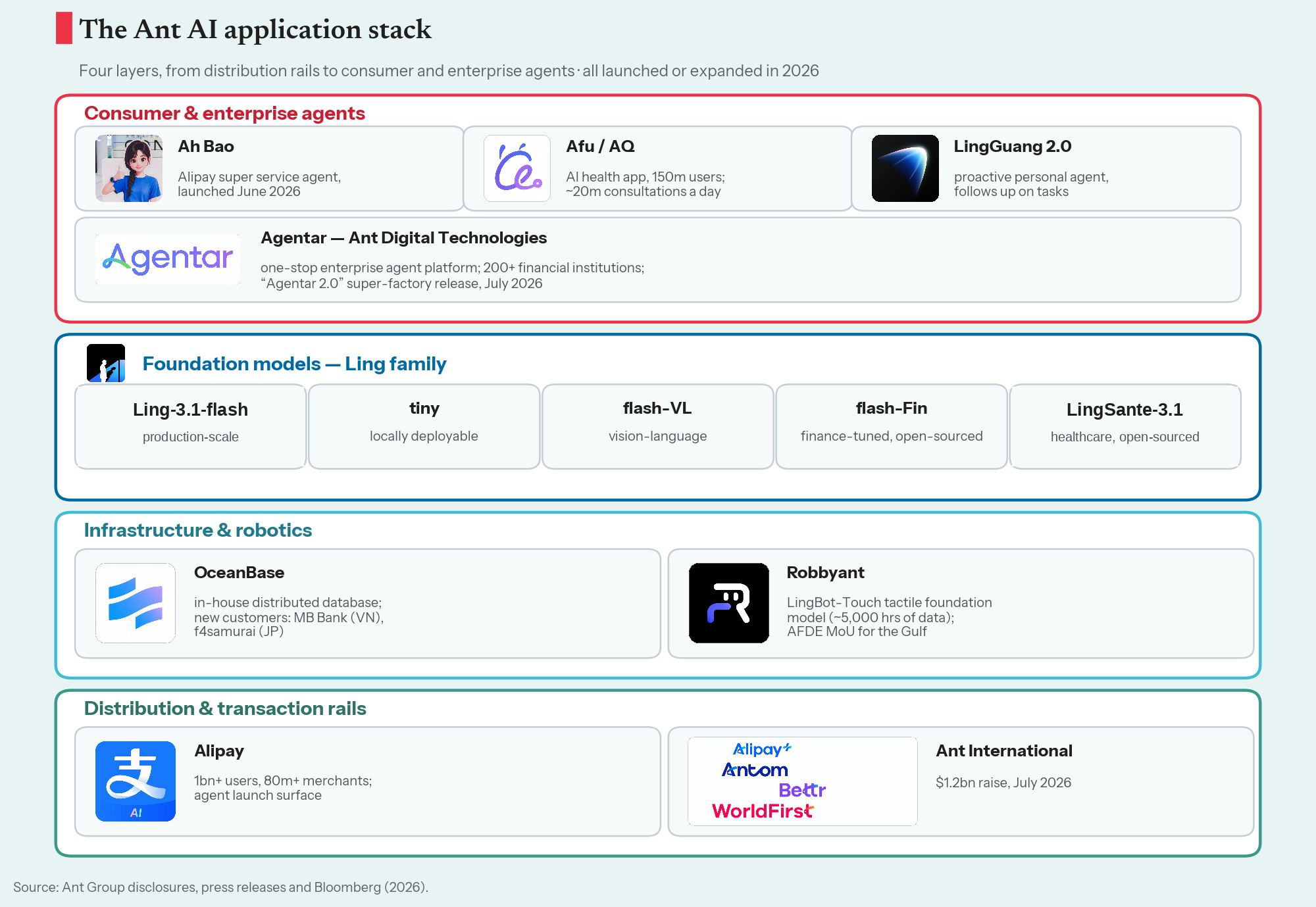
OceanBase’s arc is that story reversed. It began in 2010 as a core database supporting Alipay in tackling peak traffic challenges during China’s iconic 11.11 shopping festival — mobile payments, then the systems an economy depends on — became independent in 2020, open-sourced its engine in 2021, and has climbed upward ever since: seekdb in 2025, an AI database in June 2026, and now a lakebase platform that reaches for analytics, multimodal data and agents. Both companies started from an engine, opened the engine to a community, and are now building the platform above it. They arrive from opposite ends, with opposite strengths: Databricks with cloud-native analytics and the AI ecosystem’s mindshare, OceanBase with transaction-grade consistency, on-premises depth and a financial reference base that cloud-only vendors find hard to replicate.
The next wave goes upstream
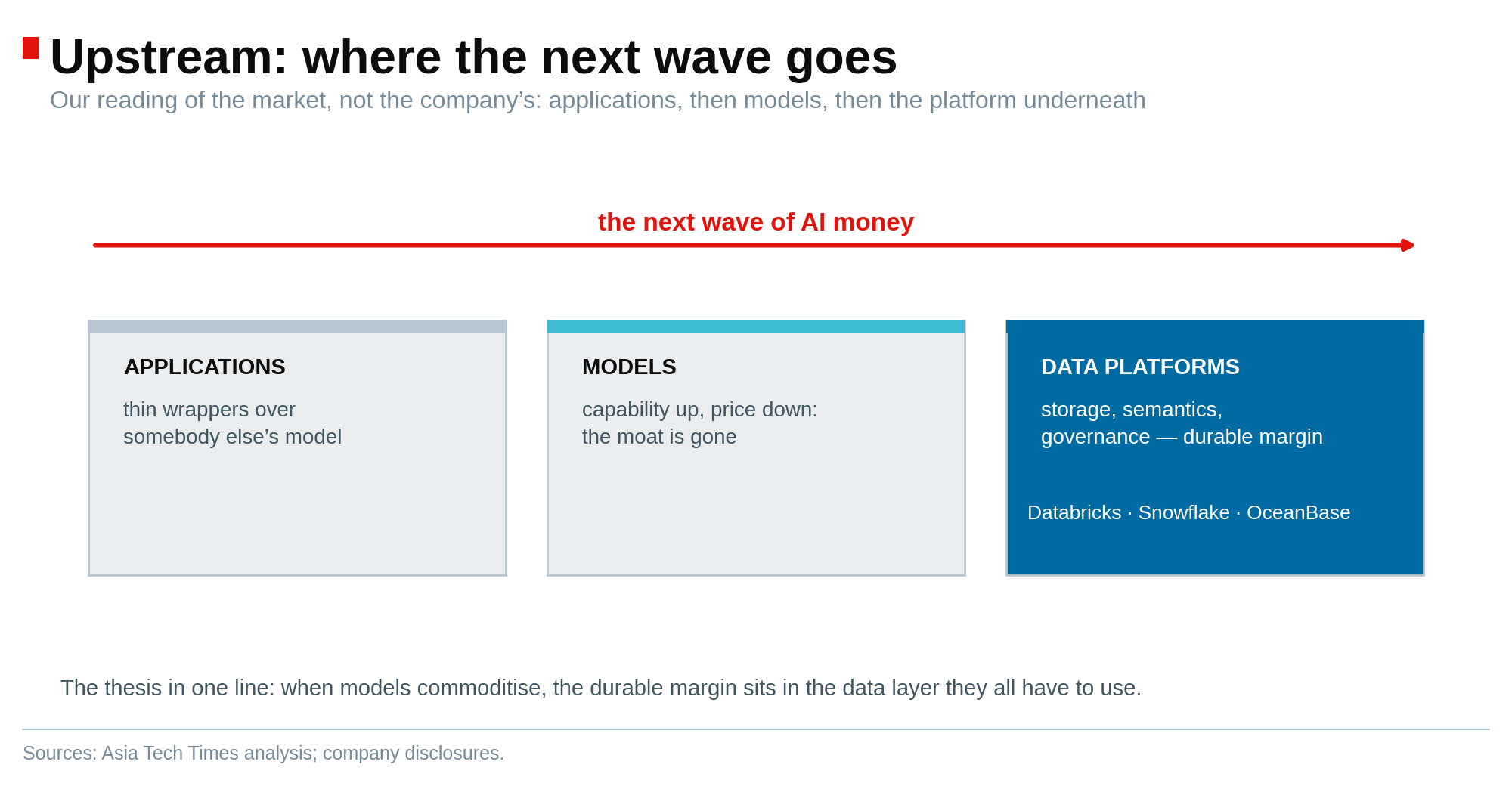
If models commoditise — and the price curve of the past two years says they are — and applications remain thin wrappers over somebody else’s intelligence, then the durable margin in enterprise AI sits where the data is stored, governed and made legible to machines. That is the AI data platform, and the market has already moved its money there: Databricks and Snowflake are valued as AI infrastructure, not as analytics tools, because both now sell the layer where enterprise data meets enterprise AI.
Call the direction upstream. The past three years of AI money flowed into applications and then into models; the next wave, on this reading, flows past both, all the way to the AI data platforms underneath — the systems that own the storage, the semantics and the permissions an agent needs before it can act. OceanBase’s vision is that this platform convergence lands on the lakebase shape: transactions, analytics and AI over one copy of data, because copying data between silos is the cost AI workloads cannot bear at scale. If that is right, the company is not selling a database with AI features. It is claiming a seat at the table where Databricks and Snowflake already sit.
OceanBase’s four principles — lakebase integration, multimodal fusion, agent-friendliness, open by default — describe a platform; what distinguishes the company is where it starts from: sixteen years of running the systems an economy depends on, and the financial customers who trust it with them.
What the ambition requires
International revenue, at about 15% of the total, is still smaller in absolute terms than OceanBase’s other streams, but its pace is promising: it doubled in a year and the customer base tripled. AI-related revenue above RMB 100 million gives the platform ambition a first line to compound from. Lakebase names a contested space, and every hyperscaler — not just Databricks and Snowflake — is building toward the same diagram, with the advantage of owning the customer’s cloud. Fusing transactional, analytical and AI workloads in one engine is the engineering frontier the whole industry is working toward. And open-sourcing OceanSeek lowers the cost of adoption while inviting the community to build on the engine — the same openness that built the ecosystem around Spark and Delta Lake.
OceanBase enters that contest from a position of real advantage: transaction-grade consistency, on-premises depth and the trust of the financial institutions that anchor its home market. The ambition is large. So is the base behind it.
The test
What to watch is narrower than the vision, and specific. Whether OceanLake’s reference customers multiply beyond Ant’s own orbit, as the first external names become a market. Whether AI revenue compounds into a line of its own. Whether international customers expand after the first migration. And whether the four principles turn into products with roadmaps and prices the market can evaluate.
The sixteen-year-old company has made its ambition public, with numbers attached. If the next two years bring the reference customers, the platform revenue and the ecosystem the vision describes, lakebase will be the industry’s name for this layer of the stack.
Method and sources
Figures are as stated in OceanBase’s press release of 24 November 2026 (issued via PR Newswire) and in Evan Yang’s guest op-ed in ITTech Pulse, published 25 November 2026, “The Last Bottleneck in Enterprise AI Was Never the Model. It Is the Data.” The Omdia market-share figure is from the report announced in September 2026, based on 2025 revenue, as cited in the release. Databricks’ history — founding, Delta Lake, the MosaicML acquisition of 2023 and its 2025 valuation — is drawn from the company’s own announcements; Snowflake’s from its public filings and product announcements. Customer proof points are the company’s own disclosures. Bloomberg called OceanBase China’s Databricks in its July 2026 coverage of the company’s Series A. The interpretation of where AI value accrues — the “upstream” argument in this article — is Asia Tech Times’ editorial judgement, presented as analysis.