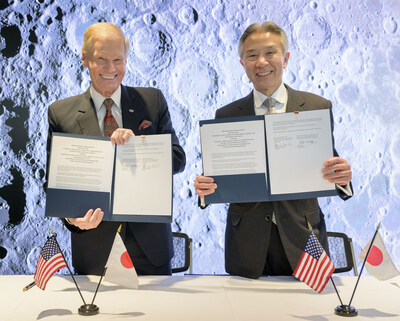
NASA and Japan's Ministry of Education, Culture, Sports, Science and Technology have signed an implementing arrangement under which Japan will design, develop and operate a pressurised rover for crewed and uncrewed exploration of the Moon. NASA will provide the launch and delivery of the vehicle, and two opportunities for Japanese astronauts to travel to the lunar surface. The signing took place at NASA headquarters in Washington on 9 April.
A pressurised rover is the valuable half of the bargain because an enclosed cabin turns a vehicle into a mobile habitat. It lets astronauts travel beyond walking distance of a lander and work for days rather than hours; NASA says this one will carry two astronauts for up to 30 days near the lunar South Pole, serving as a laboratory and a place to live while it moves. That range is what makes the geology of distant sites reachable.
An arrangement, not yet a machine
NASA plans to use the rover on Artemis VII and later missions over a lifespan it describes as about ten years. The agreement sits under a wider framework, and under a 2022 arrangement for the lunar Gateway, NASA is to offer a Japanese astronaut a place as a Gateway crew member while Japan supplies the station's environmental control and life support systems and cargo transport. Japan's Masahito Moriyama called the arrangement a symbol of a new era of cooperation, and JAXA's Hiroshi Yamakawa said the agency was ready to support the work.
The release gives no cost, no mass and no contractor, and the rover does not exist yet. Artemis VII depends on a chain of earlier flights, each of which has been delayed before. An implementing arrangement divides responsibility and states an intention; the test of it is a vehicle on the surface, years from now, so a reader cannot yet judge whether the timeline holds.