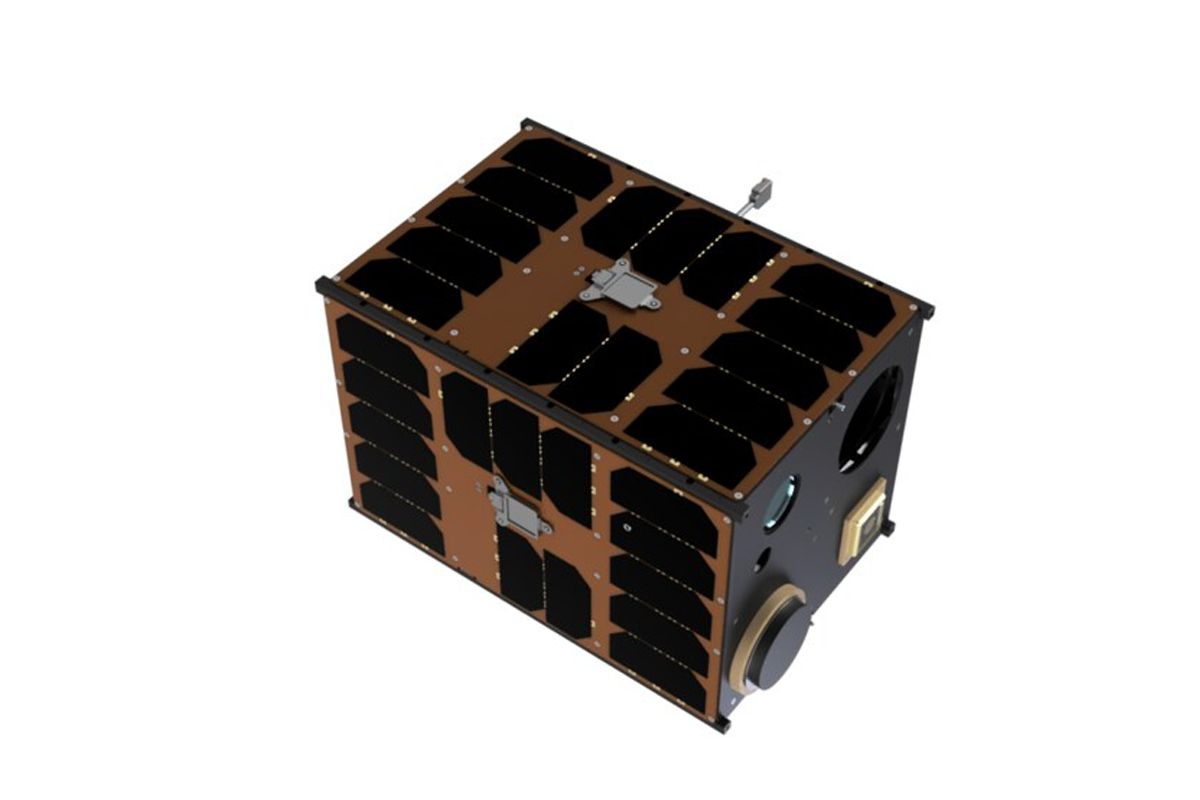
SpeQtre, a twelve-unit CubeSat carrying a quantum payload built by the Singapore company SpeQtral, is now in orbit, launched with the UK Science and Technology Facilities Council's RAL Space. The mission is a demonstrator: its purpose is to test whether entangled photons can be sent from a satellite to a ground station and turned into a usable cryptographic key.
SpeQtral is not starting from nothing. The company took part in an earlier CubeSat, SpooQy-1, that showed an entangled photon source could work in space, and it has partnerships with the satellite operators SES and Hispasat and with Thales Alenia Space to move the technology towards commercial use.
Why satellites are proposed for this at all
Quantum key distribution solves a specific problem: two parties can agree on a key and know whether anyone listened in, because measuring the photons disturbs them. On the ground, the signals fade over fibre after a few hundred kilometres; a satellite can, in principle, reach places fibre cannot. That is why space agencies and companies are testing it.
The technology also carries well-known limits that a demonstrator does not remove. Ground stations and trusted nodes are expensive and few, and a link that works between a satellite and one station is a laboratory result rather than a service anyone can buy. SpeQtral's chief executive, Chune Yang Lum, described a deliberate, step-by-step approach that validates each part of the technology before the next. That is the right posture, and it is also an admission that the working network is some distance away. Nothing in the announcement settles how many more missions, or how many years, sit between this orbit and a commercial offering, and no ground-segment partner or paying customer is named in the announcement.