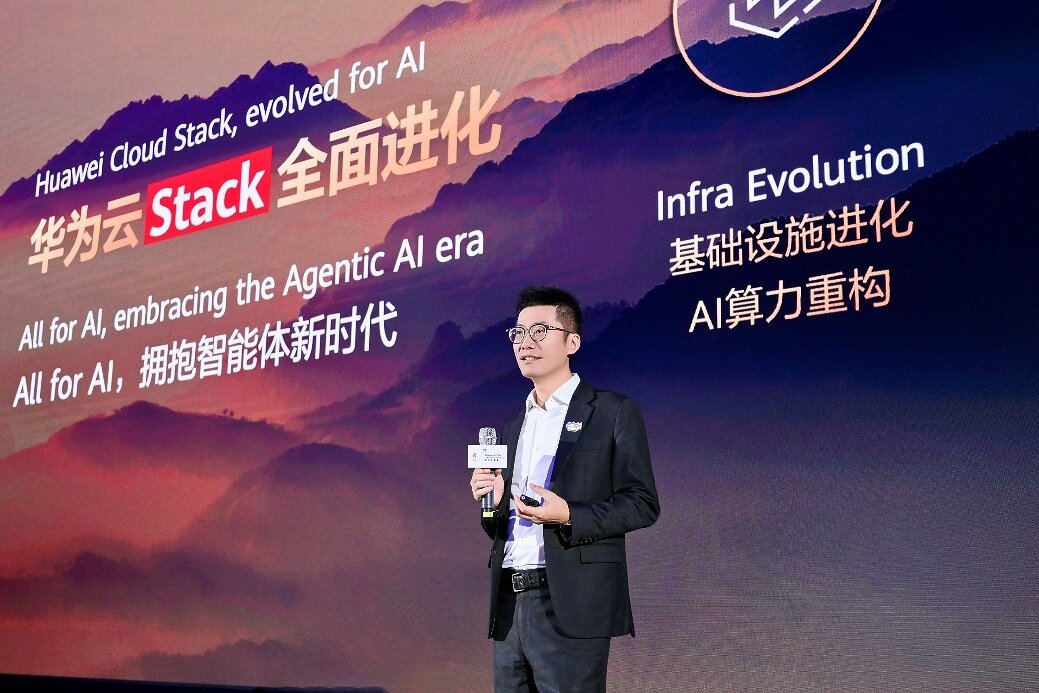
Huawei hosted a Huawei Cloud Summit at HUAWEI CONNECT 2026, where Antonony Gu, president of Huawei Hybrid Cloud, gave a keynote on the changes he said AI agents are bringing to enterprise computing and on how Huawei Cloud Stack is developing across cloud infrastructure, data, AI and ecosystem under the principle of 'All for AI', the company said.
Gu described three shifts. The parties carrying out business work are moving from people using applications to collaboration between people and agents and between agents themselves, with AI agents appearing at scale as a new kind of digital employee. Resource provisioning is becoming task-oriented, with compute, data and models packaged and ready for invocation rather than assembled layer by layer. The objects of management are moving from conventional IT resources such as compute, storage and networking to AI compute, data and models, which the company said can create new IT silos when handled through separate systems.
In response, Huawei Cloud introduced what it described as an AI agent-ready hybrid cloud architecture with four capabilities: cloud infrastructure that is elastic and built for continuous evolution, with general-purpose and AI compute unified; an AI-native capability hub connecting data, compute and tokens; an agent-native enablement platform for developing and running agents at scale; and intelligent operations with end-to-end security covering the whole agent lifecycle. Gu said a deterministic hybrid cloud architecture is a clear path for enterprises as agent adoption accelerates over the next three to five years.
On infrastructure, Huawei Cloud Stack supports A5 SuperPoDs and uses NPU pooling and memory snapshots, which the company said can raise compute utilization from 30% to 70%. It also provides an operations and management framework for AI agents that is observable, measurable and governable, plus end-to-end protection for infrastructure, models and agents. For data, the company cited lifecycle capabilities spanning management, delivery, use and circulation, a decoupled storage and compute architecture, AI DataLake for multimodal data and DataArts for data-driven decision-making.
On AI, Huawei Cloud said it is increasing investment in foundation models and pairing them with industry knowledge for automated iteration, and named domain models including a Vision-Language Model, a Scientific Computing Model and a Prediction Model, along with OptVerse AI Solver and a training and inference platform. For its ecosystem, the company described open collaboration backed by incentives and AI and service capability programs, and an Industry AI Foundry with partners and developers that draws on reference solutions from areas including Smart Finance and Smart Government to replicate proven AI deployments. Huawei Cloud Stack said it will continue to invest in Agentic Infra, data and AI.