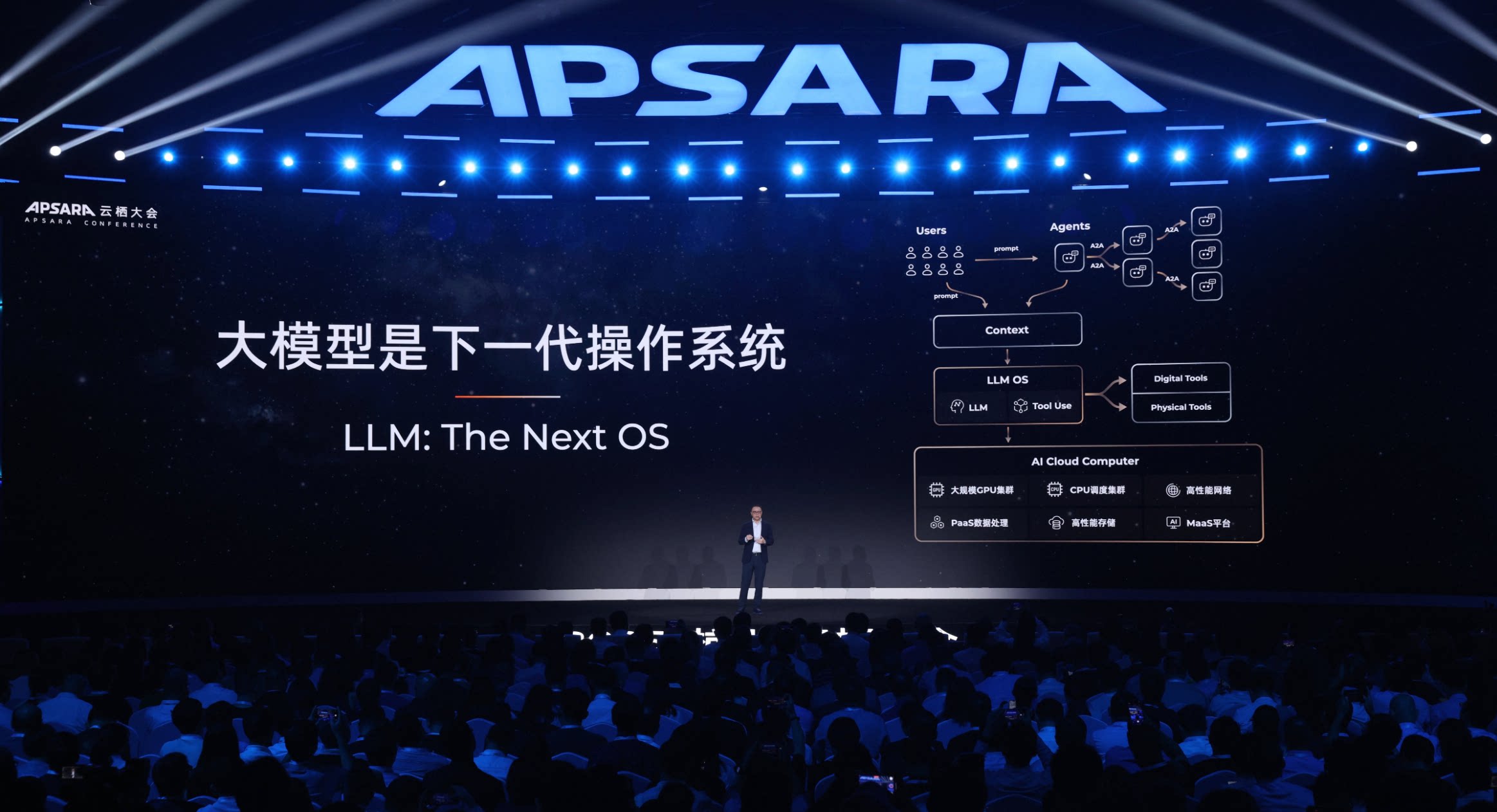
Alibaba Cloud used its annual Apsara conference in Hangzhou to stake a position: that large models will become the layer everything else is built on, and that its Qwen family should be that layer. Eddie Wu, the unit's chairman and chief executive, said models would be woven into devices much as operating systems are, and repeated a commitment to keep Qwen open.
The money behind the claim is large. Wu said the company would press on with a plan to invest RMB 380 billion in artificial intelligence and cloud infrastructure over three years. Since the first Qwen model appeared in 2023, Alibaba says it has released more than 300 models based on Qwen and its Wan image system, drawing more than 600 million downloads and 170,000 derivative models, with more than a million businesses and individuals using them through its Model Studio service.
Numbers a buyer can check, and ones they cannot
The headline release was Qwen3-Max, which the company calls its largest language model at more than a trillion parameters, offered in a fast mode and a slower reasoning mode. Alibaba reports a score of 69.6 on a coding benchmark called SWE-Bench. It also open-sourced a multimodal model, Qwen3-Omni, pre-trained on 20 million hours of audio, and previewed Wan2.5, which doubles generated video from five seconds to ten.
The accuracy figures are the company's own, and a benchmark is chosen by the vendor that reports it. More telling is the count of model calls through Model Studio, which Alibaba says rose fifteenfold in a year, and the 800,000 agents its customers have built. Those are usage numbers rather than capability claims, and usage is what an open-source strategy has to produce. Whether openness wins the platform is the open question; Alibaba has bet a very large sum that it will.