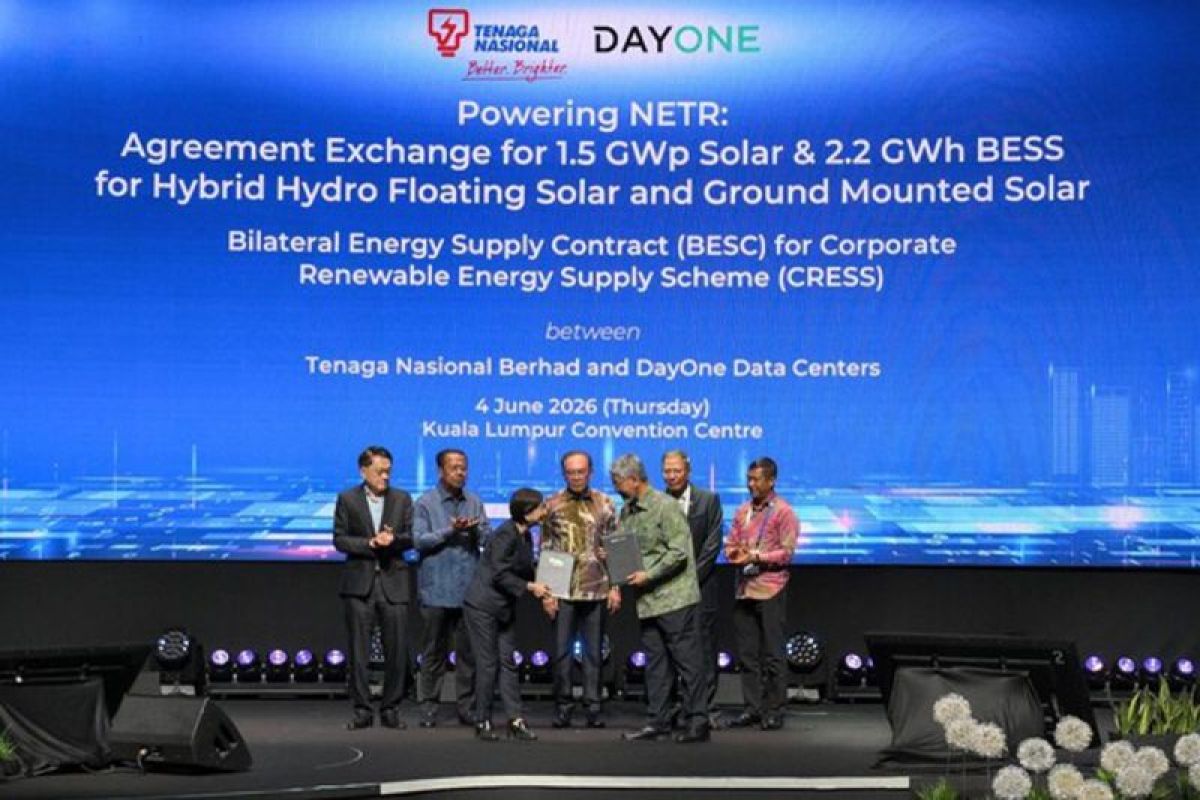
DayOne Data Centers, a Singapore-headquartered operator, has signed renewable energy supply agreements with two units of the Malaysian utility TNB, covering roughly 1.5 gigawatts-peak of solar capacity and 2.2 gigawatt-hours of battery storage. The contracts fall under Malaysia's Corporate Renewable Energy Supply Scheme and were signed in the presence of the prime minister, Anwar Ibrahim.
The documents exchanged were bilateral energy supply contracts, one with TNB Renewables and one with TNB Power Generation. DayOne's chief executive, Jamie Khoo, signed alongside TNB's president and chief executive, Shamsul Ahmad. DayOne presents the deal as among the first to move from an intention to buy green power to a signed contract under the scheme.
Why a data centre buys power directly
Data centres are heavy, constant users of electricity, and the operators chasing large customers increasingly need to show that the power is low-carbon. Buying certificates is the cheap route; signing for new generation capacity is the expensive one, because it underwrites construction. The 1.5 gigawatts-peak here is a generating figure, and solar produces a fraction of that on average, so it is not the same as 1.5 gigawatts available around the clock. Batteries of 2.2 gigawatt-hours cover a couple of hours at full draw, not a night.
The company frames the agreements as cementing Malaysia's position as a regional digital infrastructure hub. That is also the government's language, and the ceremony reflects it. What the announcement does not disclose is the price DayOne has agreed to pay for the power, the length of the contracts, or whether the generation is yet built.
A supply agreement is a commitment. It becomes a fact on the grid only when the panels are connected and the storage is charged, and neither is an overnight matter.