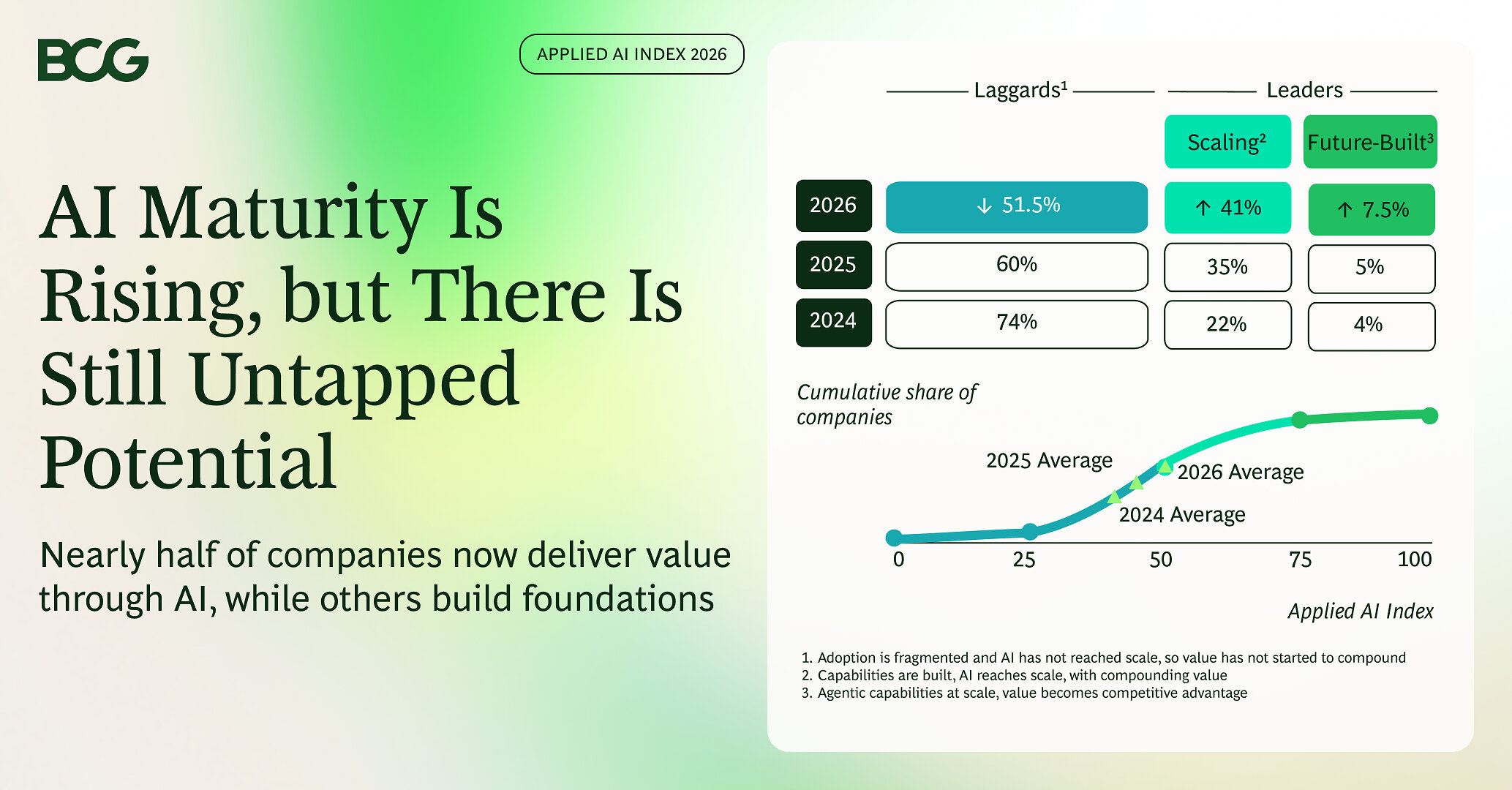
Nearly half of companies are now generating meaningful value from AI, according to Boston Consulting Group's Applied AI Index 2026, which is based on a survey of 1,330 CxOs and senior leaders. A year earlier, the firm said, only 5% of companies generated substantial value from AI.
The index classifies 7.5% of companies as future-built, a group that delivers 2.3 times the total shareholder return, 2.4 times the revenue growth and 2.8 times the EBITDA growth of laggards. A further 41% of companies are scaling AI and also outperforming, at 1.8 times the shareholder return of laggards. Together, the two groups make up nearly half the market.
AI spending has risen from about 1.7% of revenue in late 2025 to 3.3% now, and more than 80% of that spending sits outside enterprise IT, the report states. BCG describes AI as a core business investment rather than a technology initiative, and one it says many boards are underestimating.
The report identifies control, rather than capability, as the binding constraint. By 2030, 42% of companies expect to give AI agents real decision-making authority, while only 5% have the full set of controls in place today. Those controls include oversight and rollback gates plus security, audit and cost guardrails. Agentic AI is expected to account for about 40% of all AI value by 2030.
On staffing, companies expect a workforce reduction of roughly 10% to 15% by 2030, concentrated in coordination and middle-management layers. Seven in ten future-built and scaling companies are already retraining staff, and dedicated AI roles are projected to triple from 7% of the workforce in 2026 to 22% by 2030.