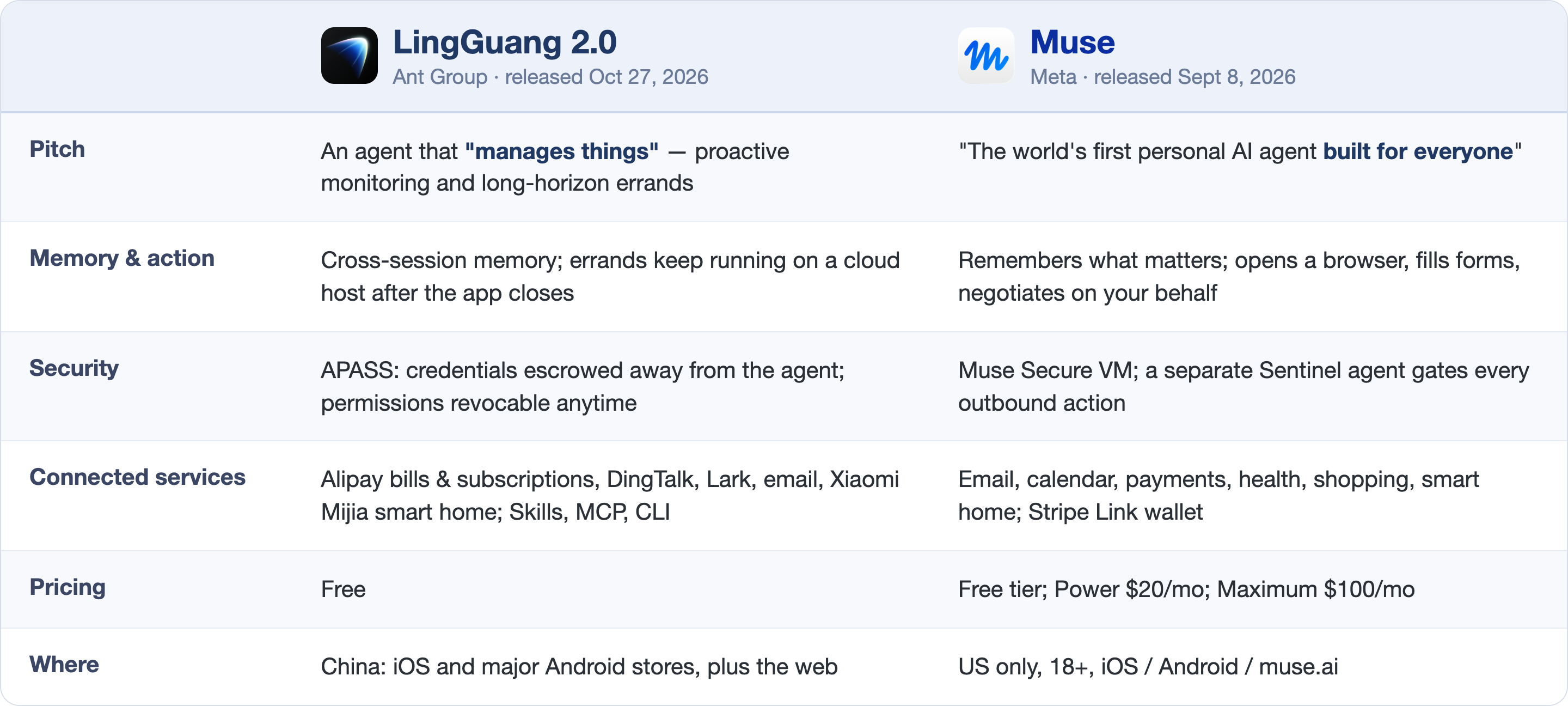
LingGuang 2.0 and Meta's Muse at a glance.
- What happened: Ant Group released LingGuang 2.0 on October 27, 2026 — its biggest upgrade since the viral November 2025 debut. The pitch shifts from an assistant you ask to an agent that remembers, watches and acts.
- The interface: a new Help Me Manage tab. Hand over an errand in one sentence; get a live status card, a scheduled watch plan, and alerts only at decision points.
- The reach: it reads Alipay bills and subscriptions, talks to DingTalk, Lark, email and Xiaomi smart-home devices, and calls external tools via Skills, MCP and CLI — with credentials escrowed under Ant's APASS security layer.
- The benchmark: Chinese media promptly dubbed it "China's Muse", after Meta's personal agent Muse — a US-only agent that had reached 2.5 million downloads within thirteen days of its September 8, 2026 launch.
- The market: LingGuang is free in China on iOS, Android and the web; Muse monetises at $20 and $100 monthly tiers.
- The pedigree: the 1.0 app cleared 1 million downloads in four days and 2 million in six, and users have since built more than 30 million Flash Apps on it.
From chat toy to life manager
LingGuang launched on November 18, 2025 as a multimodal assistant that answers through code — 3D models, charts, interactive maps and "Flash Apps", working mini-apps generated from a single sentence in about 30 seconds. Within two weeks users were already creating millions of them. Version 2.0 keeps all of that, and adds the missing dimension: time. Its errands run on an independent cloud host, so a task keeps updating after you close the app — for hours, days or weeks.
The core change is where AI steps in. Instead of waiting for a request, the agent — once asked and authorised — reads the services it is connected to, spots needs on its own, starts monitoring and follow-ups, and surfaces an alert only when the user must decide. Early hands-ons show the texture: concert-ticket on-sale times turned into to-dos, a gold-price tracker that fired on a 2 per cent drop, a family trip that flagged a ¥500-per-person fare drop and re-checked hotels overnight.
What the app actually shows
The shipping build centres on the Help Me Manage tab. A "Handed to LingGuang" feed shows each errand's live status and latest one-line briefing; a "More life ideas" shelf suggests things the agent can take over next — trip prep, fuel-and-charging logs, a weekly craft idea. The App Store subtitles the app "the personal assistant that gets things done".
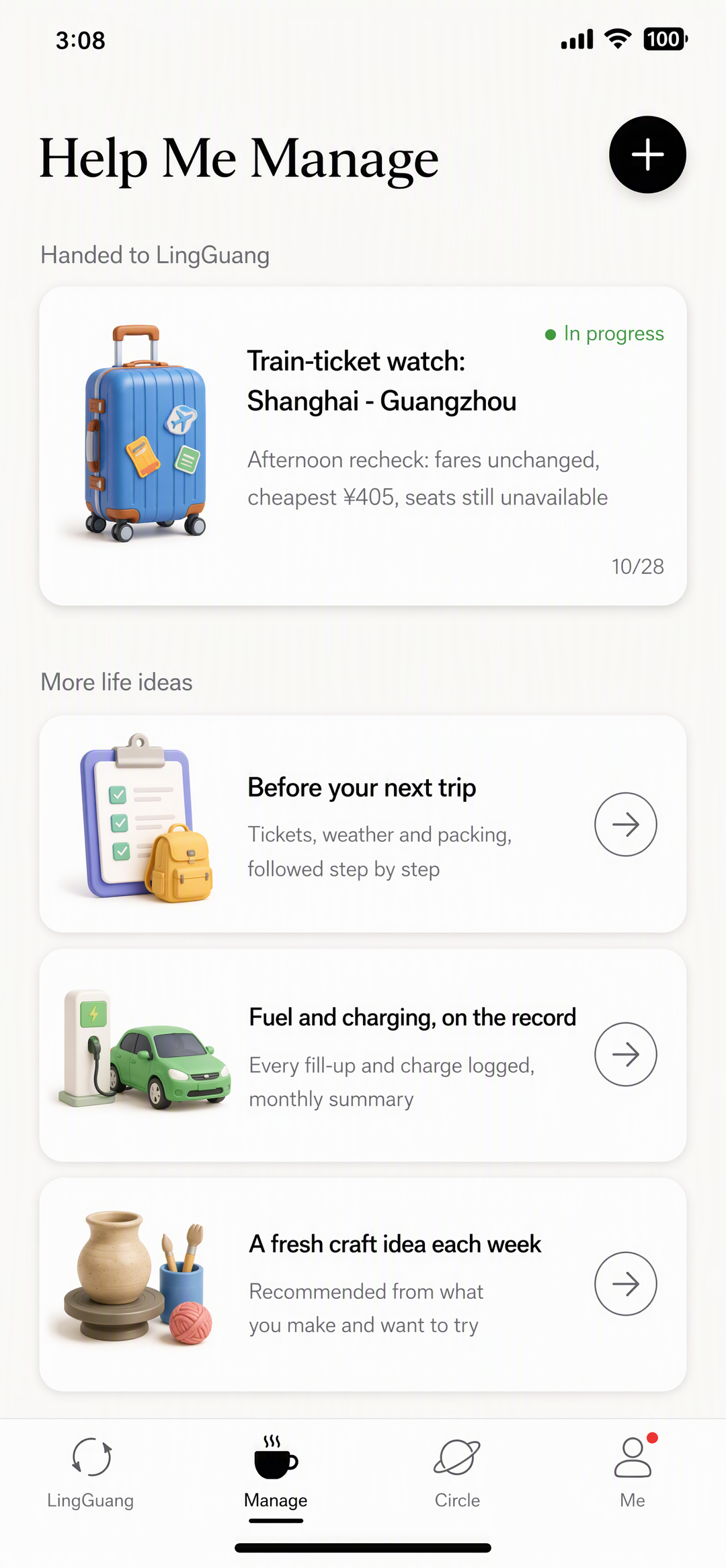
The Help Me Manage tab. (AI illustration, not an official screenshot)
Train-ticket watch. Holiday train seats sell out in waves, so the agent keeps a running brief: fare and seat status per train, which data source was queried, and the next scheduled check — then pings the moment seats appear. The same loop covers concert on-sales and airfare dips.
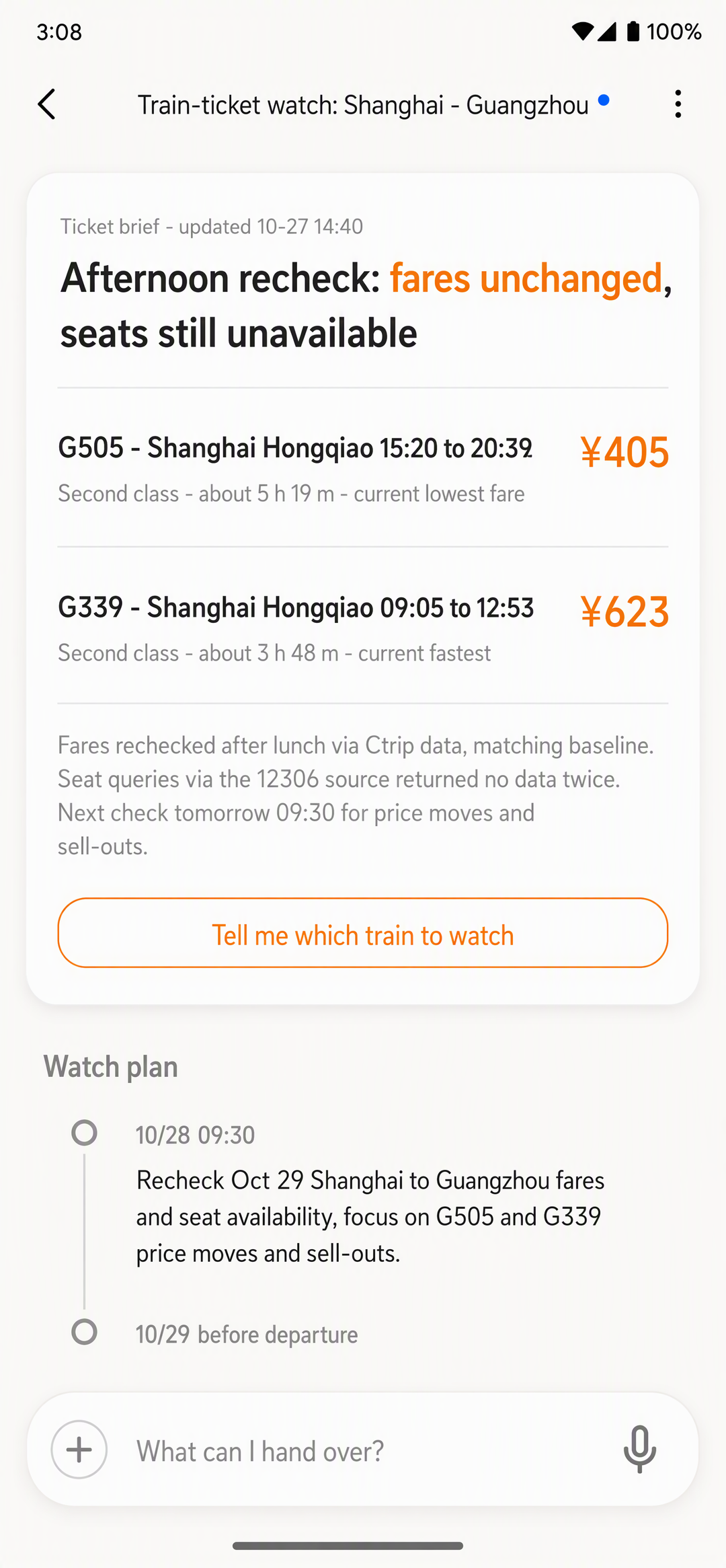
Train-ticket watch. (AI illustration)
Group-dinner venue. One sentence — six people, Saturday, a hotpot place everyone can reach — yields a compromise-location map and a shortlist ranked by rating, price and distance, ready to share into the group chat. Because 2.0 remembers preferences, next time needs no re-briefing.
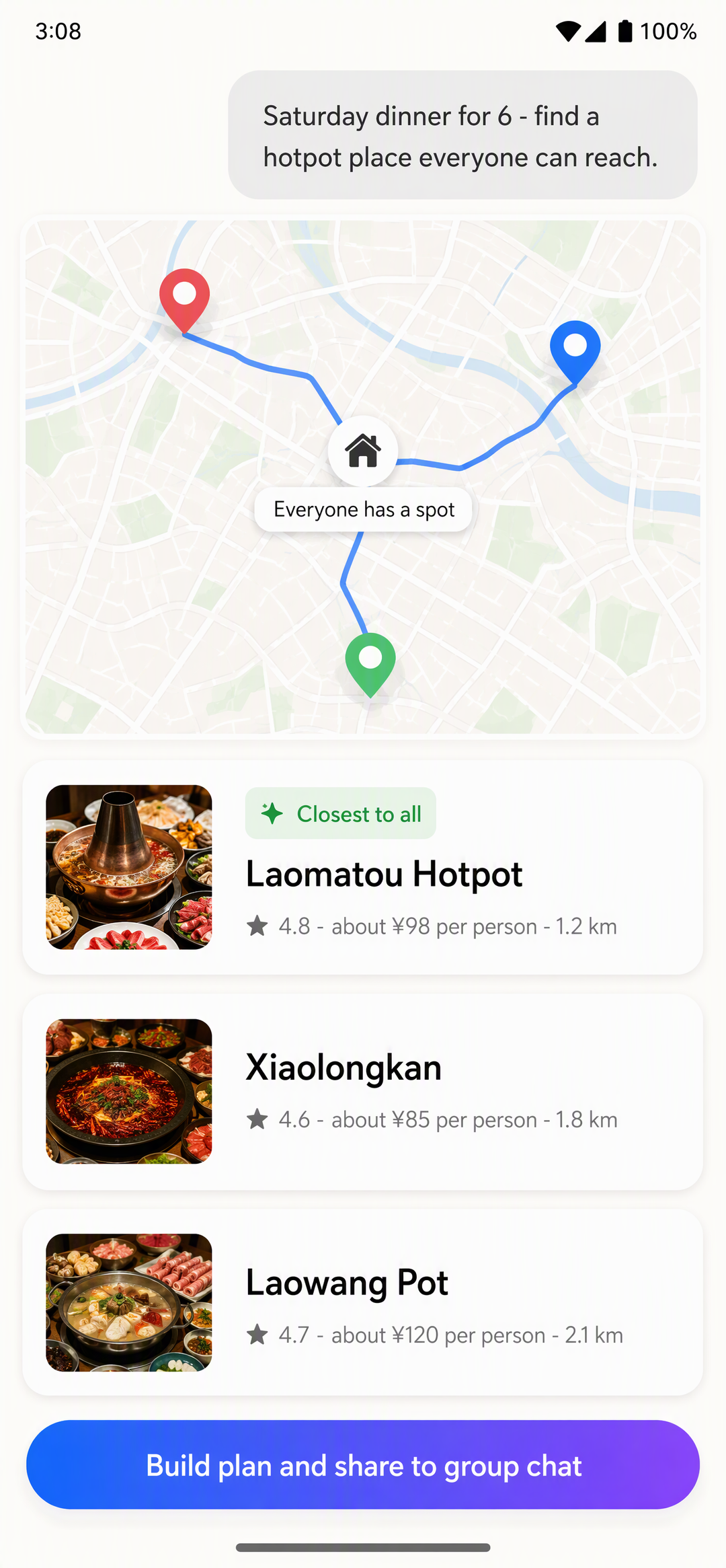
Group-dinner venue. (AI illustration)
Cinema and showtimes. For tonight's movie the agent sorts nearby cinemas by price or distance, flags the option that wins on both, and — once you pick — volunteers the detail humans forget: a departure reminder timed to traffic. Small task, but it is the 2.0 pitch in miniature: the AI does the noticing, you do the deciding.
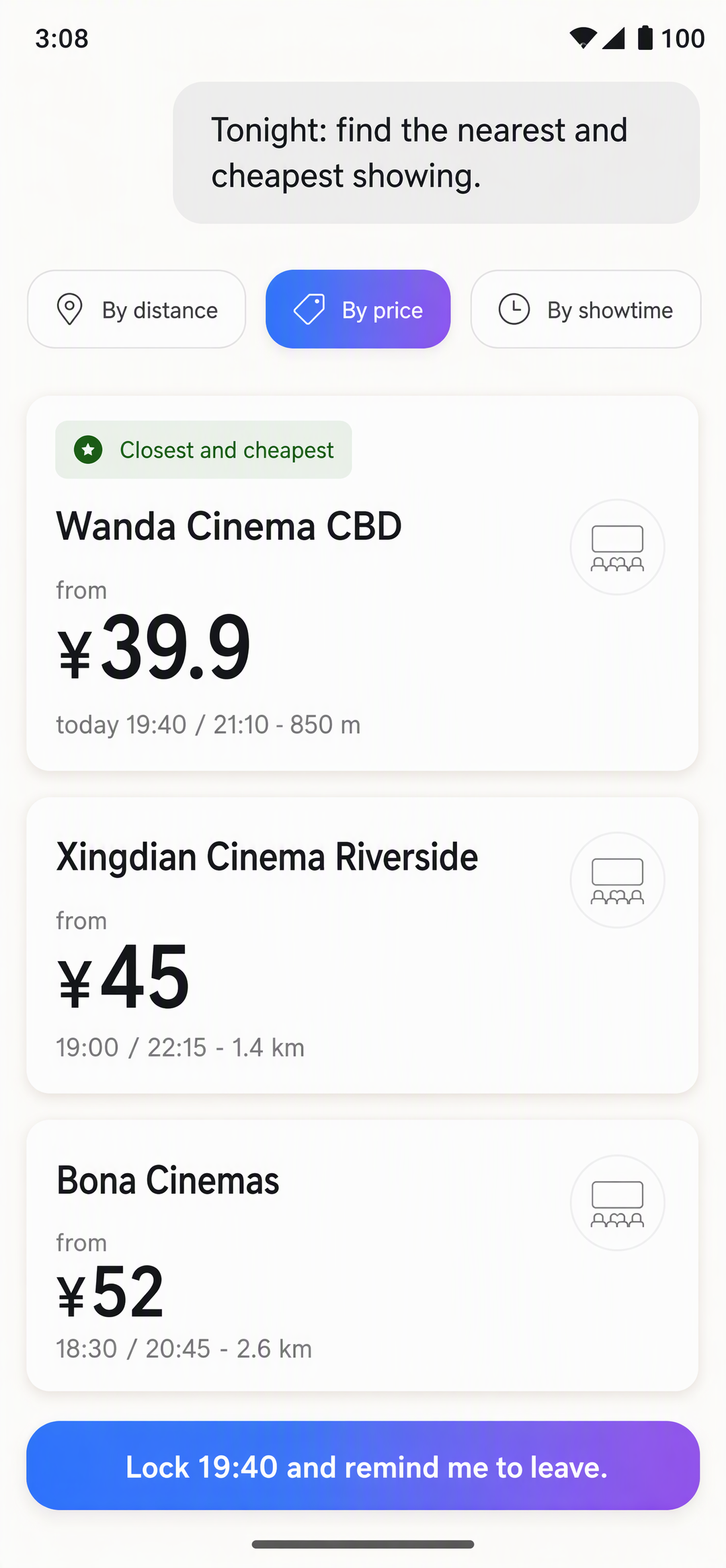
Cinema and showtimes. (AI illustration)
LingGuang 2.0 vs. Meta Muse
Meta launched Muse in the US on September 8, 2026, and briefly topped the App Store free chart. The two products converge on the same thesis — memory plus action between conversations — and diverge on ecosystem and monetisation. The graphic at the top of this piece sets the two side by side.
Why it matters
Several big Chinese internet companies are racing down the same road, making personal agents the consensus bet of autumn 2026 rather than one company's moonshot. The contested ground is shifting from model quality to trust and ecosystem integration: whose agent can plug into the services where life actually happens, hold permissions safely, and finish what it starts. Ant's bet is that agent-mediated payments and service fees inside Alipay's loop matter more than subscription revenue — which is why LingGuang is free where Muse charges $20 or $100 a month.
The fine print
No public benchmarks exist yet for this product class — task-completion rates, failure explainability and long-horizon reliability remain unmeasured everywhere, Meta included. Permissions are per-service and revocable at any time, but the real test is behavioural: whether users feel comfortable enough to keep handing over errands after the novelty fades.
Availability
LingGuang 2.0 rolled out free on October 27, 2026, in Chinese iOS and Android stores and on the web at www.lingguang.com. Proactive management activates only for the services and data a user explicitly connects; chat, Flash Apps and the multimodal tools from 1.0 all remain.
Note on images: the four phone screens in this explainer are AI-generated illustrations of LingGuang 2.0's documented feature flows, recreated in English for readability; they are not official screenshots. The comparison graphic is an original rendering of reported facts.