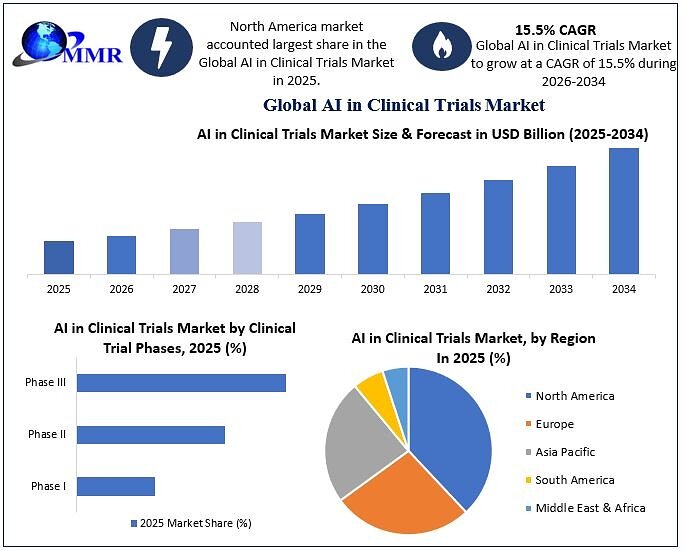
The global market for artificial intelligence in clinical trials was valued at USD 2 billion in 2025 and is projected to reach USD 7.32 billion by 2034, growing at a compound annual rate of 15.5% from 2026 to 2034, according to Maximize Market Research. The firm said its 2026 report on the AI in clinical trials market assesses trends, clinical research activity, AI adoption, patient recruitment, data analysis, safety monitoring, drug discovery, personalized medicine, trial-phase applications, end-user demand and competitive developments.
The market is segmented by trial phase, technology, application, end-users and region, the firm said. The trial phases covered are Phase I, Phase II and Phase III; the technologies are machine learning, natural language processing and deep learning; and the applications include patient recruitment, data analysis, safety monitoring, drug discovery and personalized medicine. Pharmaceutical companies, research institutes, CROs, hospitals and other end-users are listed as adopters.
Pharmaceutical and biotechnology companies are using AI for patient screening, cohort selection, trial design, large-scale data analysis, safety evaluation and treatment optimization, according to the firm, which said the technology can help researchers identify suitable participants, detect patterns more quickly and support more targeted clinical decision-making. North America leads the market on the strength of its healthcare infrastructure, a mature pharmaceutical industry, investment in AI research and collaboration between drug and technology companies; the United States remains the key regional market, while the UK, Germany and France are cited in Europe.
Asia Pacific is described as an emerging market led by China, India and Japan, supported by large patient populations and expanding pharmaceutical sectors, while South America and the Middle East & Africa remain developing markets. Barriers listed by the firm include data privacy concerns, regulatory compliance, data quality issues and the need for specialized AI expertise, along with the requirement that AI-generated insights rest on accurate, high-quality clinical data.