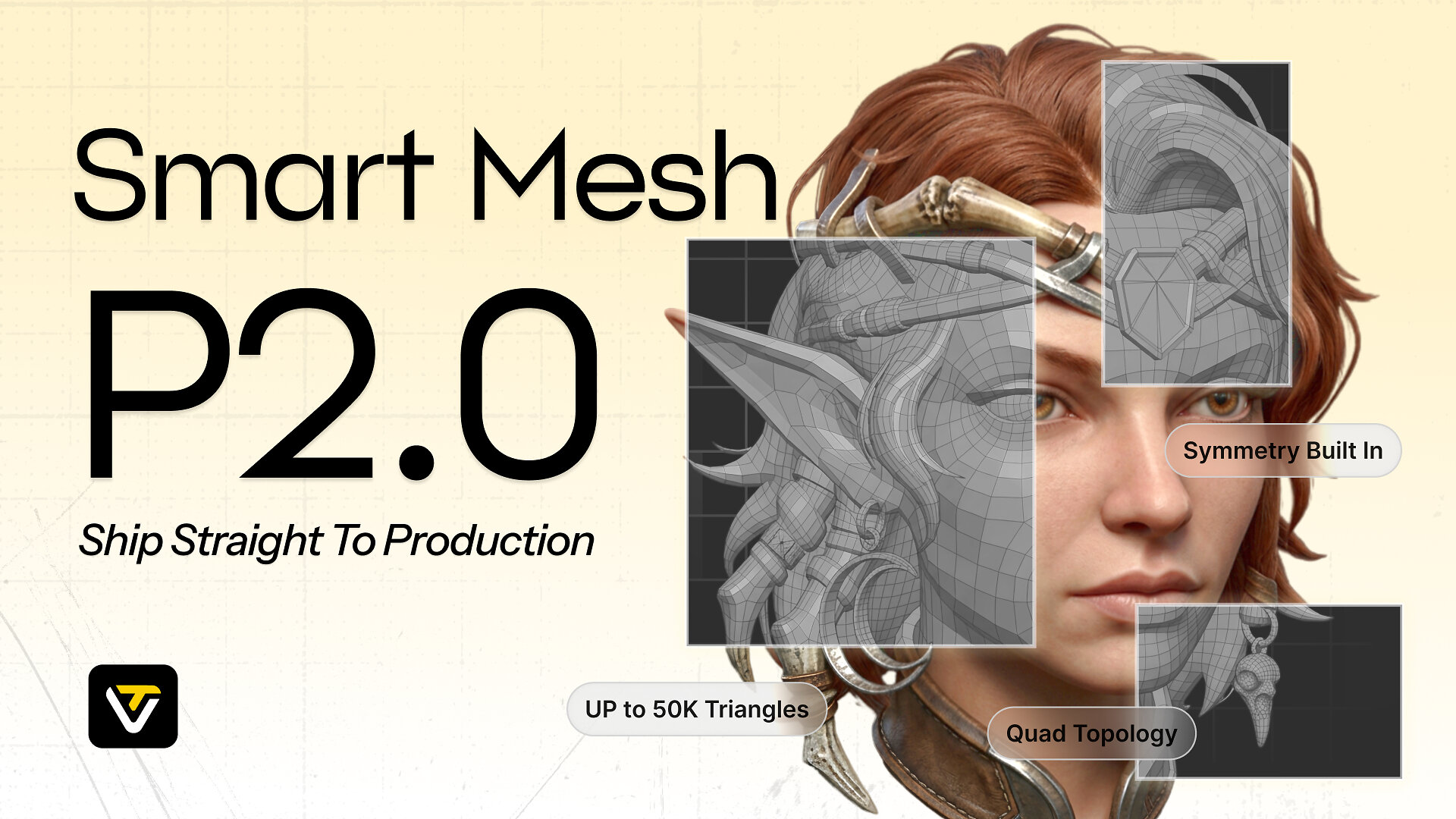
Tripo AI has released Tripo P2.0, a 3D-native foundation model that generates high-fidelity 3D assets with quad topology, the company said. It is an upgrade to Tripo Smart Mesh P1.0 and produces native quad meshes, an approach the company described as a first for the AI 3D industry. According to the release, the model allows creators to move AI-generated 3D content into production.
The official launch follows a P2.0 Preview in August and adds two features: generation of multiple versions from one prompt, and Mesh Edit. With a single prompt, the model can produce up to four versions of the same asset with different face counts, the company said. It supports triangle and quad topology, at up to 50,000 faces for the former and up to 25,000 for the latter.
Mesh Edit is intended to give creators direct control over results: they can select and regenerate any region of a mesh without changing the rest of the asset, rather than regenerating the whole asset. The model also provides front, back, left and right views of generated assets, and supports Smart UV, which unwraps assets into a 2D layout in one click for texturing and further editing.
Dr. Yanpei Cao, chief scientist of Tripo AI, said topology has been the barrier between AI-generated 3D and production, because game and film pipelines are built on quad meshes that AI previously reached only through slow and unstable retopology. He said P2.0 generates quad-dominant meshes natively, with part separation and edge flow of the kind an artist would lay out manually, and that the longer-term goal is models that understand, generate and interact with 3D environments.
The company said P2.0 is designed for games and interactive experiences, and is aimed at 3D artists, technical artists and game developers. It said the model is particularly suited to generating game characters; hard surface objects such as vehicles, props and buildings; and 3D assets at scale.