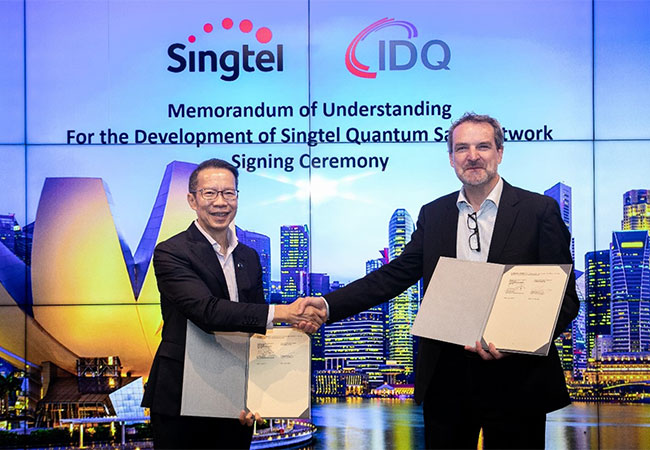
Singtel says it has been appointed by the Infocomm Media Development Authority to develop Singapore's first nationwide quantum-safe network for enterprises, in partnership with ID Quantique, and that the network is due to launch in mid-2024. The project sits inside the country's Digital Connectivity Blueprint, which sets a goal of being quantum-safe within ten years.
The network is to combine two distinct technologies. Quantum key distribution uses physics to distribute encryption keys and can reveal interception in transit; post-quantum cryptography is a family of software algorithms designed to resist attacks by quantum computers. Singtel will supply its managed network services and fibre, with designated exchanges acting as trusted nodes; under a memorandum, ID Quantique will contribute its key-distribution and quantum-safe key-management products. Ng Tian Chong, who heads Singtel in Singapore, and ID Quantique's chief executive, Gregoire Ribordy, both frame the work as preparing for a threat that has not yet arrived. The regulator's BizTech head, Ong Chen Hui, calls it Southeast Asia's first such infrastructure.
Why the two technologies are not the same thing
It matters that the release names both. Post-quantum cryptography is a software change that can be made across ordinary networks; quantum key distribution needs dedicated fibre and hardware and works between fixed points. A network that offers the first is a migration; one that offers the second is new infrastructure with its own cost and reach limits, which is why the two are often discussed together while being deployed very differently.
The announcement describes an intention to build, a partner and a date. It does not name an enterprise customer, a price, or the extent of coverage at launch — mid-2024 could mean one link or several. The threat itself is likewise a projection: the case rests on the judgement that today's encrypted traffic, recorded now, could be read later. That judgement may well be right; the point is that the release asserts the risk rather than measuring it.