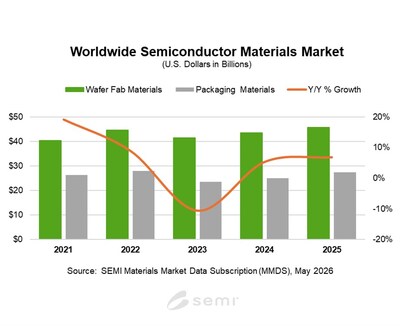
Revenue from semiconductor materials rose 6.8 per cent in 2025 to a record USD 73.2 billion, according to SEMI, the industry association that publishes the Materials Market Data Subscription. The figure covers two groups: the chemicals, gases and wafers consumed inside a fabrication plant, and the substrates and other materials used to package finished chips.
The split matters because the two move for different reasons. Wafer fabrication materials track how much silicon is being processed and how complex the process is. Packaging materials track demand for finished devices and, increasingly, for advanced packaging, which is how makers of artificial-intelligence hardware stack memory and logic together. The association attributes the growth to higher process complexity, demand at the leading edge, and continued investment in high-performance computing and high-bandwidth memory.
Reading a number whose base is the point
The detail is more useful than the total. Packaging materials revenue grew 9.3 per cent to USD 27.4 billion, led by substrates and bonding wire, where higher gold prices and demand for advanced substrates both contributed. Taiwan remained the largest consumer for the sixteenth year in a row, at USD 21.7 billion; China was second at USD 15.6 billion on double-digit growth, ahead of South Korea at USD 11.2 billion. Every region except Europe grew.
This is a trade body counting its own members' market, and it reports revenue, not volume. A record measured in dollars can be a price effect as easily as a production effect, and the release offers no tonnages to separate the two. The regional figures are the honest part of the picture, because where materials are consumed says where the fabs are actually running. Whether 2025 was a year of more wafers or more expensive ones is a question the total alone cannot settle.