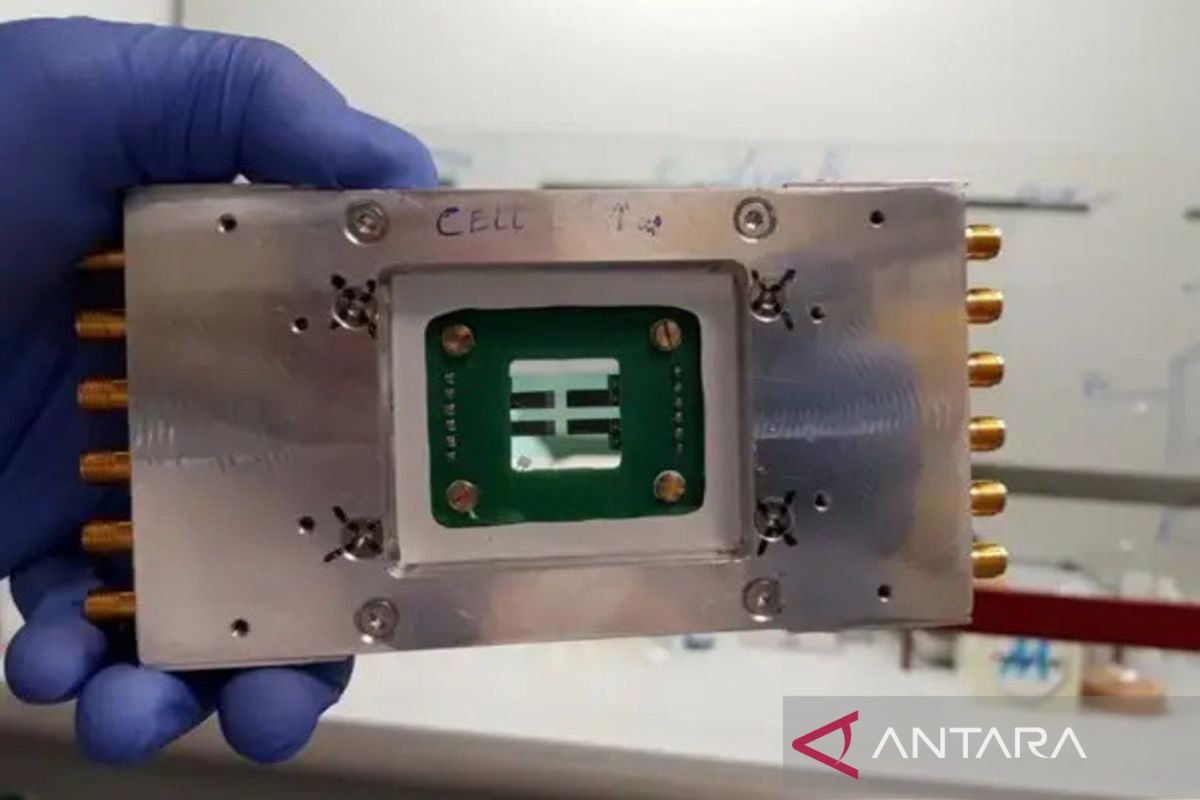
Indonesia's National Research and Innovation Agency is developing a solar cell that does not use silicon as its light absorber. Instead, the device uses part of a bacterium's photosynthesis machinery — a protein complex known as reaction centre-light-harvesting 1, taken from the purple bacterium Rhodobacter sphaeroides — as the layer that captures sunlight.
In a plant or a bacterium, photosynthesis absorbs light and uses the energy to move electrons, separating charge across a membrane. That is, in outline, what a solar cell does too: light is absorbed, charge is separated, and the separated charge is drawn off as current. The bacterial complex is efficient at this and, its users argue, unusually good at keeping the separated charges apart — which is why the research group thinks it can serve as a cell's absorbing layer. The organisms are not harmful to people, the team notes.
Where the biology ends and the panel has to begin
According to Tulus, a researcher at the agency's Research Center for Nanotechnology Systems, the group builds the device by combining the protein with semiconductor layers, and collects the electrons through a layered electrode of indium tin oxide, zinc oxide and a fullerene, with molybdenum oxide and silver on the other side. The work is described as a third-generation, or bio-solar, cell, appealing because it can be processed at lower temperatures and uses plentiful materials rather than scarce metals. The study is a collaboration with the University of Bristol and Vrije Universiteit Amsterdam.
Bio-photovoltaic cells sit firmly in the laboratory. A protein that works in a beaker has to be kept intact for years on a roof, and no efficiency, lifetime or cost figures were given for this device; the researcher's own stated aim is to raise the current the cell produces. The question that would decide whether any of this leaves the bench — whether a biological light absorber can survive the weather — is the one the experiment is not yet built to answer.