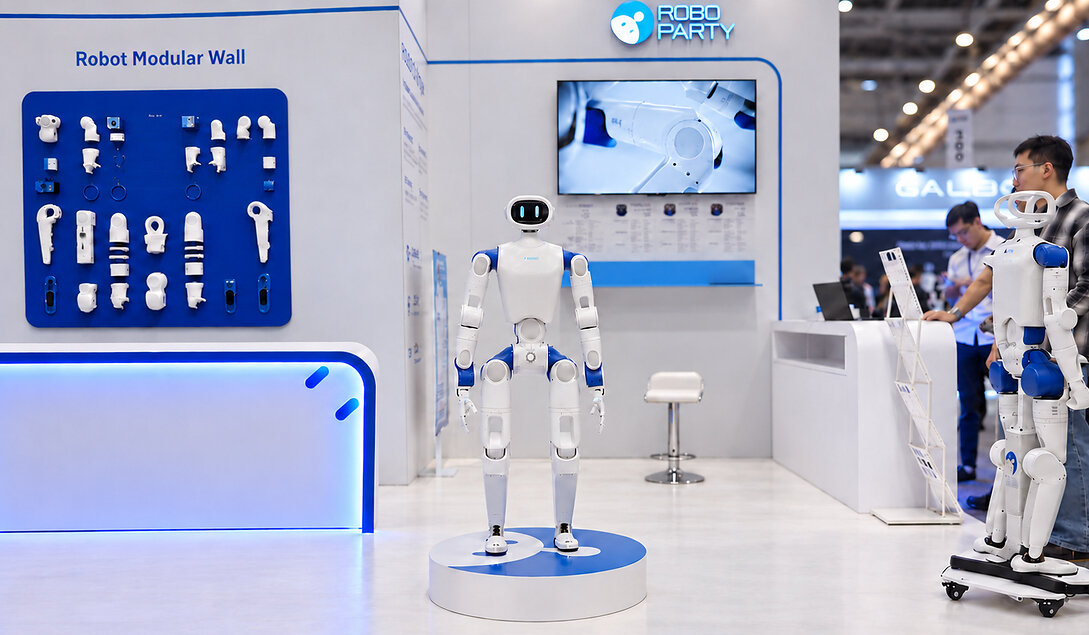
On September 28, 2026, RoboParty unveiled RP1 (ROBOTO 01) at IROS 2026, the robot's first public showing. RP1 follows RPO (ROBOTO ORIGIN), the fully open-source humanoid project the company launched in January 2026 and says has more than 2,500 stars on GitHub.
The company said RP1 is the world's first full-stack open-source bipedal humanoid robot, built for researchers, educators, robotics developers and embodied AI teams. At its IROS booth, visitors were invited to push and kick the robot in a demonstration called "Kick Me"; RP1 adjusted its posture and recovered its balance, which the company said tested its dynamic stability, body performance and system-level robustness.
PartyOS, RoboParty's open research and development foundation for humanoid robotics, supports the robot. It integrates UFO, a training framework that discovers humanoid motor skills through unsupervised reinforcement learning, covering skill transitions, disturbance recovery and fall recovery without predefined motion trajectories. The company said RP1 reaches a peak joint torque of up to 160 N·m using in-house Romomo actuator modules and a real-time motion-control system, and that it combines the robot body, actuator modules, low-level control and embodied AI algorithms in one system for continuous joint validation.
RoboParty said full-stack open source means more than releasing mechanical files. It plans to progressively open its motion-control systems, simulation environments, SDKs, training tools and the PartyOS development foundation, so developers can take part from hardware and low-level control through to model training and deployment. Yi Huang, the founder, said humanoid robots should not be closed systems that only a small number of teams can build while others can do little more than watch.
The company said RP1 draws on RPO's validated open-source robot body and workflow, Romomo actuator modules and the RP Hand, with PartyOS evolving across humanoid locomotion, perceptual interaction, whole-body manipulation and autonomous intelligent humanoids. Core team members studied at Tsinghua University's Yao Class, Peking University's Zhi Class, Harbin Institute of Technology, Stanford University, Carnegie Mellon University and Zhejiang University, among other institutions. RoboParty said it has built a community of more than 5,000 developers and will announce further details of RP1's open-source roadmap in October 2026, with broader software and hardware releases and a mass-production program later in the fourth quarter.