Robbyant, the embodied AI company within Ant Group, said on 27 November that it had open-sourced LingBot-Map 2.0, a streaming 3D reconstruction model, and LingBot-Navi, a navigation model built on it, releasing code, model weights and a dataset of 511 real-world scenes.
The pair addresses two bottlenecks in robot mobility. Over long distances, maps accumulate drift that external correction tools never feed back into a model's internal memory; and navigation models treat every task as new, sending robots to re-explore space already mapped. LingBot-Map 2.0 corrects its own memory as it runs, and LingBot-Navi carries what it learns between missions, according to the company.
The mapping model builds on LingBot-Map 1.0, released in April 2026, and adds native error correction during inference, removing the need for external place-recognition modules or pose-graph optimisation backends. Its mechanism, Geometric Context Reshaping, is described as inspired by memory reconsolidation in the brain: it reuses local geometry already extracted and realigns historical memory without re-encoding images.
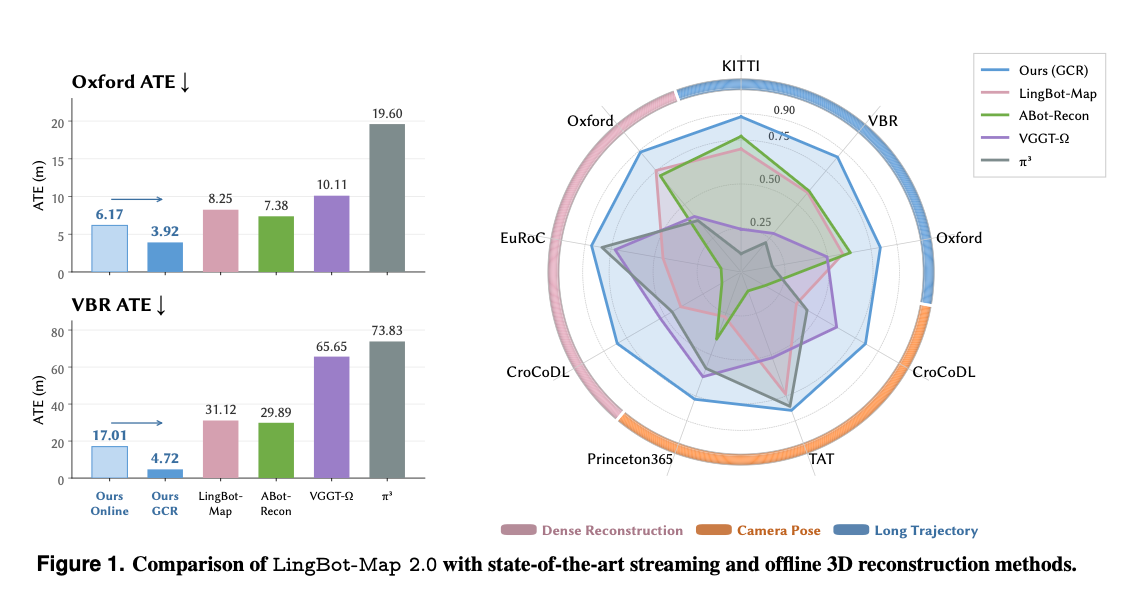
LingBot-Map 2.0's trajectory error against streaming and offline reconstruction methods, left, and across nine public benchmarks, right.
In an urban trajectory test covering 5.2 km and nearly 19,000 frames, average trajectory error fell from 31.12 metres in version 1.0 to 4.72 metres, a reduction of nearly 85 per cent, against 9.98 metres for the best external loop-closure method. The model placed first on three dense reconstruction benchmarks, CroCoDL, EuRoC and Oxford, according to the company.
A map that outlasts the task
LingBot-Navi keeps rather than discards the map between tasks. Retaining object and location data, it plans a direct route from a natural-language command without redundant exploration, and each operation sharpens its understanding of the environment, which the company says steadily raises execution speed. It can run on-device, keeping commands and scene data local.
On the GOAT-Bench benchmark, in simulations where LingBot-Navi selects targets and a simulator executes the movement, it reached a 68.60 per cent success rate on one subset, 10.36 percentage points above the best of six comparison methods. Swapping only the mapping engine, from version 1.0 to 2.0, raised navigation success by 4.15 and 2.35 percentage points without retraining the navigation model, which the company presents as evidence that better maps alone lift task completion.
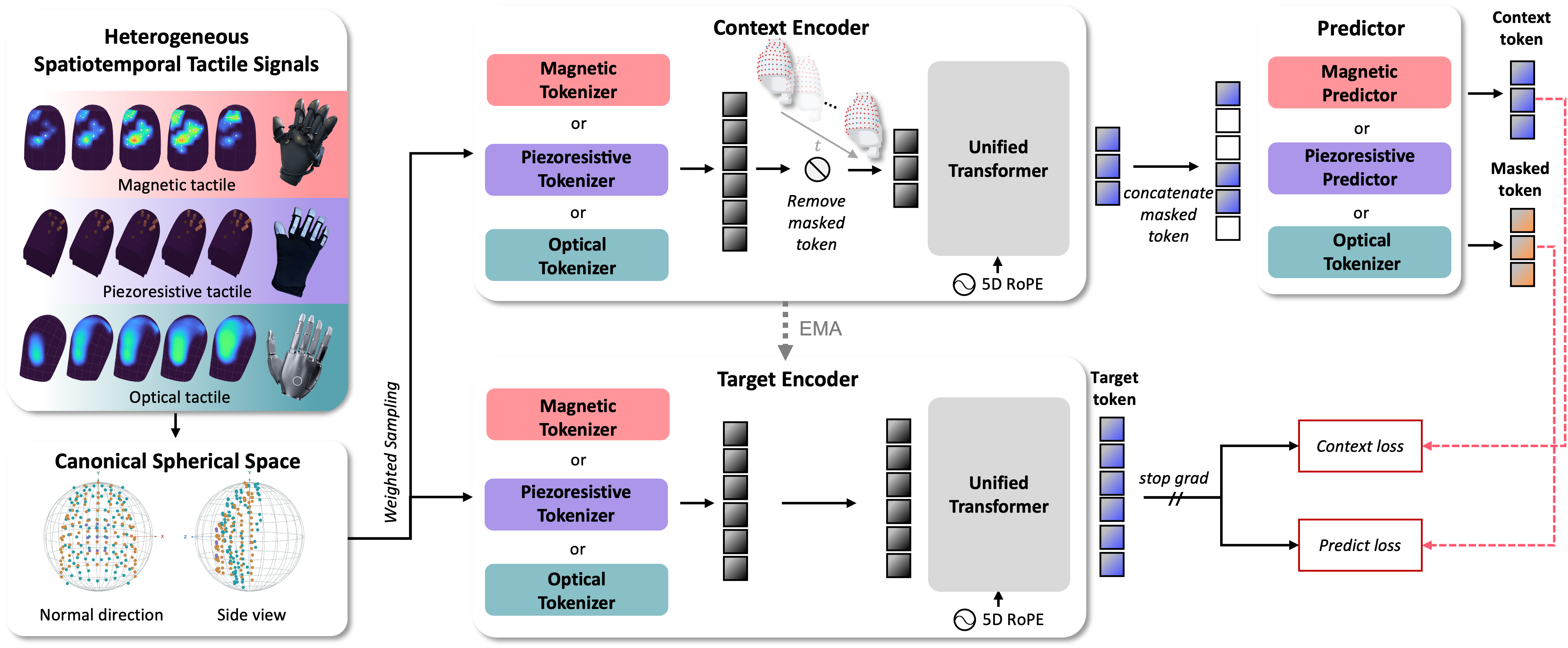
The release sits beside LingBot-Touch, the tactile model Robbyant open-sourced on 10 November, in the company's push toward what it calls a universal embodied AI brain. The figures are Robbyant's own, from public benchmarks and simulations, and the release names no commercial deployment of either model. How far the gains travel into a working warehouse or a street full of people is the question the benchmarks cannot answer.