Researchers at Seoul National University of Science and Technology have developed a token-management method for long-context AI models that they say can be added to existing systems without retraining or architectural changes. The work was led by Professor Hyun Kim with Dahun Choi and Huibeom Kang in the university's Department of Electrical and Information Engineering. Kang, the paper's first author, is now a machine learning researcher at ENERZAi.
Keeping a rough picture
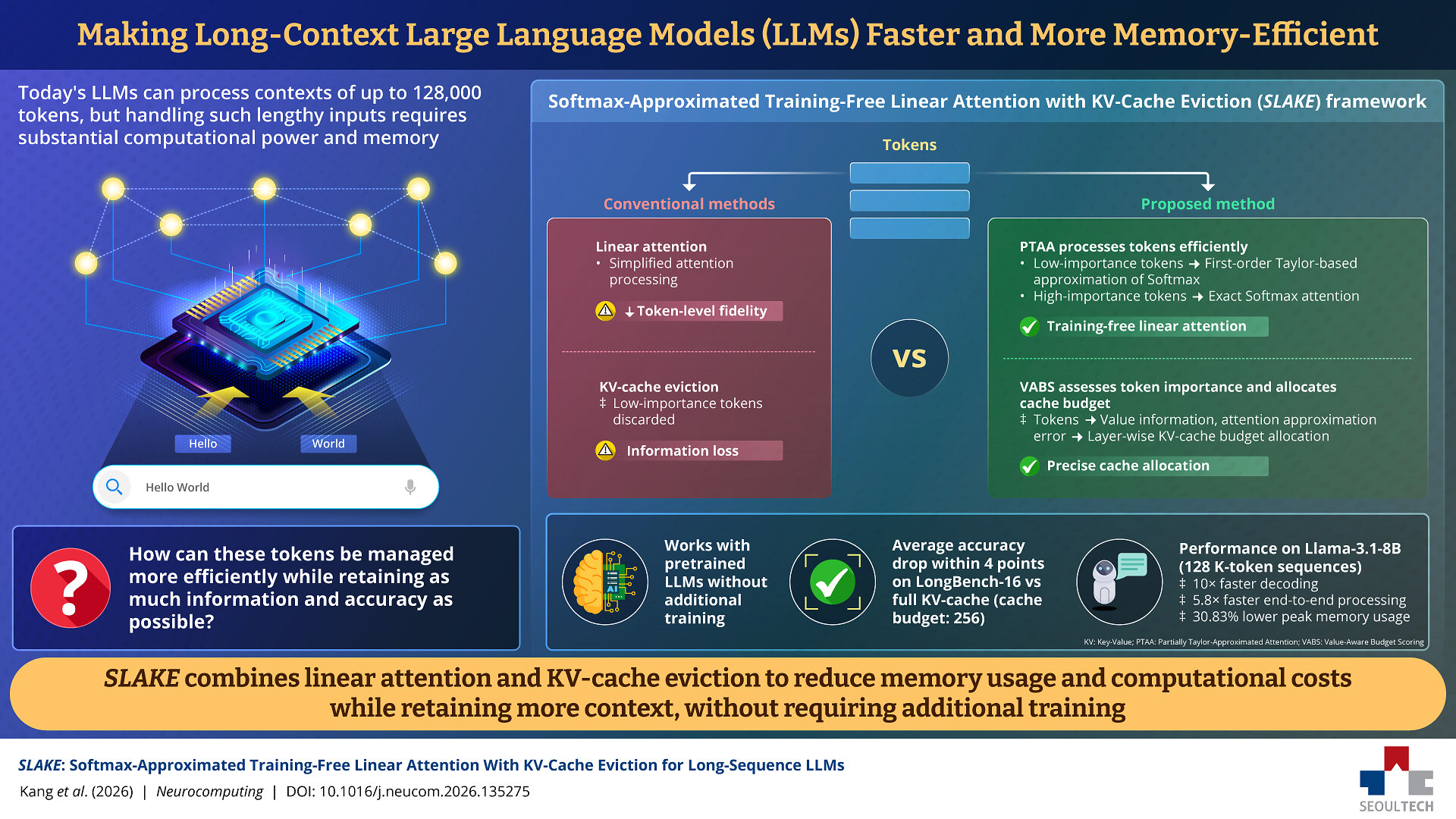
The method, called SLAKE, keeps an approximate representation of the tokens a conventional system would discard while processing the most important ones at full precision, the university said in the release. It combines two components. Partially Taylor-Approximated Attention uses a Taylor-based approximation to simplify attention calculations for less important tokens while key tokens keep standard calculations. Value-Aware Budget Scoring decides which tokens stay inside a limited memory budget, based on how much each contributes to the final response.
Speed and memory figures
Tested on a Llama-3.1-8B model given 128,000-token inputs, SLAKE produced responses up to ten times faster, raised overall processing speed 5.8 times and lowered peak memory use by 30.8%, according to the researchers. On the LongBench-16 benchmark, average accuracy stayed within four percentage points of a model with full memory.
Journal publication in January
The paper was made available online on Oct. 1, 2026, and is scheduled for Volume 709 of the journal Neurocomputing on Jan. 14, 2027. Kang said that retaining a rough but useful picture of the whole context, rather than losing parts of it outright, means far less information is lost than with conventional eviction while memory use stays small and fixed. He said that because such methods need no retraining, the gains can be applied to existing models immediately, making capable AI affordable for small businesses, schools and individuals rather than only large technology companies. The university said the efficiency gains could make AI services faster and cheaper and allow them to run privately on smartphones and smart-home hubs.