What MemTensor released
MemTensor has released and open-sourced MemT-1.0-Pro, a memory-native model it developed jointly with NVIDIA, the company said. The model has 554 billion total parameters, of which 59 billion are active, and it follows the earlier Nano and Flash releases. The company said the NVIDIA work covered model adaptation, operator optimization, discussion of training methods and review of experiments.
Backbone and memory design
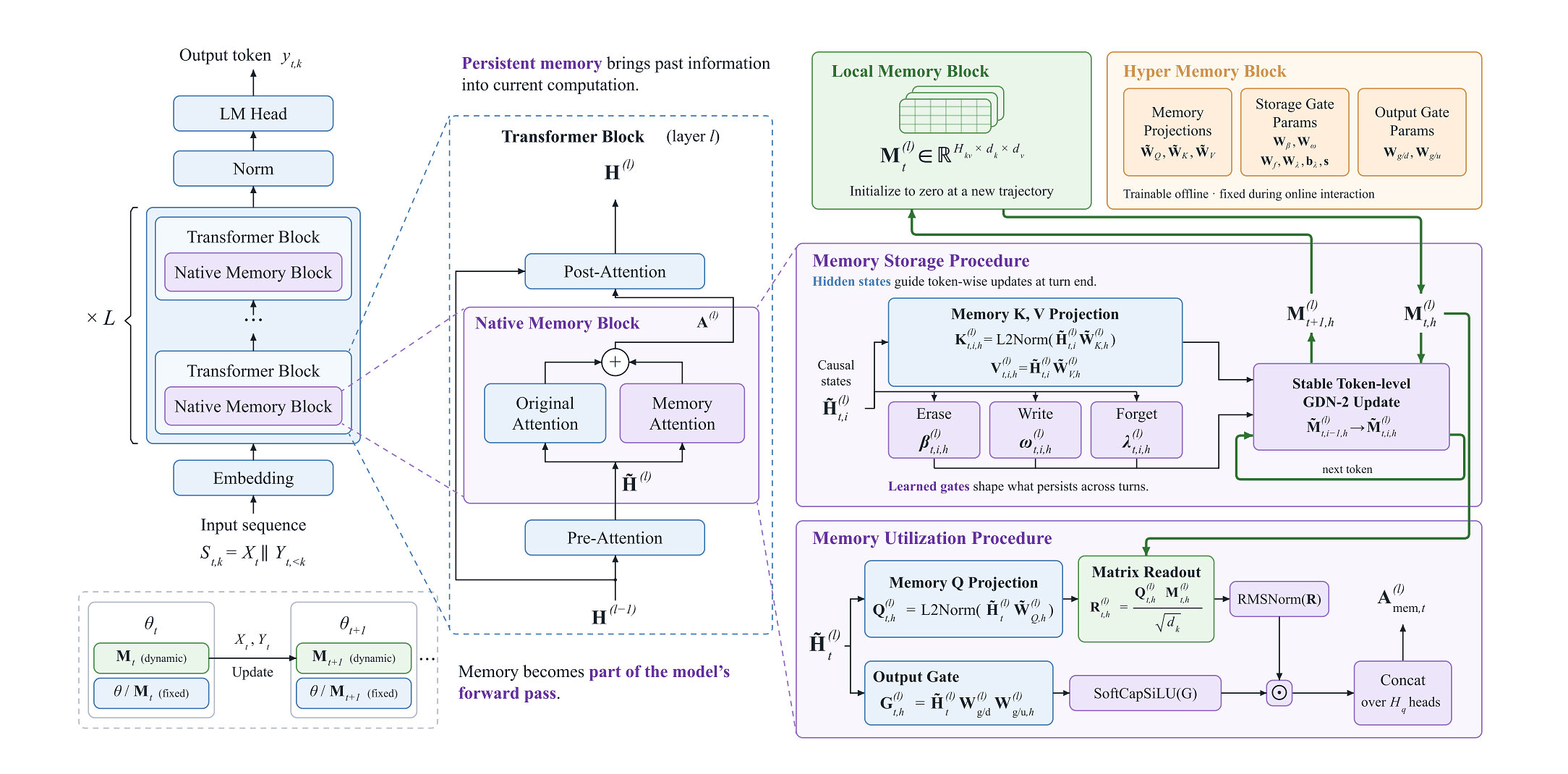
MemT-1.0-Pro uses NVIDIA-Nemotron-3-Ultra-550B-A55B-BF16 as its backbone and was trained on NVIDIA's Megatron-Core and Megatron Bridge infrastructure. Its architecture pairs a dynamic local memory, which holds information gathered during an interaction, with trainable hyper-memory components that learn to write and read that information. Memory is built into model computation, so storing, updating and retrieving historical information are learned capabilities rather than add-ons. During online interaction the backbone and the trained memory-processing weights stay fixed, and the model reaches past information through dynamic memory states without keeping the original text in the query context; after each interaction a storage procedure updates those states using a stabilized token-level mechanism based on Gated DeltaNet-2. Training ran in two stages, continued pre-training followed by post-training that distils from a full-context teacher.
The benchmark numbers
In the technical report, MemT-1.0-Pro scores 41.80 on BEAM-1M against 37.04 for MemT-1.0-Flash, a gain of 4.76 points, and 23.87 on MemoryAgentBench against 17.36, a gain of 6.51 points. It averages 53.08 across 11 memory benchmarks, which the release describes as the highest among the parametric-memory methods evaluated in the report. The company noted that Flash and Pro use different backbones and configurations and that improvements vary across benchmarks, and said strong textual-memory systems remain ahead on some evaluations.
What it is aimed at
MemTensor ties the work to agents that run extended workflows, where it says memory has to do more than recall isolated facts — holding earlier requirements, recognizing updated decisions and applying information built up over several interactions. The company said further application testing is needed to establish how the benchmark gains translate into end-to-end task performance, and that memory fidelity, selective retention and query-dependent readout remain central to further research. Developers and researchers can explore the model on Hugging Face.