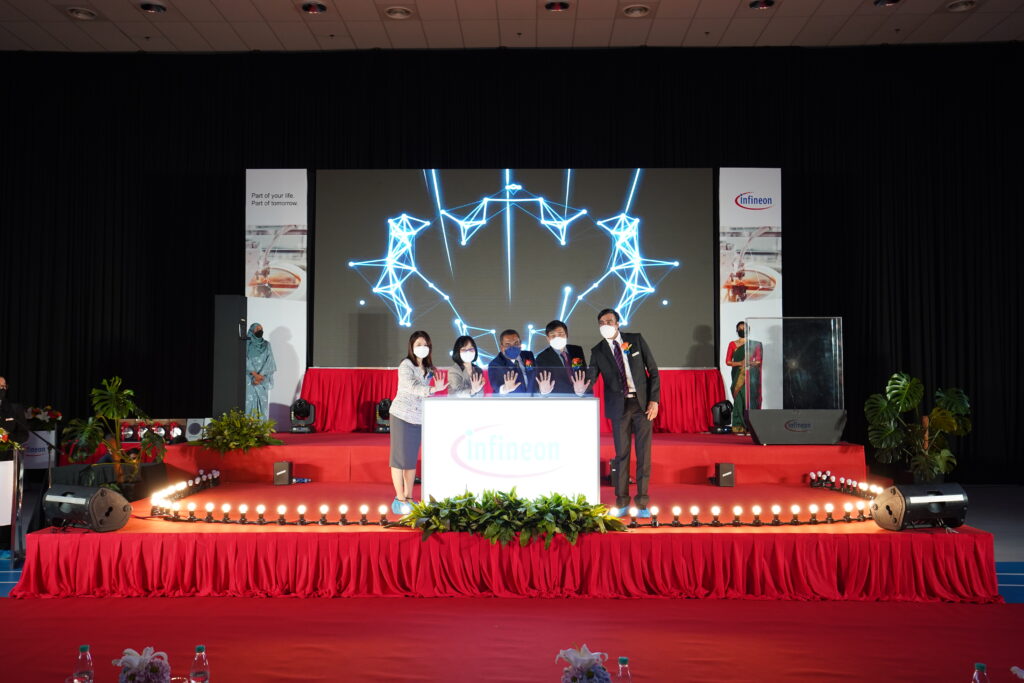
Infineon Technologies has laid the foundation stone for a third wafer fab module at its Kulim site in Kedah, Malaysia, an investment the company puts at more than RM8 billion. The module will add capacity for power semiconductors, particularly wide bandgap devices based on silicon carbide and gallium nitride, and construction is expected to be completed by the third quarter of 2024.
The ceremony was officiated by the Chief Minister of Kedah, Muhammad Sanusi Md. Noor, and attended by executives of Infineon Kulim and the Malaysian Investment Development Authority.
A cost now, a projection later
Infineon's chief operations officer, Rutger Wijburg, says the module will generate an additional EUR 2 billion in annual revenue once fully equipped. That is the company's own projection, and it is stated for a plant that is not yet built, in a market whose prices move. The RM8 billion is a committed cost; the EUR 2 billion is an aspiration, and the two are not comparable until the fab is running at volume.
The company says the module will create 900 high-value jobs. Malaysia's investment agency notes that the country attracted RM18.6 billion, or about USD 4.4 billion, in approved electrical and electronics investment in the first quarter of 2022 alone, a reminder that a single fab, however large, is one line in a national total the agency is trying to grow.
Wide bandgap chips are genuinely in demand from electric vehicles and renewable energy equipment. Whether that demand holds until 2024, when this module starts producing, is what the investment is betting on. Infineon has manufactured at Kulim since the hi-tech park was established in 1996, and the Chief Minister, speaking at the ceremony, described the park as a growing home for capital-intensive manufacturing — the case every state makes for the next fab.