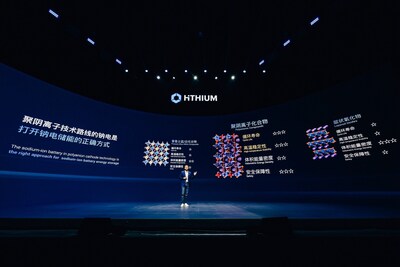
Hithium launched a sodium-ion battery, the N162Ah, at its Eco-Day event in Beijing on 12 December, describing it as the first sodium-ion cell designed specifically for utility-scale energy storage. The company says the cell is available for sampling now and that production at gigawatt-hour scale is planned for the fourth quarter of 2025.
The cell pairs a sodium iron ortho-pyrophosphate cathode with a hard carbon anode. Cathode chemistry is where sodium-ion designs differ most: Hithium argues that layered oxides and Prussian-blue compounds have struggled with cycle life and high-temperature stability, and that the polyanion route trades some energy density for better round-trip efficiency, cold-weather behaviour and charge rate — the qualities a fixed installation needs.
A projection is not yet a result
The numbers Hithium offers are measured, and they are also early. At 25 degrees Celsius and a 1P rate, it reports 94.2 per cent capacity retention after 4,000 cycles, from which it projects a life of more than 20,000 cycles down to 70 per cent of original health. At 45 degrees it reports retention of 92.5 per cent after 4,000 cycles and says cycle life improves more than fivefold. The cell passed the safety tests listed in the GB/T 44265 standard for utility-scale storage, and the company says it loses no capacity after six months stored at zero volts.
A life of 20,000 cycles is an extrapolation from the first 4,000, run on the maker's own benches. A grid-scale battery has to last a decade or more in the field, which is exactly why the gap between a projection and a result matters here. Whether sodium-ion displaces lithium in stationary storage will be settled by the cost per delivered kilowatt-hour over those years, not by a cell launched at a company event.