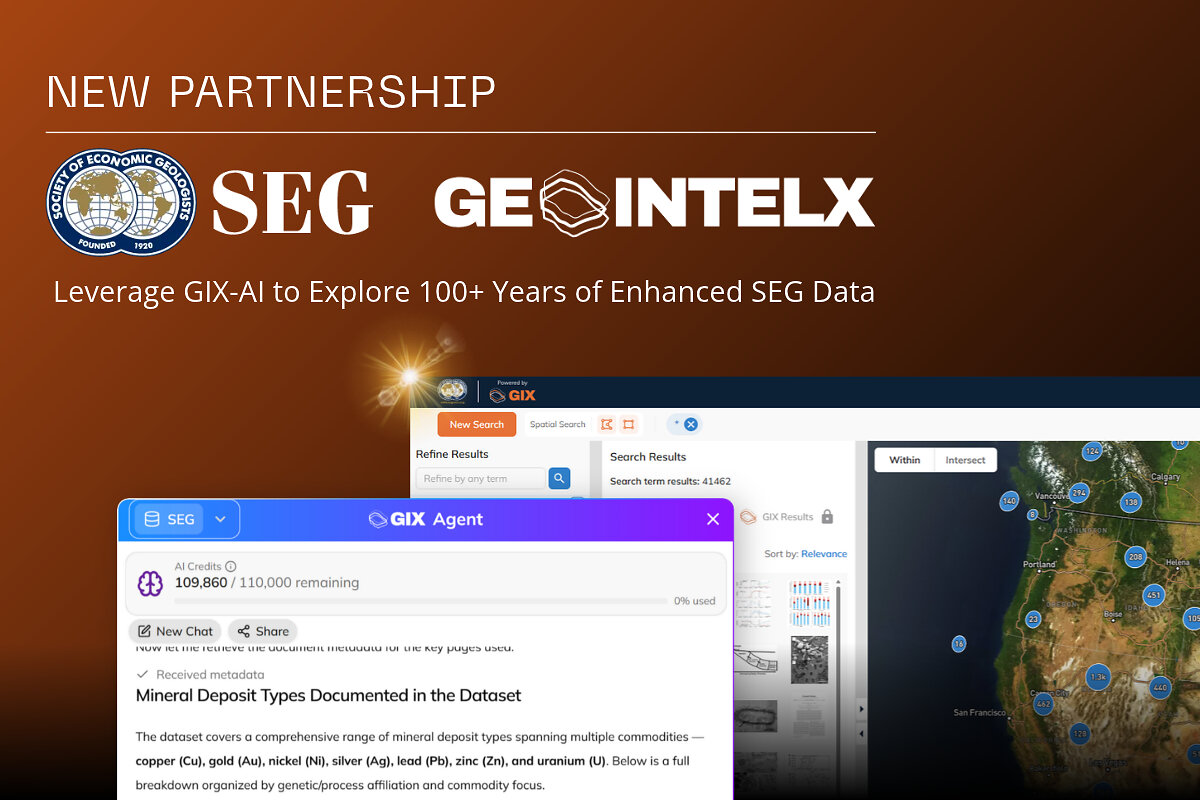
GeoIntelX announced a strategic partnership with the Society of Economic Geologists that will integrate more than 100 years of SEG publications into GIX, its geospatial intelligence platform, the company said. The material to be added includes technical research papers, maps, figures and geological datasets.
Geoscientists and executives using GIX will be able to put complex geological and exploration questions to trained AI agents about specific spatial regions they delineate on a map, according to the company. The answers returned are intended to combine a century of SEG knowledge with public datasets, the users' own proprietary data and AI computation, and to be delivered securely. Rather than reviewing thousands of reports and publications by hand, teams will be able to query geological models and basins and receive detailed answers with references and explanations, the company said.
The collaboration will introduce a dedicated SEG experience inside GIX for SEG members, offering AI search, geospatial exploration and advanced geological querying. Initial member access in Phase 1 will run through a credit-based system, with expanded access and options in Phase 2. The official launch is planned for the SEG 2026 Conference in Salt Lake City in September 2026.
Gilad Hoshen, chief executive and co-founder of GeoIntelX, said the addition of the SEG database puts the company on track to hold one of the most comprehensive datasets in the world, and that it is working with SEG to give members direct access to the toolset and to integrate it with their own data and workflows securely. Jennifer Craig, executive director of SEG, said the partnership is meant to make the society's publications more accessible, searchable and actionable for members and the wider industry through a map interface.
The announcement follows a partnership between NewMed Energy and GeoIntelX to accelerate natural gas exploration and production using the GIX platform. The company said structuring, enriching, geotagging and connecting SEG's content with its AI and geospatial technologies will let exploration teams and researchers accelerate technical evaluations and reporting, reduce exploration risk and improve the discovery process for critical minerals and energy resources.