
On August 10th, CNBC put seven executives on one live panel: Jensen Huang of Nvidia, Larry Fink of BlackRock, David Solomon of Goldman Sachs, Jon Gray of Blackstone, Bruce Flatt of Brookfield, Jim Zelter of Apollo and KKR's digital-infrastructure chief. The occasion was an announcement with no recent precedent: memorandums of understanding between the world's most valuable chipmaker and six of its largest financial institutions — Apollo, BlackRock, Blackstone, Brookfield, Goldman Sachs and KKR — to establish "independent compute financing platforms" designed to "mobilize over $500 billion of third-party capital" for AI infrastructure "over time". Huang called the moment historic. "This is really the first time that technology chips have become an investable asset class," he said. "They're productive, they're long-lived, they're fungible, they're flexible," he told CNBC. Larry Fink compared the project to the creation of mortgage-backed securities in the 1970s, calling it the "next future for financial engineering".
The idea is simple enough. A data-centre operator buys Nvidia systems, leases the compute out, and the expected lease cash flows — not the silicon — become the collateral for loans and, eventually, asset-backed securities. GPUs are to be underwritten the way mortgage lenders look at homes — as a "financeable asset class", as Jon Gray put it in the CNBC interview. David Solomon described the goal directly: the aim is "to create a market for credit backed by NVIDIA compute". Each gigawatt of AI factory costs "something like $50, $60 billion", Huang told CNBC's Becky Quick — sums that only the bond market can carry.
The market's first verdict on the new asset class was to sell it: Nvidia's shares fell roughly 3 per cent that day, erasing about US$60 billion of market value, as Barchart noted. Three months later, the Wall Street Journal checked the ledger and found that Wall Street "hasn't put up a dime". The memorandums reportedly run only a few pages, fix a target size and a range of potential customers, and leave every credit decision to case-by-case underwriting; no institution has committed capital, and Huang had originally pushed for a programme of up to US$1 trillion, per the Journal's account. Nvidia's own release had flagged the escape hatch in its final line: "These partnerships remain subject to execution of the final agreements".
Nothing has closed yet, but the announcement revealed the underlying condition. The world's most profitable chipmaker cannot bankroll its own boom, so it has asked the bond market to do it, and offered to vouch for its customers with its own balance sheet. The fine print of August, Nvidia's November accounts and the Federal Reserve's November 13th Financial Stability Report tell the same story: a meaningful share of the demand for AI chips is demand that AI's own financing has created, as Federal Reserve Governor Michael Barr put it.
An asset class, three pages at a time
To be clear, the machine works — in miniature, it has worked for three years. CoreWeave borrowed US$2.3 billion in 2023 with H100 GPUs pledged as collateral; Lambda raised US$500 million against its servers in 2024; in January, xAI bought US$5.4 billion of Nvidia's GB200 systems through a special-purpose vehicle called Valor, with US$3.5 billion of it financed by Apollo; and Meta's US$27 billion Hyperion data-centre joint venture with Blue Owl sold the largest project bond on record, rated A+ by S&P, as one market survey records. Oracle has moved at least US$13 billion of its Abilene data centre into a similar vehicle. Compute treated as an income-producing asset is no longer a metaphor. It is a filing.
The fine print, though, is where the asset class thins out. Nvidia's contribution to the August platforms is credit support — a residual-value guarantee covering at most a quarter of project costs, assessed deal by deal. The lenders want a higher ratio, and they do not accept the seller's valuation of the collateral: Nvidia argues its chips remain productive for about a decade; the institutions are underwriting two to three years of residual value, and no chip-collateralised transaction under the platforms is expected to close before next year, per the Journal's reporting. Amazon, for its part, recently shortened the estimated useful life of its servers from six years to five, explicitly because AI is moving that fast, as Barchart noted. The Fed, monitoring the same question, offers only that "the lease rates of older vintages of chips appear to be holding up" — a trend it flags as worth watching.
Nor does the US$500 billion convert automatically into US$500 billion of chip sales. It is third-party capital to be raised "over time", platform by platform, project by project; none of it is Nvidia revenue. The orders beneath it are softer still. Nvidia's own disclosures concede the point: its November commentary flags that commitments "could be reduced or eliminated" where some customers fail to secure financing, and its filings note that some supply agreements "may be cancelable, rescheduled, or adjustable" before firm orders are placed. The deal that started the narrative — OpenAI's ten gigawatts — is a letter of intent under which Nvidia intends to invest "up to $100 billion... progressively as each gigawatt is deployed"; by February the two sides were still haggling over terms, as CNBC reported. Microsoft's US$250 billion of Azure commitments to OpenAI, signed in October 2025, was loosened into a non-exclusive arrangement within six months, per Microsoft's own announcement, with the exclusivity formally dropped in April, per Bloomberg's guide. Oracle's US$300 billion cloud contract ties OpenAI's payments to infrastructure delivery, usage and performance rather than a lump sum, as reported. Huang's bookings line has drifted the same way: "US$500 billion" of Blackwell and Rubin revenue visibility through 2026, claimed in October 2025, had become "at least $1 trillion" through 2027 by the following March, as DataCenterDynamics reported. Visibility is a forecast, not a backlog. Even the suppliers hedge. TSMC, the Taiwanese manufacturer whose capacity the industry depends on, reportedly sets credit limits per customer, demands cash beyond them, and does not "allow our customers to sublet or auction off the capacity", as the Commercial Times reported.
Why the chipmaker hunts for its customers' money
The answer is in Nvidia's third-quarter accounts, published on November 17th. "Our supply commitments increased from $279 billion last quarter to $390 billion, primarily related to the multi-year procurement of memory supply," reads the commentary filed with the SEC. Add the rest of the disclosed obligations — US$28 billion of cloud service agreements, US$74 billion of data-centre leases not yet commenced, US$20 billion of equity investments and US$6 billion of capital expenditure — and total commitments reach US$518 billion, before another US$32 billion of contingent agreements with neoclouds and US$118 billion of maximum guarantee exposure. Against that sits US$53.5 billion of cash, cash equivalents and marketable debt securities — down from US$56.6 billion a quarter earlier, even after a record US$28.1 billion of buybacks. To help fund the ecosystem, Nvidia itself borrowed US$24.9 billion in the first nine months of its fiscal year, lifting long-term debt from US$7.5 billion in January to US$32.4 billion. The stakes it carries in unlisted AI companies rose from about US$22 billion in January to US$66 billion in October. (Figure 1)
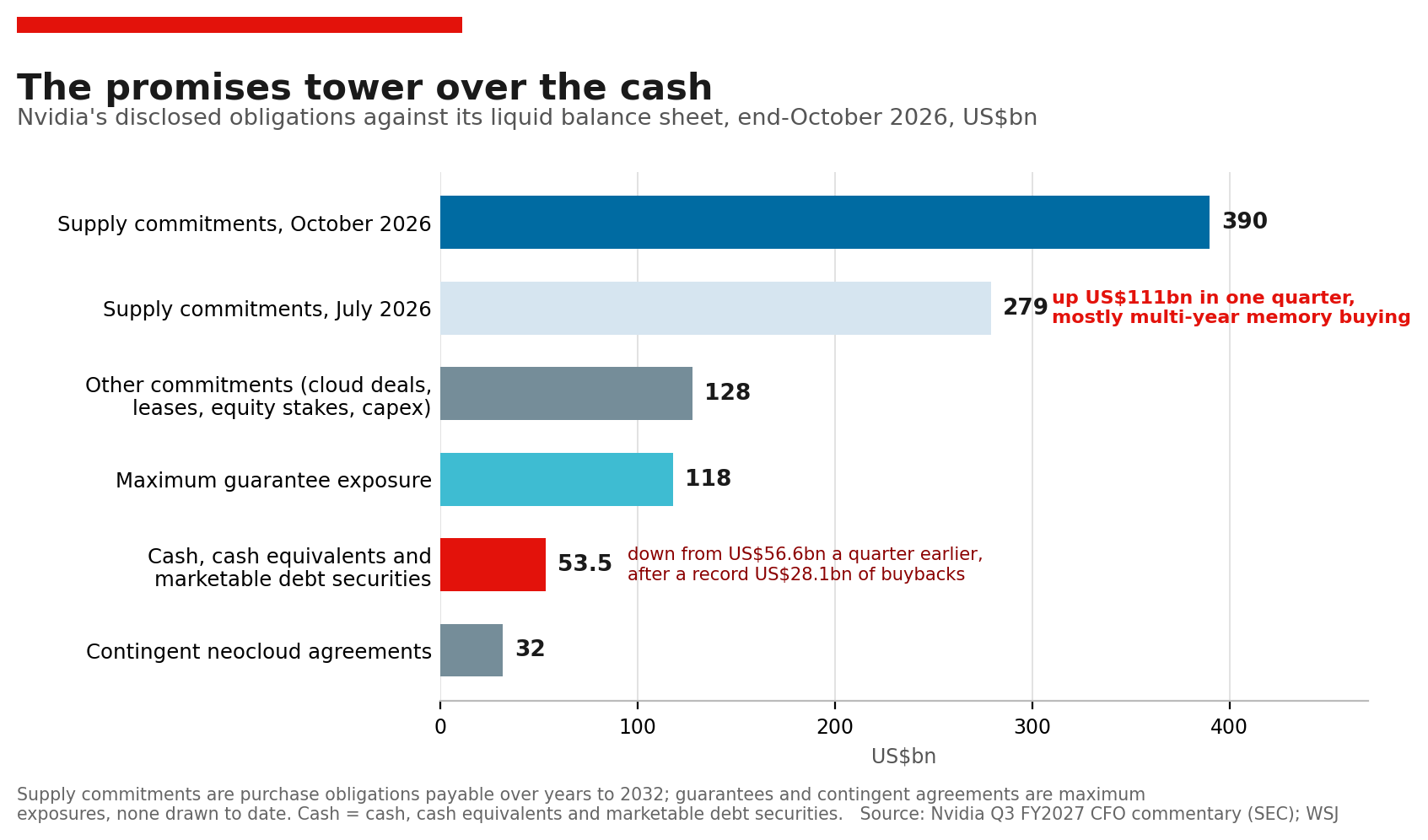
None of this is distress. Revenue in the quarter more than doubled year on year to US$115.8 billion; the data-centre business grew 110 per cent to US$107.6 billion; guidance for the current quarter is US$130 billion, in the company's results announcement. The issue is structure, not solvency. To keep US$390 billion of supply flowing, Nvidia's customers need money; lenders protect themselves by underwriting customers rather than chips; and so the seller vouches. Nvidia caps residual-value support at a quarter of project cost, per the Journal. It guaranteed, up to US$105 billion, the lease and power payments behind SB Energy's Ohio campus, which OpenAI has leased for twenty years — a guarantee that phases in building by building from fiscal 2029 and has so far paid out nothing, as Reuters reported. "We're not making loans," chief financial officer Colette Kress told investors in August, describing take-or-pay minimums taken in exchange for revenue shares. "We get paid twice," she said in the second-quarter call. By November the tone had changed: "We are rigorously evaluating future investments, commitments and guarantees," Kress said on the third-quarter call, as the Journal reported.
The change of tone had a reason. On November 12th Nvidia announced Huang's resignation, amid reports of an extramarital affair, as NPR reported; the Federal Reserve published its report the next day; the earnings call went to Kress as interim chief executive; and on November 23rd the board reinstated Huang, with the stock rallying 31 per cent, as CNBC recounted. In the same week that the Fed counted Nvidia's counterparty risk, the company's own management became the story. The drama aside, the financing problem was already documented, and it has not gone away.
The demand problem Ford solved
Strip the financing away and the industry's question is the old one: who pays? Barr put the condition plainly: "For the AI buildout investments to ultimately become economically viable, the smaller firms will eventually have to replace that funding from their suppliers, the hyperscalers and GPU makers, with revenue from paying customers". Bain & Company has run the arithmetic: AI applications must generate US$2 trillion of annual revenue by 2030 to fund the buildout — about US$800 billion more than even a generous count of current and planned uses produces, in its 2025 Technology Report. The 2026 edition raised the bill to US$6 trillion a year by 2031, with US$4.2 trillion of the required revenue "still to be invented", in the 2026 report. OpenAI's contract with Oracle works out at roughly US$60 billion a year — several multiples of the revenue OpenAI was generating when it was signed, as reported.
The historical order of operations runs the other way. In 1908 a Model T cost US$850 — about eighteen months of an average American wage, in a market where the few cars on sale cost two to three years' wages, as pricing histories note. Ford drove the price under US$300 by the mid-1920s and sold more than fifteen million of them, per Britannica. The upstream industry — steel, rubber, glass, machine tools, petroleum, paved roads — grew up behind that demand, financed by it rather than ahead of it, as the Studebaker National Museum describes. Ford never had to guarantee his customers' instalments; the price of the car did the selling. The AI chip trade is attempting the sequence in reverse: the upstream industry is fully built and financed years ahead of demand, and the downstream monetisation — applications, agents and services that consumers and companies pay for from their own budgets — remains a promissory note. "In AI, compute is revenue," Huang said in August's announcement. That sentence is the one under test: compute is revenue only when somebody pays for the tokens with money earned somewhere else.
The loop the Fed finally counted
On November 13th, the Federal Reserve gave the question its own chapter for the first time. The Financial Stability Report's new box — "Leverage in the Data Center Buildout" — inventories the financing of what it calls advanced computing. On-balance-sheet debt of the seven largest AI firms — Amazon, Alphabet, Broadcom, Meta, Microsoft, Nvidia and Oracle — is expected to exceed US$800 billion by year-end, a growth curve the report compares with the telecom buildout of the late 1990s. Their off-balance-sheet obligations — energy supply contracts, long-term data-centre and compute leases, take-or-pay contracts and residual-value guarantees — have a "potential maximum nominal value" that "now exceeds $3 trillion", counted before discounting, in the same speech. Reporting on the report puts the split at more than US$1 trillion of signed-but-not-yet-commenced leases and more than US$2 trillion of take-or-pay contracts and guarantees, per Fortune. Advanced-computing bond issuance reached US$680 billion in the first ten months of 2026 — about 31 per cent of all non-financial investment-grade issuance, up from under 6 per cent in 2023, as TechTimes summarised the chapter. And in the Fed's survey of market contacts, 87 per cent named AI a principal risk — up from about half in the spring. (Figure 2)
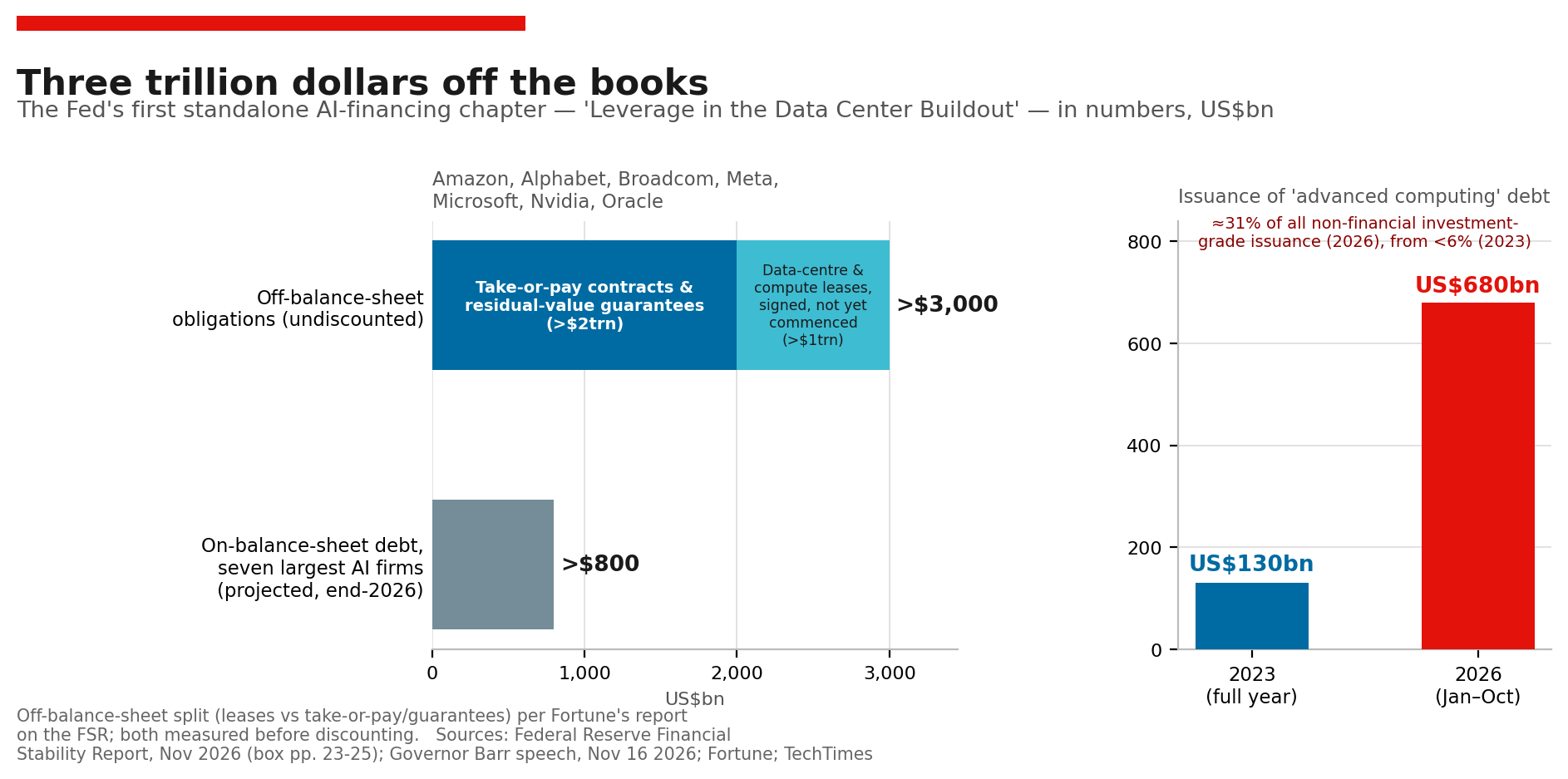
The chapter's sharpest paragraphs concern what the market has come to call circular financing. "These equity investments represent a form of 'circular financing' in which hyperscaler firms and GPU makers invest capital in smaller firms, and the smaller firms turn around and use these funds to rent or purchase GPUs and compute from the firm that made the investment," Barr said, sizing the ring at more than US$100 billion of cumulative equity. Bloomberg's guide to the "circular deals", maintained since January, defines the term — one company invests in another that buys its products — and distinguishes it from the fraudulent "round-trip" accounting of the telecom era. The Bank for International Settlements reckons roughly 30 per cent of AI investment deals by value now have an AI firm on both sides; the IMF's Global Financial Stability Report lists "circular financing arrangements" among the salient risks to the system, in its October report. The web itself is easy to map: Nvidia's up-to-US$100 billion letter of intent with OpenAI, announced in September 2025, was renegotiated down to a reported US$30 billion stake in OpenAI's February funding round after the megadeal went "on ice"; the US$105 billion Ohio guarantee followed in August, as Reuters reported. OpenAI, meanwhile, signed a US$300 billion take-or-pay contract with Oracle in September 2025, holds warrants over 160 million AMD shares struck at a cent that vest as it buys AMD chips, per AMD's filing, and collects from Microsoft a commitment of US$250 billion of Azure services and from Amazon a US$38 billion AWS contract, expanded in February alongside a US$15 billion investment, as Bloomberg's guide records. (Figure 3)
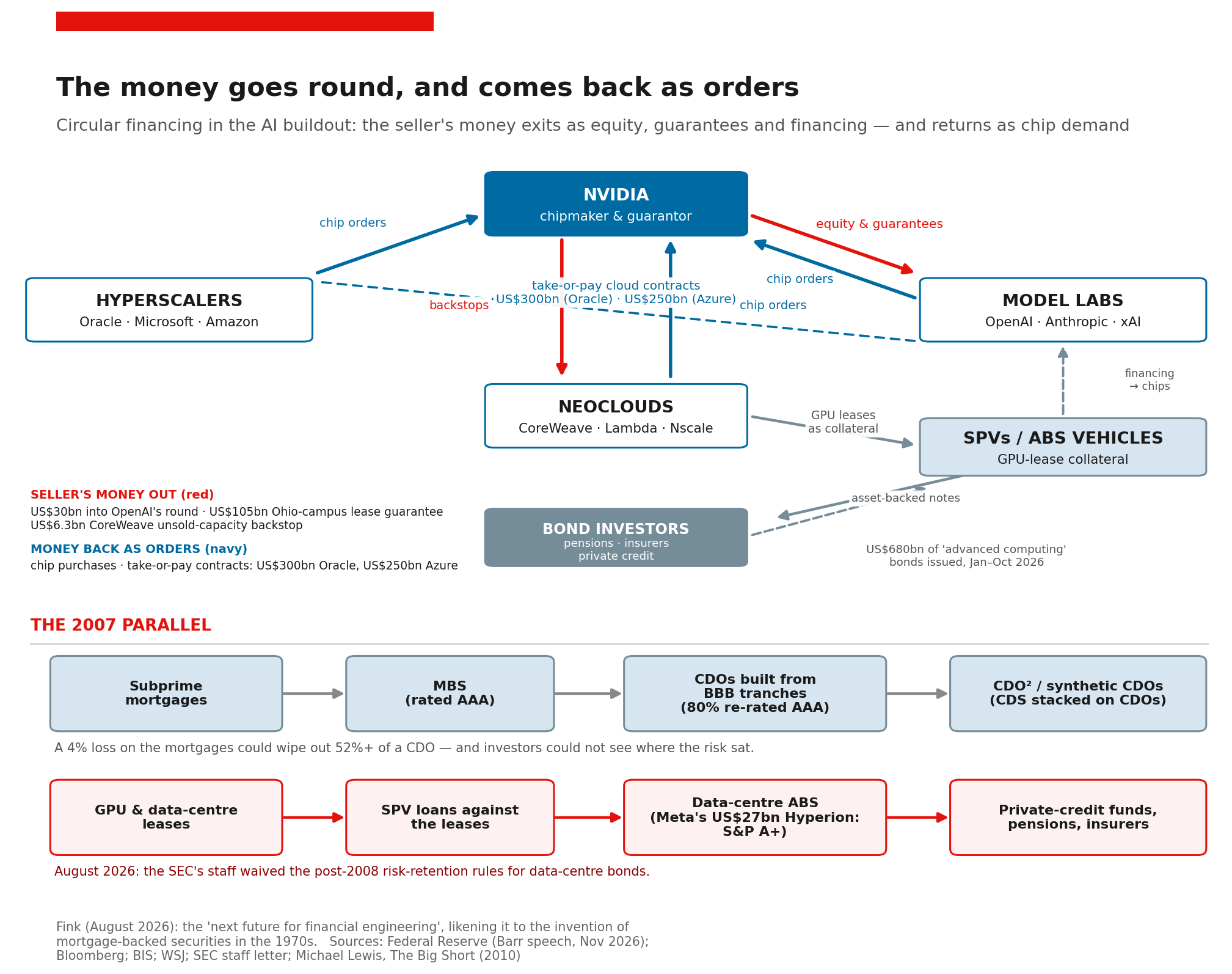
Fink's mortgage-securities analogy invites the comparison the Fed stopped short of making. In the 2000s the chain ran: subprime mortgages pooled into mortgage-backed securities rated AAA; the weakest tranches repackaged into collateralised debt obligations, themselves re-rated AAA; then synthetic CDOs built from credit default swaps stacked on CDOs — until a 4 per cent loss on the mortgages could wipe out more than half of a CDO, and nobody could say where the risk sat, as Investopedia explains. The 2026 version runs: GPU and data-centre leases pledged to special-purpose vehicles; SPV loans; asset-backed securities sold to private-credit funds, pensions and insurers. In August, the SEC's staff waived the post-2008 risk-retention rules for data-centre bonds; Barron's has called the structures a crisis-era tool, revived. The difference is real: this collateral sits in real buildings with investment-grade tenants and take-or-pay contracts, not in no-documentation mortgages, and the Fed itself notes that older chips' lease rates are holding up. What carries over from 2008 is not the loans but the shape of the chain. Risk moves from the party that knows the asset best — the chipmaker, which sets its price, finances its buyers and vouches for its resale value — to investors who cannot value it. "That opacity can exacerbate selloffs when investor sentiment shifts," Barr warned, "as it is hard to know where risk resides".
History offers a nearer precedent than housing. Lucent Technologies ended 2000 with US$8.1 billion of vendor financing outstanding — roughly a quarter of its revenue — much of it lent to phone carriers so they could buy Lucent's equipment; when the carriers defaulted, provisions and write-offs followed, and revenue collapsed, as later analyses recount. Cisco, having watched customers "double and triple order" through the shortage, wrote off US$2.25 billion of inventory in a single quarter in 2001, as CNET reported at the time. Memory-chip makers have repeated the pattern every few years — most recently in 2019, when customers caught holding six to nine months of excess inventory cut orders and DRAM prices fell about 60 per cent in four quarters, as one industry history puts it. A chip glut does not need a financial crisis to happen. It needs only a pause in the financing.
When the loop runs in reverse
In systems terms, the AI buildout is a positive feedback loop. Financing buys capacity, capacity wins orders, orders raise revenue, and revenue invites more financing. Control theory's warning about such loops is old: without a damping term, one whose gain exceeds one does not settle; it saturates, oscillates or breaks. In the chip business the damping term is supposed to be revenue from end users outside the financing chain — the Ford families, paying with their own money.
The same loop runs in reverse. Financing withdraws, orders soften, collateral values fall, credit tightens, and orders soften further. Barr's language is the language of feedback: "a sharp reversal could lead to rapid deleveraging and, potentially, self-reinforcing fire sales". Nvidia's filings say the same in accountant's prose — commitments "could be reduced or eliminated" where customers cannot refinance. The wobble is no longer hypothetical. The Journal's not-a-dime story, the eleven days between Huang's resignation and his reinstatement, and Kress's new caution all point the same way.
Ford, at least, had the sequence right: he made the product cheap enough that ordinary families paid for it themselves, and the parts industry grew up behind them. The AI buildout has built the parts industry first and is still searching for the families. Until they show up — until US$4.2 trillion of "still to be invented" revenue exists, as Bain puts it — much of the demand for AI chips will be demand the industry has financed for itself. The Fed has now put a number on it.