The alliance
Chengdu has formed a university-enterprise alliance aimed at building a brain-computer interface industry in western China. It was inaugurated on Nov 20 at a matchmaking event hosted by the Chengdu Science and Technology Bureau, which brought together universities, research institutes, hospitals, enterprises and government departments, according to the release. The alliance is initiated by Yao Dezhong, a professor at the University of Electronic Science and Technology of China and director of the China-Cuba Belt and Road Joint Laboratory on Neurotechnology and Brain-Apparatus Communication.
What it is meant to do
The alliance is intended to link four stages into one chain: original research at universities, industrial commercialisation by enterprises, clinical validation in hospitals and ecosystem support from government. Its stated focus covers core research in brain signal analysis and BCI modelling, and it aims at innovations holding independent intellectual property rights along with competitive consumer products. It also plans to open up research equipment, experimental data, innovation resources and policy channels, train interdisciplinary talent and encourage collaboration along the industrial chain.
More than 60 companies
A white paper on the city's emerging BCI industry, released at the event, put the number of BCI companies based in Chengdu at over 60. Yao said the city has a large talent pool in brain science, strong capabilities in materials science and many clinical scenarios to draw on. He said the alliance would help each party find its role, and that policy support and coordination with departments including healthcare security and market regulation would clear the bottlenecks between technology and clinical application.
Lab products and demonstrations
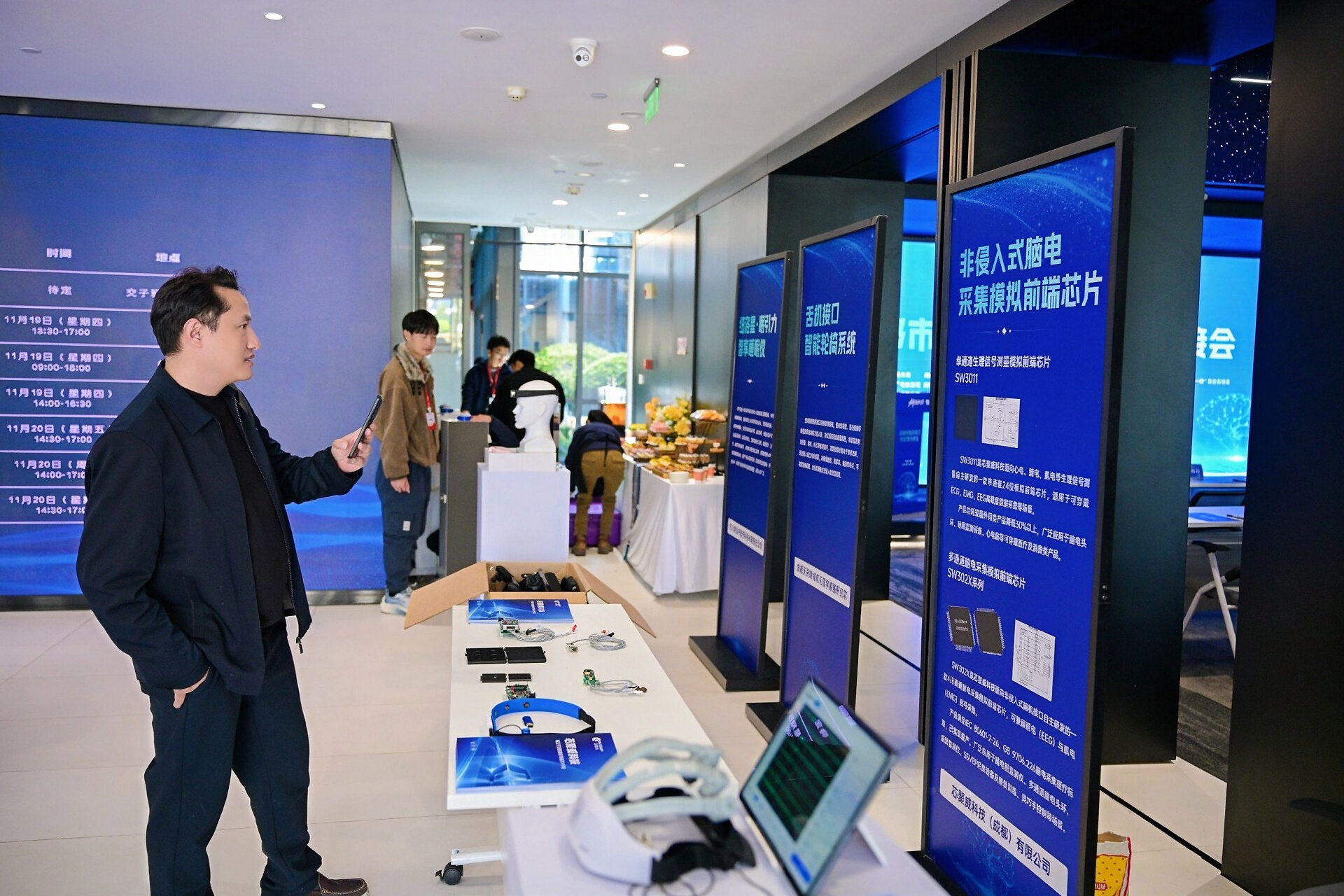
Lu Jing, deputy director of the China-Cuba joint laboratory, said its components have reached leading domestic performance levels and that it has incubated several technology-intensive companies. Products for sleep regulation and autism intervention are about to reach the market, Lu said. Three hospitals presented clinical application scenarios and said they were willing to open their clinical research resources and take part in prototype validation and product testing. More than a dozen BCI and associated products were shown, among them a headband from Chengdu Wabo Technology that lets users control drones with their thoughts and a non-invasive sleep headband from Sichuan Jinhong Traditional Chinese Medicine Technology developed from research by Yao's team.