What the researchers built
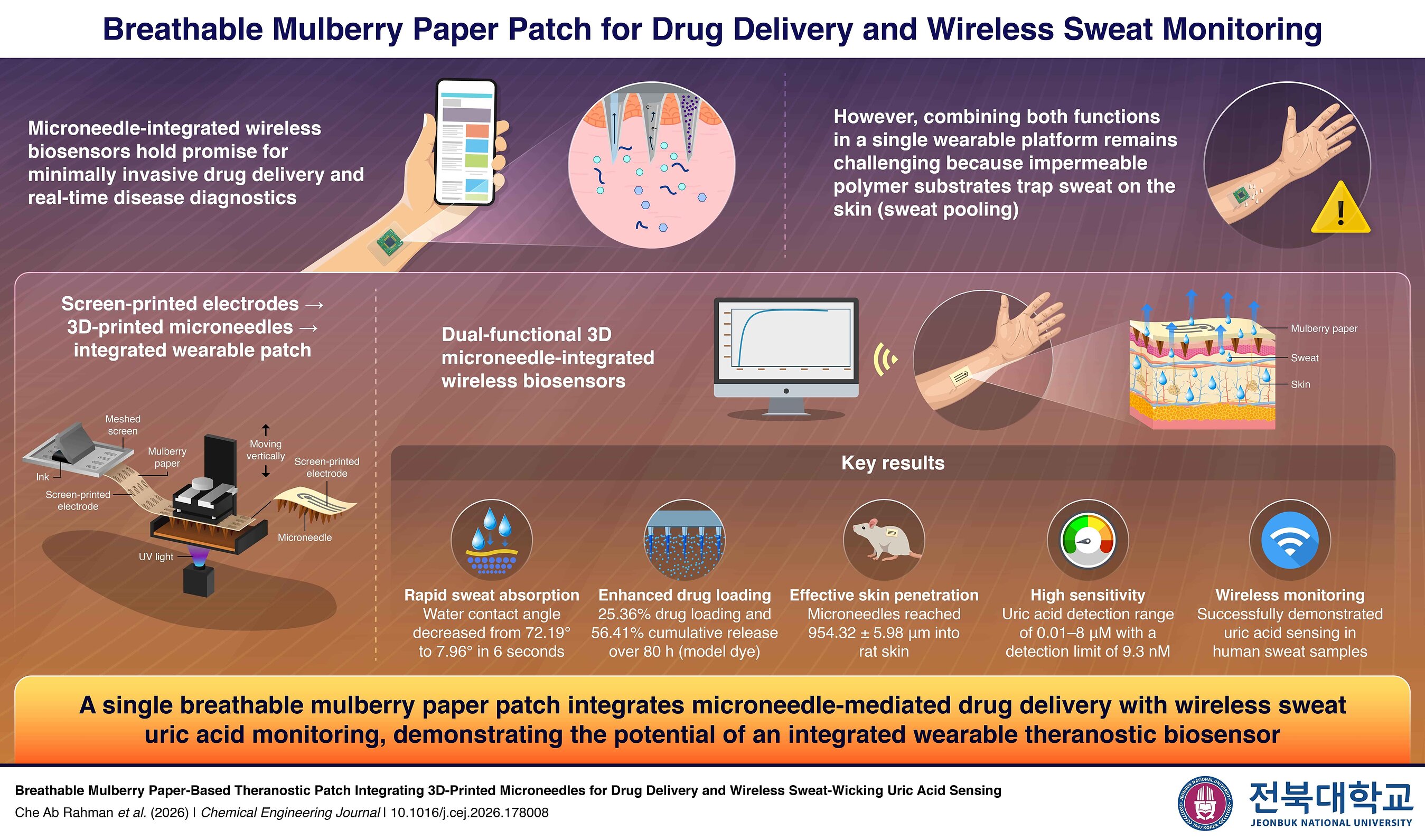
Researchers at Jeonbuk National University in South Korea have made a breathable wearable patch on hanji, the traditional Korean mulberry paper, combining 3D-printed microneedles intended for drug delivery with printed electrodes for wireless uric acid sensing. The work was led by Professor Sooman Lim, the university said. The paper, "Breathable mulberry paper-based theranostic patch integrating 3D-printed microneedles for drug delivery and wireless sweat-wicking uric acid sensing" (DOI), went online on 3 June 2026 and appeared in Volume 542 of the Chemical Engineering Journal on 15 August 2026, with Aqila Che Ab Rahman and Habibulla Imran listed as equal contributors.
The measured numbers
The microneedles were printed straight onto the paper by light-based 3D printing without adhesives. The optimised needles reached 25.36% drug loading, against 12.6% for unmodified needles, and released 56.41% of a model dye over 80 hours; they penetrated about 954 micrometres into excised rat skin without structural deformation. The printed sensor covered uric acid concentrations from 0.01 to 8 micromolar with a detection limit of 9.3 nanomolar, and recoveries of 98.1% to 101.3% in buffer and sweat samples agreed with laboratory LC-MS analysis.
Why the paper carries it
Water contact angles on the paper fell from 72.19° to 7.96° within six seconds, which the team presents as moisture transport that manages sweat accumulation. The sensor dries in 13 seconds, gives consistent readings across three uses and runs on a low-power wireless system drawing 15 mW. Lim said conventional patches struggle to balance skin comfort with reliable sweat collection, and that the porous paper was chosen to move moisture while accommodating both the needles and the printed electrodes.
Separate tests, next steps
The release states that delivery and sensing were evaluated separately, and that the results show the feasibility of putting both functions on one paper-based platform rather than a finished combined device. Uric acid is described as a key marker for gout and hyperuricemia. Future work will involve testing the patch with clinical drugs, running skin-safety studies and performing real-time on-body testing, according to the university.