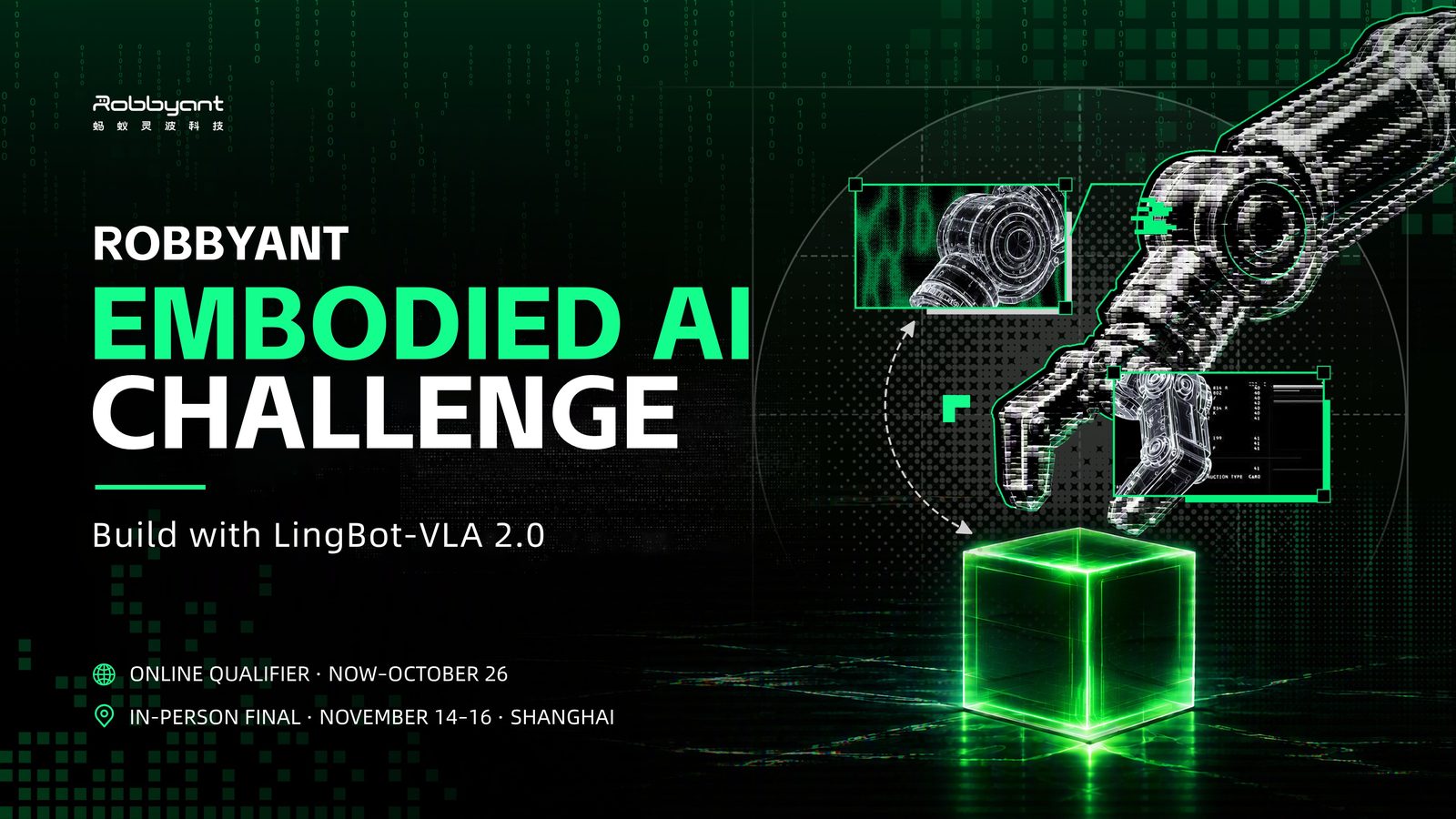
Qualifier submissions for the inaugural Robbyant Embodied AI Challenge closed on 27 October, marking the end of the competition's online preliminary round. Organised by Robbyant, an embodied AI company within Ant Group, the challenge was launched in September at the 2026 Inclusion Conference on the Bund in partnership with ModelScope and Alibaba Cloud Tianchi.
The competition is based on the open-source LingBot-VLA 2.0 embodied foundation model and is designed for developers working on embodied AI algorithms. Participants are evaluated on model training and fine-tuning, simulation-based generalisation, and adaptation to real robots. The challenge is open to enterprises, universities, individual developers and technology enthusiasts worldwide.
More than 1,800 teams and thousands of developers from 13 countries have registered for the challenge, according to the company. Participants include teams from leading universities, research institutions, technology companies and embodied AI startups. The on-site final will take place in Shanghai from 14 to 16 November, conducted as a real-robot hackathon.
The competition has drawn teams from leading Chinese universities, including Tsinghua University, Peking University, Shanghai Jiao Tong University and Zhejiang University. International research teams have also joined from Carnegie Mellon University, University College London, Technical University of Munich, National University of Singapore, Nanyang Technological University and other institutions.
Industry participants include developers from Tencent, Alibaba, ByteDance, Meituan, Microsoft, BYD and Xiaomi. Leading embodied and humanoid robotics teams such as UBTECH, Fourier Intelligence and Agibot have also registered.
According to the company, teams from universities and research institutions make up 74.7 per cent of participants, with master's and doctoral students representing 67.4 per cent. Developers from enterprises and frontline engineering roles account for 25.2 per cent. Participants with backgrounds in VLA, or vision-language-action, and multimodal foundation models represent 51.7 per cent.
The Robbyant Embodied AI Challenge aims to provide a shared evaluation environment for developers to experiment with embodied foundation models and test their capabilities in realistic robotic tasks. By opening access to LingBot-VLA 2.0 and related evaluation settings, the organisers hope to encourage broader participation in embodied AI development and support the transition from algorithmic research to practical robotic applications.