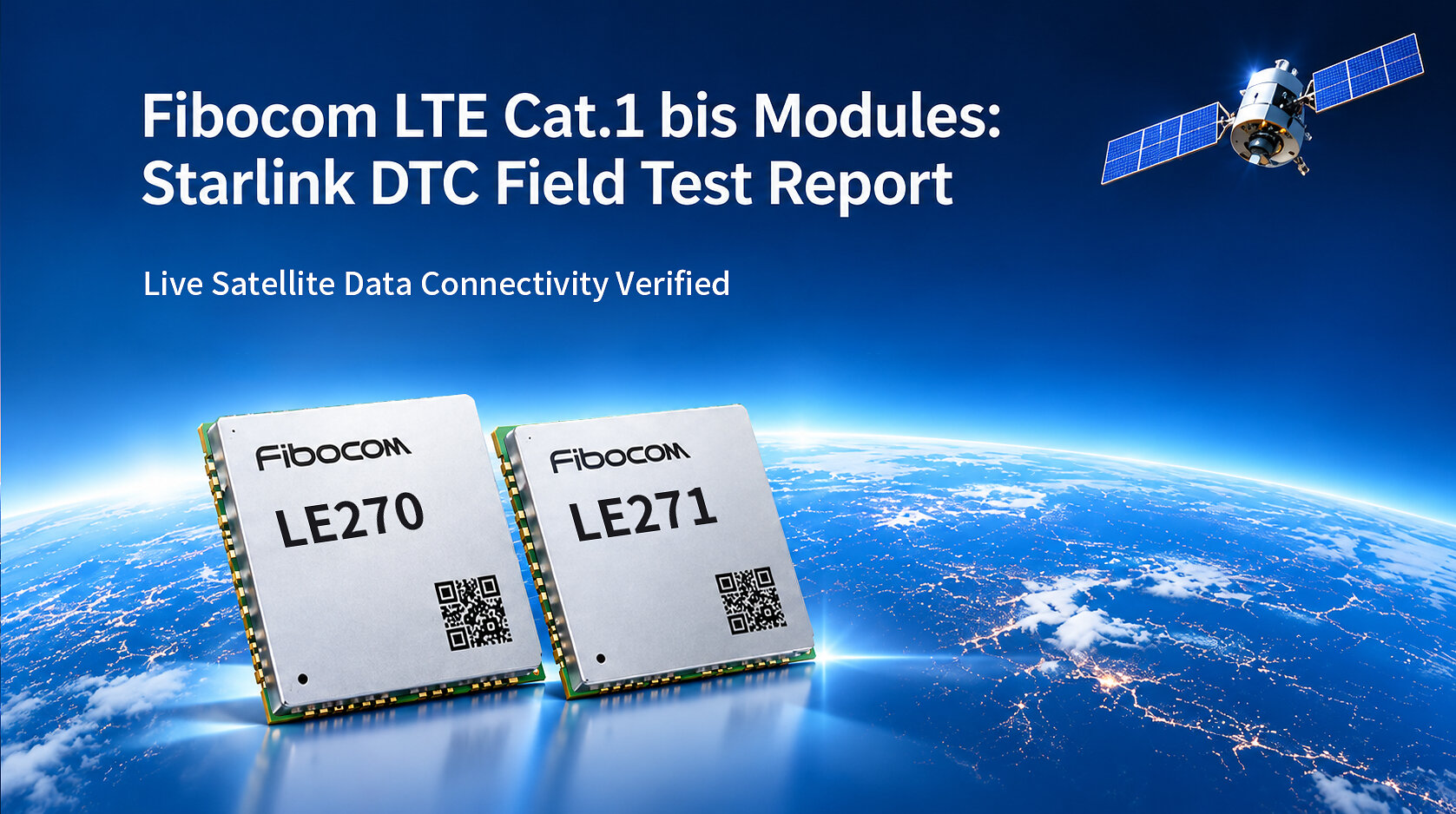
What was tested
Fibocom said its LE270-EU and LE271-GL LTE Cat.1 bis modules registered on SpaceX's Direct to Cell satellite network and carried data during live-network testing in New Zealand. The modules ran standard firmware and needed no satellite-specific hardware modifications, the company said. Tests covered outdoor, in-vehicle and indoor settings.
Throughput on the satellite link
In outdoor and in-vehicle tests with good sky visibility, the LE270-EU reached roughly 2.2 Mbps downlink and the LE271-GL roughly 2.0 Mbps, according to the release. Both delivered about 0.3 Mbps uplink, with network registration taking about 1 to 30 seconds and ping response rates between 80% and 90%.
Inside a hotel room with obstructed sky visibility, downlink throughput fell to about 0.5 Mbps in some scenarios and ping response rates were 65% to 70%, with some data requests taking noticeably longer.
Size, power and energy use
Both series use a 17.7 × 15.8 × 2.4 mm form factor with Power Saving Mode current as low as 2.5 μA, and include OpenCPU development capabilities and peripheral interfaces. In the field tests, uploading the same file over satellite took about 1.5 to 1.8 times the energy of a terrestrial connection, which Fibocom attributed mainly to longer transmission times, higher transmit current and retransmissions. The modules held their low sleep current, the company said.
Firmware work continues
Fibocom said it is continuing to optimize DTC firmware compatibility for the LE270 and LE271 series, with a focus on network registration efficiency and connection resilience. The company said the work is intended to support device makers looking at satellite links for asset tracking, remote monitoring and other IoT uses.