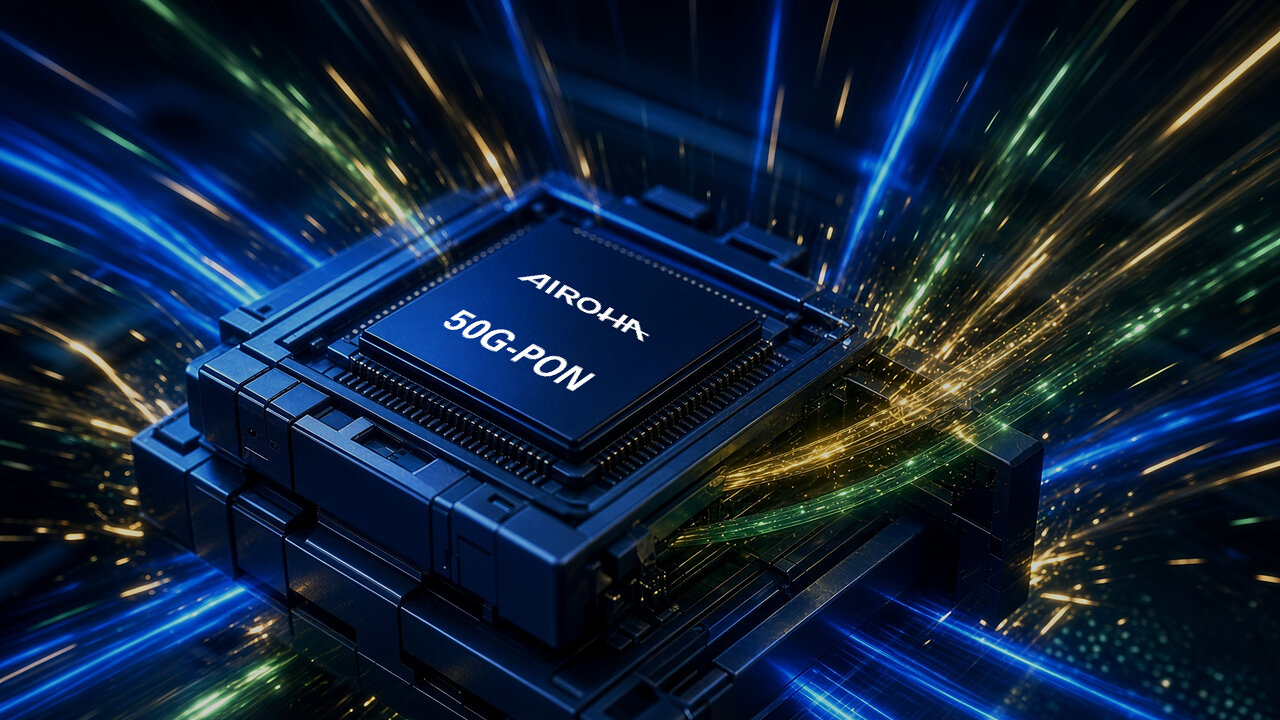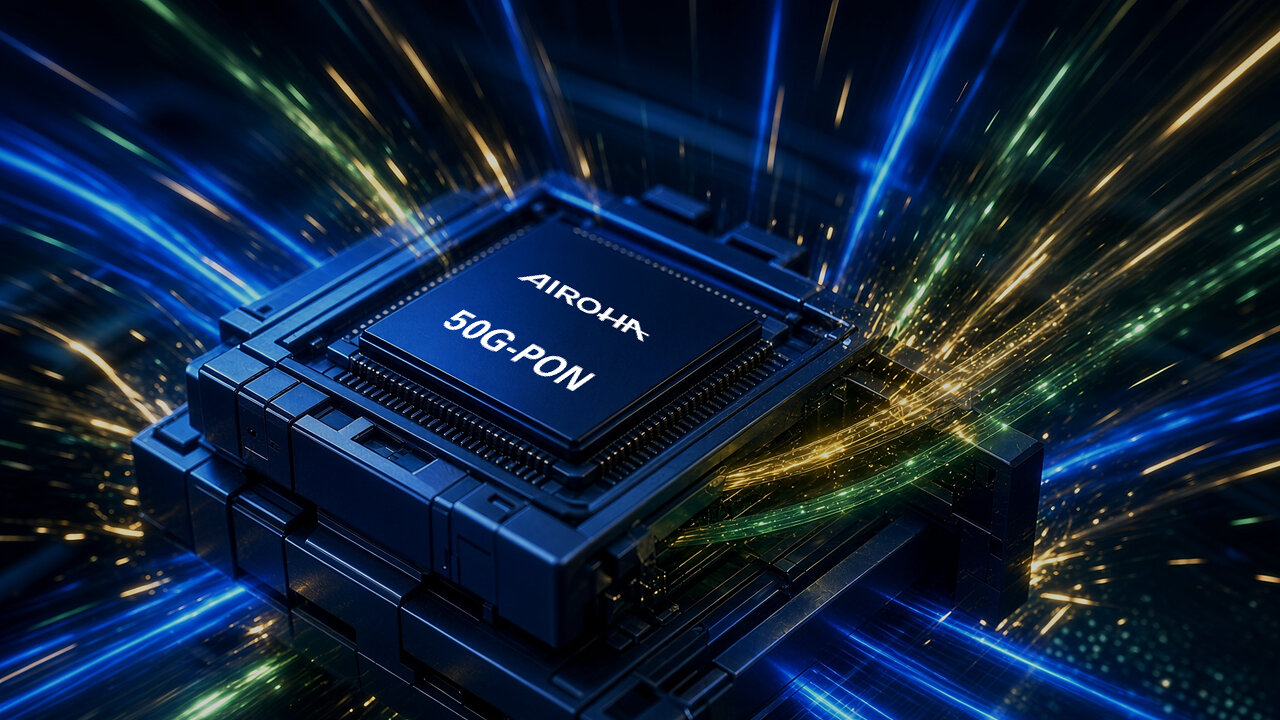
Airoha Technology and its parent company MediaTek are jointly exhibiting at Network X 2026, held from 13 to 15 October 2026 at Messe Wien in Vienna, at Booth K35. They are showing a 50G-PON AI Gateway Processor and an agent-based AI solution for fixed broadband network diagnostics and self-healing, the company said. The processor has been shortlisted for the Network X Awards 2026 in the "Outstanding Multi-Gigabit Fibre Access Innovation" category.
The 50G-PON offering delivers 50+50 Gbps symmetric bidirectional throughput with low power consumption, and the company said it provides up to five times higher transmission speeds and up to 80% lower latency than XGS-PON. It combines high-speed PON, Ethernet, Wi-Fi 8 and Edge AI in a single fixed broadband gateway platform. Built on an integrated SoC architecture with 20 cores, it can handle 50 Gbps PON, Ethernet interfaces, Wi-Fi 8 and encrypted packet processing simultaneously. Applications including AI, cloud services, 4K/8K video, AR/MR and smart manufacturing are continuing to grow, and the company said fixed broadband networks now need low latency, packet-processing performance and edge-computing capability in addition to higher speeds, across residential, enterprise and industrial use.
MH Shieh, executive vice president and spokesperson of Airoha Technology, said fixed broadband is evolving past high-speed access toward intelligent networking. He said the company integrates PON, Ethernet, Wi-Fi, packet processing and Edge AI on one platform, which raises network bandwidth and reduces latency while allowing the gateway to progressively gain network diagnostics and self-healing capabilities. Airoha and MediaTek also tightly integrate high-speed fiber networking, Wi-Fi and 5G CPE, he said, to help global telecom operators improve network service quality and operational efficiency and to establish a foundation that can support future AI-native broadband services.
The processor features built-in TOPS-level compute and can support multiple mainstream AI models, allowing telecom operators to deploy value-added services directly on the gateway. The company said these capabilities can be applied to network anomaly detection, automated fault diagnostics and self-healing, and can also support generative AI applications. The platform additionally supports Post-Quantum Cryptography for network security requirements in the quantum computing era.
For common home broadband issues such as poor wireless signal quality, misconfiguration, abnormal Optical Network Unit status, unstable connectivity or device overload, the solution places an LLM-based AI agent with chipset-specific domain expertise on the gateway or ONU. The company said users can describe problems in natural language, after which the agent combines device telemetry, network status and a diagnostic knowledge base to identify the root cause and then recommend actions or execute safe remediation. Airoha said enterprise-grade AI-assisted diagnostics have already been validated for deployment on existing fiber gateways, with its fixed broadband chipsets running large language model-based intelligent agents on CPU and RISC-V architectures, reducing the dependence of AI agent deployment on high-TOPS endpoint computing while maintaining core routing performance.