

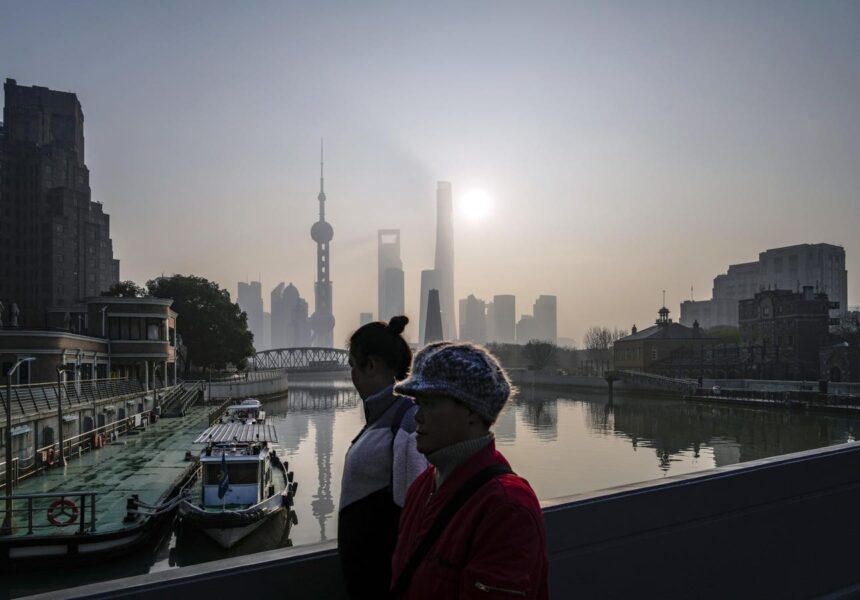
Pedestrians walk past buildings on a bridge in the Lujiazui financial district in Pudong, Shanghai, China.
Shen Qilai/Bloomberg
CChina’s deflation problem has not yet reached crisis levels. But Xi Jinping’s team is making fundamental mistakes that could accelerate Asia’s largest economy in achieving that goal.
The question is how Xi Jinping’s Communist Party addresses weak household demand: short-term stimulus and lower bond yields. This is how Japan responded to the NPL crisis in the 1990s, and why Tokyo is still dealing with its consequences today.
We need bold and urgent steps to build a social safety net that encourages spending rather than saving. Until Xi Jinping’s reform team fills this huge fiscal void, it only treats the symptoms of China’s malaise.
Beijing must also speed up other upgrades: repairing its flagging real estate sector, creating more dynamic capital markets, reducing record youth unemployment, reducing runaway local government debt, curbing the dominance of state-owned enterprises and increasing transparency.
But nothing is more urgent than incentivizing households to hoard less yuan in the fight against deflation. This is a structural challenge that requires a strong policy response, not just throwing money at the problem.
This is especially true given China’s demographics. Population aging is inherently deflationary. Here’s why: People in their 70s don’t spend as much money as people in their 20s or 30s.
Now, falling bond yields in China have economists comparing it to Japan. Prices of mainland government debt soared after Xi Jinping’s party said it would embark on the biggest monetary easing in 14 years. As the 10-year note gets lower and lower, traders think a move to zero seems more likely.
By then, China may be in real trouble – like boiling a frog in warm water. If any major economy has proven to the world that this famous defense is true, it is Japan. The reference here is to an old story: The frog in the pot feels no trouble because the temperature only gradually rises – until it’s too late.
The point of this metaphor is that it is difficult to make people aware of a unfolding crisis unless it becomes catastrophic. From an economic perspective, Tokyo is Exhibit A.
China must avoid this model. Just, at least not yet. The big lesson from Japan is that governments that mostly address symptoms of a problem rather than its root causes are more vulnerable to economic losses.
It is unclear to what extent Xi Jinping and Premier Li Qiang have internalized these lessons. Chinese stocks fell sharply on Friday following last week’s Politburo meeting, a sign of investor doubts.
Deflationary dynamics also don’t provide much confidence. Prices have now fallen for six consecutive quarters. If they also fall in the current three-month period, which seems likely, they will mirror China’s experience during the Asian financial crisis in the late 1990s.
As the uncertain year 2025 approaches, this is not the situation Xi Jinping wants China to develop into. The scale of the trade war threatened by US President-elect Trump may lead to a sharp decline in China’s domestic gross product and prices.
This risk explains why the People’s Bank of China shifted decisively to easing mode. For much of 2024, People’s Bank of China Governor Pan Gongsheng was reluctant to lower interest rates. Of course, he avoided using the “bazooka” of massive stimulus measures adopted by China’s central bank during the 2008 global crisis.
One reason: Xi Jinping’s party is unwilling to inflate any more bubbles or somehow reward bad behavior, squandering progress in deleveraging the economy. Another reason is that a sharp drop in the exchange rate could increase the risk of default for property developers with huge offshore debt.
Trump 2.0 is also a factor. Beijing is concerned that a weaker yuan could trigger higher U.S. tariffs on Chinese goods.
last week, Reuters Reports say Beijing is considering the pros and cons of devaluing the yuan to combat deflation.
It is also concerned that a weaker yuan could increase the risk of property developers defaulting on overseas debt. Yet Trump officials have also signaled bold moves to weaken the dollar to gain a trade advantage. All this could trigger a race for exchange rates the likes of which the global economy has never seen.
The longer China delays in developing a trustworthy safety net, the more likely its economy will export deflation rather than the economic growth that underpins its international standing.
Imports fell 3.9% year-on-year in November, showing that stimulus measures so far have not had the effect Xi Jinping hoped for. Focusing on big-picture structural flaws may lead to greater success than short-term stimulus.
Japan wrote the script here. To write its own new and better chapter, China under Xi Jinping should work hard to deploy trillions of dollars in household assets and prepare to change the dynamics of the global financial system. Help Beijing build a more dynamic and competitive economy.