

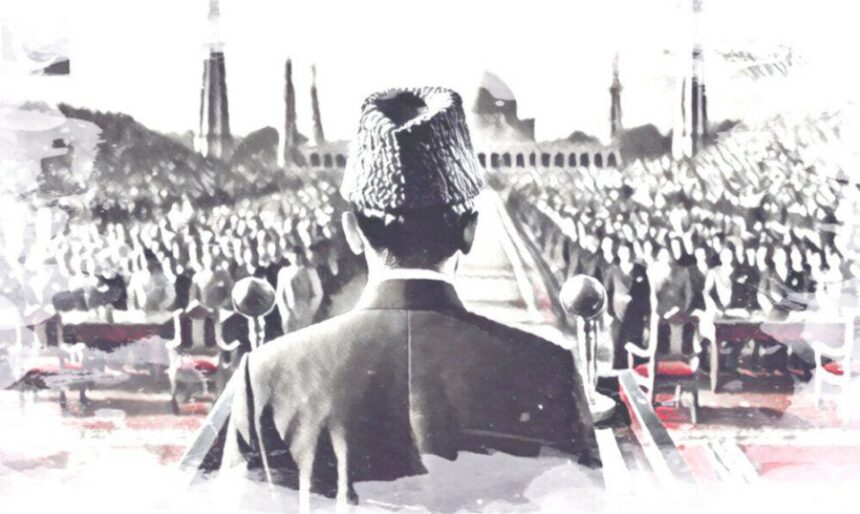
Islamabad – Quaid understood the rule of law better in 1918 than many of those who will swear an oath under his likeness in 2024.
Public memory is a fickle thing—what it chooses to remember, and what it wishes to forget. It’s even worse on days like this, when everyone quotes the founder’s name and quotes his message without truly understanding it or what he stood for. After all, the act of forgetting is itself a statement.
Because Muhammad Ali Jinnah is a problem in Pakistan today. He was too liberal for the right, too nationalistic for the left, too populist for the generals, and too meritocratic for the dynasty. Wouldn’t it be better, then, to put this gentleman on a pedestal too high to reach?
But if the founder remains limited to portraits and stamps, there’s a price to pay: the permanent crisis we have now is the inevitable result of years of evading his ideas. This is why a central aspect of his life was so suppressed: Jinnah’s time as a parliamentarian.
Enter Rowlatt Act
Quaid is one of the greatest legislators of his generation. In a country that increasingly views law as a coercive force, this fact has faded from view. But in today’s Pakistan, amid the 26th Amendment and military trials of civilians, reading Jinnah is nothing less than illuminating.
For our purposes, we will revisit one of the earliest and most powerful speeches of his career: a 1919 speech on the rights to a fair trial and due process. Be protected. The result was exactly the opposite: a total crackdown on the Rowlatt Act—emergency trials and arrests without cause.
In laying out their case, Britons were angered by the low conviction rate in ordinary courts, the impossibility of responding to the riots “under normal law” and how the protesters’ aims were to fuel an uprising against the government.
Sir William Vincent, the cantankerous Home MP, said the anarchist forces were given “unrestricted license to carry out their designs”.
Opposing these colonists was Jinnah of the Imperial Legislative Council of Delhi. When protests broke out in India on September 23, 1918, Jinnah said: “Of course it cannot be said that these people have suddenly become common criminals. The reason, Lord, is that there is discontent; there is discontent; there is turmoil. May I say, Your Majesty? , this is partly, if not entirely, due to your policies.
Yes, riots broke out in India, but the problem stemmed from a callous regime and a lack of representation – and the Rowlatt bill “is the wrong cure for the disease”.
Quaid said: “I would rather give power to the judiciary than to give power to the executive branch, and I would even rather have the judicial courts try these crimes summarily because in my opinion, they are worse than the crimes of the executive branch. Small.
Stern warning
More than a century ago, Jinnah opposed the replacement of state judges. It’s even more of a shame that our members have recently argued that through the horror show of the 26th Amendment, Quaid knew better about the rule of law in 1918 than many of the people who will be sworn in his likeness in 2024.
This leads to his main speech of February 6, 1919 – which editors Malik Mohammad Jafar and IA Rehman called one of the most glorious chapters of his long career.
“Your Honor, to anyone who believes in law and justice, these measures appear abhorrent and appalling…My first reason [for opposition] Well, it violates the fundamental principles of law and justice, namely that no one should lose his liberty or be deprived of his liberty without a judicial trial in accordance with generally accepted rules of evidence and procedure.
A deposition ensued: “…my third reason is that the executive branch will assume power, which means that the executive branch replaces the judicial branch, and this power may be abused…Pg. Four… There is no precedent, or anything like it, that I am aware of, in any other civilized country, where a law of this nature has ever been enacted.
What’s the purpose? “…You may be able to catch more real criminals, but…the cost is that many other innocent people will be persecuted and they will not have the opportunity to face a proper trial.”
Ultimately, if such a cruel law is passed, “you will create from one end of the country to the other a discontent and unrest the likes of which you have never witnessed, and believe me, it will bring about a most catastrophic… as a result of” . Affect the good relationship between the government and the people. “
Jinnah addressed the crux: “I firmly believe that no one should be deprived of his liberty for a single minute without due judicial enquiry.”
To be clear, this is not a soap opera speech. When his warnings fell on deaf ears and Lord Chelmsford, the Governor-General of India, pushed for the passage of the Emergency Bill, Jinnah remained true to himself – resigning from Parliament as soon as the vote was announced in March 1919.
He wrote to Chelmsford: “At a time when the country is in no real danger, the people’s constitutional rights are being violated by an over-anxious and incompetent bureaucracy that is neither accountable to the people nor in touch with the real people.” public opinion.
Jinnah continued: “I am of no use to the people in this Council, and it is impossible from the point of view of self-respect to cooperate with such a government… A government which passes or approves such a law in peacetime loses its claim to be legitimate government.
Applying Quaid’s Principles Today
All of which lends itself to reflection today: the Founders’ views on liberty, on judicial trials as a right, on not replacing judges with the executive branch, and on civil unrest as a political issue. Not least, he backed up his words with action – quitting parliament where ugly bills were passed by non-representatives (Indian MPs unanimously opposed the Rowlatt Act).
Interestingly, Mr. Jinnah’s 1919 speech would resurface nearly a hundred years later in 2015 – Rawalpindi District Bar Association vs Federalthe Supreme Court will allow military courts to try terrorists.
There were two future chief justices in the minority: Jawwad S Khawaja and Qazi Faez Isa. Justice Issa upheld Justice Khawaja’s dissent (“…I fully agree with him”), citing Jinnah’s 1919 speech and stating that “the Constitution does not permit the military to try civilians as this would violate fundamental rights…”
But when the military trial of civilians came in 2023, retired judge Jawwad S Khawaja lived up to the spirit of Quaid’s speech – challenging the Supreme Court trial. In contrast, when the same case was resolved, Judge Issa, who was still in office, stormed out of the bench and refused to hear the matter.
Pakistan’s founding ideals have proven to be something that needs to be fought for every day. Or, as Quaid concluded at the time, “Your Majesty, there is no use dodging the question, there is no use dodging the whole question.”
In a brief moment, five Supreme Court justices bravely answered the question by striking down the provision that allowed civilians to be tried by military courts.
But that didn’t last: the verdict has been stayed on appeal. However, no matter what the new “constitutional bench” decides, one fact remains eternal: the original verdict remains consistent with Quaid’s speech. May his voice be heard by more people.