
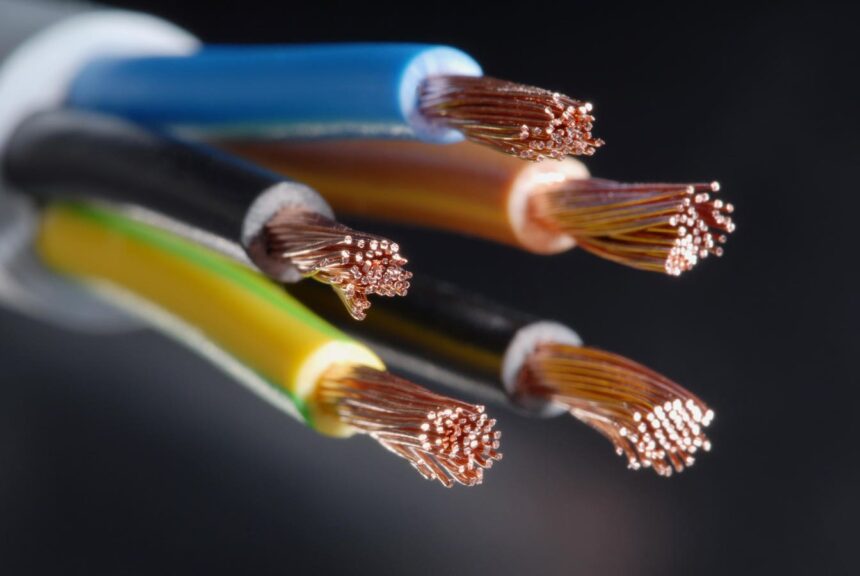
Macro detail of some cables.
It is now clear that the data centers of the future will require large amounts of power to operate.
I’ve seen these very sudden moves toward safe and shared nuclear power in America, like Microsoft and Constellation reopening Three Mile Island, or the groundbreaking work at local small nuclear power plants.
There is also a lot of research on renewable energy and how it works. I even wrote about these new plans to generate electricity and perform artificial intelligence operations on satellites orbiting the Earth to get power in different ways.
But let’s look at some potential challenges and our history of solving similar problems.
Electrical Engineering as Instructor
In a recent talk, Deborah Douglas noted that as we approach the problem of AI power, we already have some historical examples that can inform our search. Douglas is senior director of collections and curator of science and technology at the MIT Museum.
She talks about early power systems and how the grid evolved from different networks.
I would also like to add that you can also make an analogy to the internet. You could also talk about a decentralized internet. But another thing Douglas mentions is the actual tools that professionals used for engineering before modern electrical systems became the norm.
(Just to clarify: Of course there was electricity, just not in the modern systems and formats we see now.)
Douglas takes us back to the 1940s, when a lot was changing—not just in the power grid, but in society.
a woman’s story
She mentioned the example of Phyllis Fox, who was writing her master’s thesis at MIT and submitted it in 1949. title? “Solutions to power network problems on large-scale digital computers.”
This is a story about glass ceilings, resilience, and the power to change the world.
Douglas also mentioned Vannevar Bush, also popular at MIT, who taught electrical engineering in 1919. He had a machine called a differential analyzer, and Fox was interested in it.
A hard day’s work
Douglass gives us a vivid picture of how Fox started working as an engineering assistant at General Electric.
“She was put in an office with a Marchant calculator and given a series of problems to calculate, and on average, she completed one equation a minute. So 60 times an hour, you know, 300, 400 a day Times, if you will. And they’re expected to have a caretaker, a guy walking around to make sure they’re doing their job and not allowed to talk. Well, Phyllis is one of those adventurous people. One, she was wandering around campus and discovered that there was an office downstairs with a calculator during lunch time. And, they were solving problems by hand upstairs. So she would go downstairs at lunchtime and work on her calculator all day. And then she would come back upstairs and pretend to be working, and I thought she was very smart. In a twist, she also discovered that GE purchased a differential analyzer like the one I just showed you in the photo from MIT.”
Fox eventually began working on differential analyzers, she noted.
That calculator reminds me of something I wrote about the other day, MIT professor Ethan Mollick’s idea of “waiting to calculate”—if you can wait, you don’t need to do all the hard physical work. Let modern tools do the same job automatically.
Regardless, in this case her adventurous nature paid off and she participated in the evolution of a fairly important field.
However, Douglas noted that when the men returned from World War II, Fox was subsequently fired and went on to study for a master’s degree.
Then she found another employer.
Douglas added that his name was Jay Forrest.
“He was ecumenical in his hiring,” she said. “So he hired women, he hired men. He hired the first black computer operator in the United States. He hired a blind computer operator. He hired people of Japanese ancestry, which caused a lot of confusion in the middle of World War II Controversy. He embraced (hired) Phyllis Fox, whom he thought was very smart.”
So what did these pioneers do with differential analyzers?
some large machines
I went to the MIT library website and looked at some of the early machines, including something called the Rockefeller Differential Analyzer.
These are behemoths the size of washer-dryer systems, with large gears and wheels that perform calculations on differential equations.
They are truly inspiring examples of analog computing.
Regardless, Fox ended up teaching at MIT and showed more about how procedural computing worked using flowcharts, block diagrams, and more.
She got a job at the Atomic Energy Commission’s Computer Center and eventually developed something called Dynamo as an early computer simulation language. Fox also reportedly wrote the first LISP manual, worked at the Newark School of Engineering (now Jersey Institute of Technology), and received tenure in 1972.
It was all incredible, and Douglass concluded his speech by surmising that perhaps someone today would play such a role in solving our current bottlenecks and challenges.
I certainly hope so. But just thinking about the history of differential analyzers and analog devices, I know we have the ability to create new tools to do what we need them to do in pioneering AI power solutions.
In other words, the data center will require X gigawatts and terawatts of power, which may sound daunting. But who knows how we’ll think about this in 10 or 20 years? Or even earlier?
Think about these inspiring examples and do yourself a favor – go back and look at some of these now-obsolete machines. Think about it, for their time, less than a century ago, they were very advanced.