

December 16, 2024
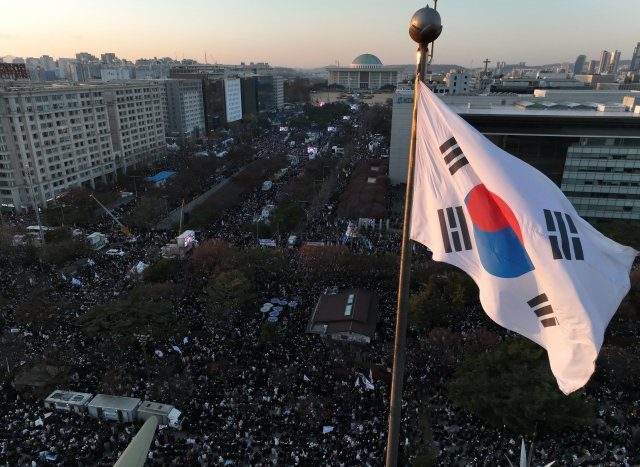
Seoul – South Korean President Yoon Seok-yeol’s sudden declaration of martial law led to his impeachment, becoming the third South Korean president to be suspended by Congress.
His political fate now lies in the hands of the Constitutional Court.
On Saturday, the impeachment motion passed by a vote of 204 to 85, with three abstentions and eight invalid votes, narrowly exceeding the 200-vote threshold in the 300-member parliament.
Notably, at least 12 members of Yoon’s ruling People’s Power Party (which has 108 members) came out in support of the motion.
Yoon’s political gamble failed and power has now been transferred to Acting President and Prime Minister Han Deok-su.
Critics argue that Yoon’s push for martial law was motivated primarily by personal factors: a deep disdain for the political process and a blatant disregard for core democratic norms, including “institutional tolerance” — which requires leaders to show restraint in exercising legal power. principle.
But political analysts in Seoul believe that Yoon’s downfall also exposed deeper systemic flaws in South Korea’s political framework that led to the crisis.
At its core is the paralysis of party politics in Congress under divided government, with the opposition Democratic Party dominating the Legislature and the ruling party controlling the presidency.
Instead of resolving the conflict through political dialogue, the two sides relied heavily on legal tactics: the main opposition Democratic Party filed a record number of impeachment motions against Yoon government officials, while the president habitually exercised his veto power over parliament to pass bills.
In addition, there are insufficient institutional safeguards against presidential overreach, as exemplified by Yoon Eun-hye’s unilateral declaration of martial law, which exposes the fragility of South Korea’s president-centered system, in which executive power is largely uncontrolled.
Yin’s disdain for politics
Mr Yoon, a political novice, was elected president in March 2022, just eight months after announcing his entry into politics in June 2021, marking a dramatic shift in his long career as a prosecutor. Due to his lack of experience, he was unable to navigate the established political process.
Yin’s martial law was therefore the result of deeply personal factors, including a disregard for political norms such as dialogue and consensus-building, and a lack of experience managing complex governance dynamics.
“The question ultimately boils down to whether this is a matter of institutional or structural flaws or individual misconduct.” A roundtable discussion titled “Martial Law, Challenges to the Constitutional Order, and Korean Democracy” held on December 10 by Shin Jung-seop, professor of political science at Soongsil University “I think the impact of individual misconduct is huge,” Zhong said. ” at Yonsei University Seoul Campus.
Analysts further emphasized the seriousness of Article 1 of the martial law order issued on December 3, which explicitly prohibits “all political activities, including the National Assembly, local councils, political parties, political associations, rallies and protests.” Extensive and authoritarian.
Lee Jae-moo, a professor at the Department of Politics and Diplomacy at Hankuk University of Foreign Studies, pointed out that this clause was not even included in the martial law order on October 27, 1979.
That was the last emergency martial law, declared the day after then-President Park Chung-hee was assassinated, but the 1979 martial law stipulated that “all outdoor gatherings must be approved in advance, and collective activities such as protests must also be approved.” prohibit.
“This highlights the president’s clear disdain for politics,” Lee said.
Ha Sang-young, a political science professor at Sogang University, noted that President Yoon’s decision to declare martial law stemmed from his belief that the unicameral National Assembly was obstructive, making cooperation with the legislative branch seem untenable.
“The express purpose of declaring martial law is to suspend the functions of the Legislature,” Ha said.
Since taking office, Mr. Yoon has engaged in numerous actions that demonstrate his disdain for politics.
Yoon became the first South Korean president in 11 years to miss the plenary session of the parliament and deliver the annual budget speech in November.
The first meeting between Yoon Eun-hye and Democratic Party leader Lee Jae-myung took place in April this year, setting a record 720 days after Yoon Eun-hye took office. It was the longest delay in such talks since South Korea became a democracy in 1988. The record was set by President Kim Young-sam, who met with the leader of the opposition party after 110 days.
“Main opposition leaders must be challenged through legitimate democratic competition and foster political competition, rather than relying on judicial risks and waiting for court rulings,” Lee Jae-mok said. He emphasized the lack of political dialogue between Yoon Eun-hye and the opposition parties.
“The lack of participation caused the (legislative deadlock) situation to spiral out of control, ultimately triggering (Yin) to use extreme measures — a card that institutional safeguards are designed to prevent but should never be played.”
Lee Geun-wook, a political science professor at Sogang University, noted that Yoon’s mistaken belief that he could privatize the military played a key role in his abuse of presidential power.
“He viewed the military as his own, not as the army of the country or the people, and believed he could mobilize it when necessary. In essence, he believed the army could be privatized for his own use.
The collapse of party politics
Analysts have highlighted the troubling lack of effective political procedures in parliament amid the legislative deadlock, which they believe may have been a factor in prompting Mr Yoon to overstep his authority in declaring martial law.
Kim Jung-hyun, a political science professor at Yonsei University, summed up Yoon Eun-hye’s decision: “Facing opposition from rival parties in a divided government, the president was unable to achieve his goals and ultimately took extreme measures.”
Ha Sang should emphasize that “politics should be used in peacetime and the law should be used in times of crisis. However, the current situation of Korean politics is exactly the opposite: use the law in peacetime and seek political solutions in times of crisis.”
The overreliance on legal measures is evident.
Since taking office, Yoon Eun-hye has exercised her veto power 25 times, equivalent to all previous presidents combined, excluding Syngman Rhee, who issued 45 vetoes during his tenure from 1948 to 1960.
On the other hand, the opposition party launched an unprecedented number of impeachment motions, with 22 impeachment motions being filed between Yoon Eun-hye’s inauguration and the promulgation of martial law on December 3. There were 6 impeachment motions under the leadership of Moon Jae-in, and 1 impeachment motion under Moon Jae-in.
“Both sides are convinced that their claims are legitimate, leading to a deadlock in which both sides rely entirely on legal mechanisms. One side believes they can file any number of impeachment motions within the law, while the other insists they are equally free to exercise their veto Quan,” Ha said. “When legal tools are used in this way in peacetime, compromise becomes impossible.”
Shin Jung-seop believes that as long as there is a healthy political culture and divided government operates effectively with a good balance of power and checks and balances, this deadlock can be resolved through political dialogue and negotiation.
“However, in the absence of this political culture, both sides will use all available institutional tools to escalate confrontation to extremes,” Shen said. “Ultimately, it can be argued that leaders who are unable to exercise good judgment in this situation make the worst decisions possible.”
Disadvantages of the presidential system
Against this background, Shin pointed out that President Yoon’s declaration of martial law also “revealed the biggest flaw of the presidential system from an institutional perspective.”
Analysts have highlighted the structural weaknesses of South Korea’s presidential system, noting how the overwhelming concentration of presidential power undermines the effectiveness of party politics and institutional balance.
“The opposition party bypassed the National Assembly and focused on the Cheong Wa Dae, while the ruling party avoided contact with the opposition party and instead sought the president’s approval,” Lee explained. “In a system where everything revolves around the president, political parties become ineffective. , further exacerbating the dysfunction.”
In winner-take-all presidential systems and majoritarian electoral frameworks that underpin two-party dynamics, parties tend to prioritize power over ideology, values, or policy agendas.
Analysts say the structure gives the president near-absolute power while providing no incentive for rival parties to pursue consensus-driven governance, exacerbating legislative gridlock and deepening political polarization.
Lee also noted, “We have realized how limited the mechanisms are to effectively check the authority and power of the president.”
“Unless the president voluntarily steps down or is impeached, there is little way to limit the president’s overreach,” Lee said.
Lee also stressed that the political turmoil caused by Yoon Eun-hye also illustrated another serious flaw of the presidential system, saying: “One of the biggest flaws of the presidential system is that it allows unfettered outsiders, who may lack proper scrutiny, to take charge and exercise power. .
Yoon Eun-hye was criticized for first lady Kim Kun-hee’s acceptance of a Dior bag, similar to former President Park Geun-hye’s impeachment over accusations of being unduly influenced by her confidant Choi Soon-sil.
“In order to prevent similar situations from happening again, there is an urgent need for institutional reform. Whether through constitutional amendments or legal and structural changes within the current framework, some form of systemic reform seems inevitable,” Li said.
Kim Jong-hyun stressed that the “silver lining” of Yoon’s martial law order was that it would spark reflection on the critical role of politics and the dangers it poses when abused, potentially depriving people of their basic rights.
“This incident provides an opportunity for the public to think seriously about the fundamental flaws of our political system,” Kim said, stressing that it was time for South Korea to confront these issues head-on by questioning and discussing necessary reforms to its elections. . systems and broader political frameworks and the public.
Kim stressed the urgent need for reforms to empower voters and push lawmakers to negotiate and cooperate within an often divided government in South Korea’s political dynamic to overcome structural flaws that perpetuate cycles of gridlock and polarization.
“We need to have an in-depth discussion about how to create institutional mechanisms that encourage politicians to negotiate and cooperate, and how to provide electoral incentives for this behavior from the perspective of voters.”